Department of Ophthalmology, Samsung Medical Center, Sungkyunkwan University School of Medicine, Seoul, South Korea.
Department of Health Sciences and Technology, Samsung Advanced Institute for Health Sciences & Technology, Sungkyunkwan University, Seoul, South Korea.
Alzheimers Res Ther. 2024 Mar 12;16(1):57. doi: 10.1186/s13195-024-01418-7.
In this study, the risk of dementia in patients with a history of herpes simplex virus (HSV) or varicella zoster virus (VZV) infection was evaluated.
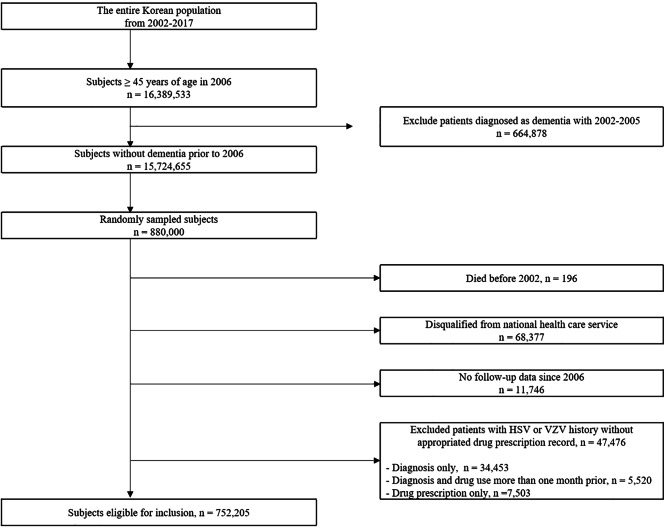
This nationwide cohort study used data from the Korean National Health Insurance Service collected between 2006 and 2017. A total of 752,205 subjects ≥ 45 years of age not diagnosed with dementia until 2006 were included. A multivariate Cox regression model, adjusted for age, sex, and other comorbidities, was used to assess the hazard ratio (HR) for dementia based on VZV or HSV infection. The interaction effects of both viral infections were analysed. Viral infections are classified into four categories: eye, central nervous system (CNS), simple, and complicated. The hazard ratio (HR) of viral infection was analysed based on the type of dementia.
In multivariable analysis, both HSV and VZV infection were associated with an increased risk of dementia (HR = 1.38, 95% confidence interval, CI:1.33-1.43) and (HR = 1.41, 95% CI:1.37-1.46), respectively. Patients who experienced both HSV and VZV infections were also at an increased risk of dementia (HR = 1.57, 95% CI:1.50-1.63). The co-infection group showed the shortest time from viral infection to dementia diagnosis (4.09 ± 3.02 years). In the subgroup analysis, all types of HSV and VZV infections were associated with an increased risk of dementia compared to the non-infection group. The eye, CNS, and complicated VZV infections were associated with a significantly higher risk than simple VZV infections. There were no significant differences between the subtypes of HSV infection. Furthermore, HSV, VSV, and co-infection were associated with an increased risk of all dementia types, including Alzheimer's disease (AD) and vascular dementia (VD).
Individual HSV and VZV infections were associated with an increased risk of all types of dementia, including AD and VD. Patients co-infected with HSV and VZV, VZV infection in the eye, CNS, or complicated type were more vulnerable to the development of dementia.
本研究评估了单纯疱疹病毒(HSV)或水痘带状疱疹病毒(VZV)感染史患者发生痴呆的风险。
本全国性队列研究使用了韩国国家健康保险服务局在 2006 年至 2017 年期间收集的数据。共纳入了 752205 名年龄≥45 岁且在 2006 年前未被诊断为痴呆的患者。使用多变量 Cox 回归模型,根据 VZV 或 HSV 感染调整年龄、性别和其他合并症,评估痴呆的危险比(HR)。分析了两种病毒感染的相互作用效应。病毒感染分为四类:眼部、中枢神经系统(CNS)、单纯性和复杂性。分析了根据痴呆类型的病毒感染的危险比(HR)。
多变量分析显示,HSV 和 VZV 感染均与痴呆风险增加相关(HR=1.38,95%置信区间,CI:1.33-1.43)和(HR=1.41,95%CI:1.37-1.46)。同时感染 HSV 和 VZV 的患者发生痴呆的风险也增加(HR=1.57,95%CI:1.50-1.63)。合并感染组从病毒感染到痴呆诊断的时间最短(4.09±3.02 年)。亚组分析显示,与未感染组相比,所有类型的 HSV 和 VZV 感染均与痴呆风险增加相关。眼部、CNS 和复杂性 VZV 感染与单纯性 VZV 感染相比,风险显著增加。HSV 感染的亚型之间没有显著差异。此外,HSV、VZV 和合并感染与所有类型的痴呆,包括阿尔茨海默病(AD)和血管性痴呆(VD)的风险增加相关。
单独的 HSV 和 VZV 感染与所有类型的痴呆,包括 AD 和 VD 的风险增加有关。同时感染 HSV 和 VZV、VZV 感染眼部、CNS 或复杂性类型的患者更容易发生痴呆。