Batra Anil, Eck Sandra, Riegel Björn, Friedrich Sibylle, Fuhr Kristina, Torchalla Iris, Tönnies Sven
Department for Psychiatry and Psychotherapy, Section for Addiction Research and Medicine, University Hospital Tuebingen, Tuebingen, Germany.
Private Practitioner, Hohenwestedt, Germany.
Front Psychol. 2024 Feb 27;15:1330362. doi: 10.3389/fpsyg.2024.1330362. eCollection 2024.
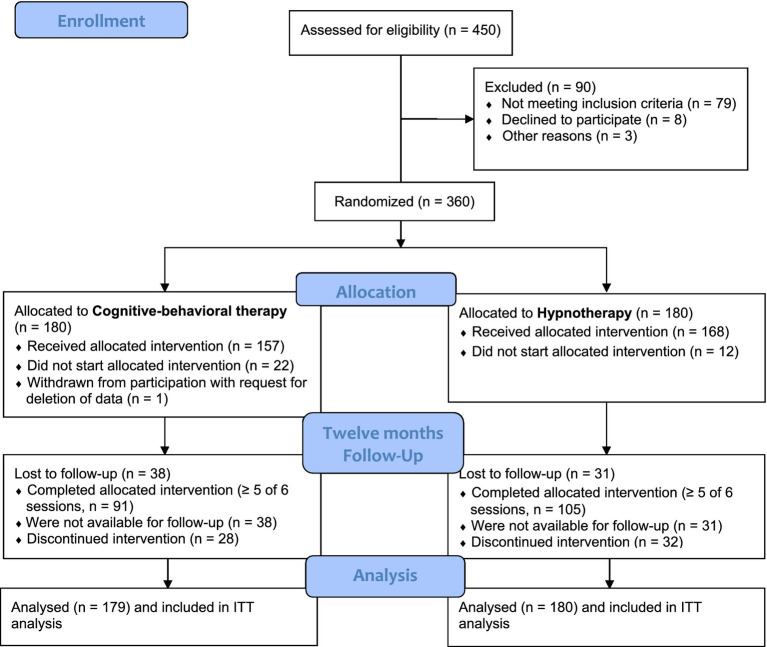
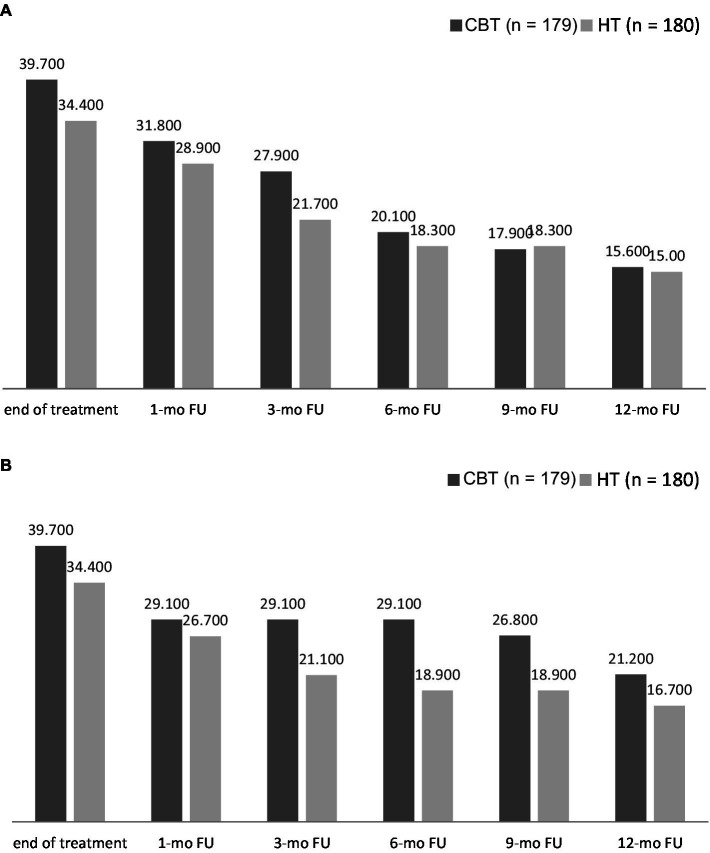
Worldwide, more than eight million people die each year as a result of tobacco use. A large proportion of smokers who want to quit are interested in alternative smoking cessation methods, of which hypnotherapy is the most popular. However, the efficacy of hypnotherapy as a tobacco cessation intervention cannot be considered sufficiently proven due to significant methodological limitations in the studies available to date. The aim of the present study was to compare the efficacy of a hypnotherapeutic group program for smoking cessation with that of an established cognitive-behavioral group program in a randomized controlled trial. A total of 360 smokers who were willing to quit were randomly assigned to either hypnotherapy (HT) or cognitive-behavioral therapy (CBT) at two study sites, without regard to treatment preference. They each underwent a 6 weeks smoking cessation course (one 90 min group session per week) and were followed up at regular intervals over a 12 months period. The primary outcome variable was defined as continuous abstinence from smoking according to the Russell standard, verified by a carbon monoxide measurement at three measurement time points. Secondary outcome variables were 7 days point prevalence abstinence during the 12 months follow up and the number of cigarettes the non-quitters smoked per smoking day (smoking intensity). Generalized estimating equations were used to test treatment condition, hypnotic suggestibility, and treatment expectancy as predictors of abstinence. The two interventions did not differ significantly in the proportion of participants who remained continuously abstinent throughout the follow-up period (CBT: 15.6%, HT: 15.0%) and also regarding the 7 days abstinence rates during the 12 months follow-up (CBT: 21.2%, HT: 16.7%). However, when controlling for hypnotic suggestibility, CBT showed significantly higher 7 days abstinence rates. In terms of the continuous abstinence rates, it can be concluded that the efficacy of hypnotherapeutic methods for smoking cessation seem to be comparable to established programs such as CBT.
ClinicalTrials.gov, identifier NCT01129999.
在全球范围内,每年有超过800万人死于烟草使用。很大一部分想要戒烟的吸烟者对替代戒烟方法感兴趣,其中催眠疗法最为流行。然而,由于迄今为止现有研究存在重大方法学局限性,催眠疗法作为一种戒烟干预措施的疗效尚未得到充分证实。本研究的目的是在一项随机对照试验中,比较催眠治疗组戒烟方案与既定认知行为治疗组方案的疗效。共有360名愿意戒烟的吸烟者在两个研究地点被随机分配接受催眠疗法(HT)或认知行为疗法(CBT),而不考虑治疗偏好。他们各自接受了为期6周的戒烟课程(每周一次90分钟的小组课程),并在12个月的时间里定期接受随访。主要结局变量被定义为根据拉塞尔标准持续戒烟,通过在三个测量时间点进行一氧化碳测量来验证。次要结局变量是12个月随访期间7天点患病率戒烟情况以及未戒烟者每天吸烟的支数(吸烟强度)。使用广义估计方程来检验治疗条件、催眠易感性和治疗预期作为戒烟预测因素。在整个随访期间持续戒烟的参与者比例方面,两种干预措施没有显著差异(CBT:15.6%,HT:15.0%),在12个月随访期间的7天戒烟率方面也没有显著差异(CBT:21.2%,HT:16.7%)。然而,在控制催眠易感性后,CBT显示出显著更高的7天戒烟率。就持续戒烟率而言,可以得出结论,催眠治疗方法在戒烟方面的疗效似乎与CBT等既定方案相当。
ClinicalTrials.gov,标识符NCT01129999。