Faculdade de Medicina, Hospital das Clínicas HC-FMUSP, Universidade de São Paulo, São Paulo, Brazil.
Faculdade de Medicina, Instituto do Coração, Hospital das Clínicas HC-FMUSP, Universidade de São Paulo, São Paulo, Brazil.
Front Public Health. 2024 Feb 27;12:1369129. doi: 10.3389/fpubh.2024.1369129. eCollection 2024.
The COVID-19 pandemic has prompted global research efforts to reduce infection impact, highlighting the potential of cross-disciplinary collaboration to enhance research quality and efficiency.
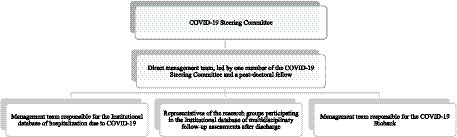
At the FMUSP-HC academic health system, we implemented innovative flow management routines for collecting, organizing and analyzing demographic data, COVID-related data and biological materials from over 4,500 patients with confirmed SARS-CoV-2 infection hospitalized from 2020 to 2022. This strategy was mainly planned in three areas: organizing a database with data from the hospitalizations; setting-up a multidisciplinary taskforce to conduct follow-up assessments after discharge; and organizing a biobank. Additionally, a COVID-19 curated collection was created within the institutional digital library of academic papers to map the research output.
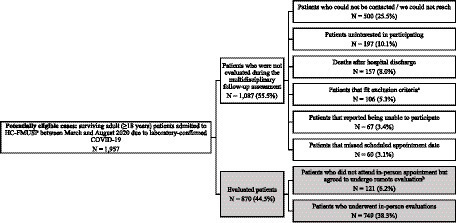
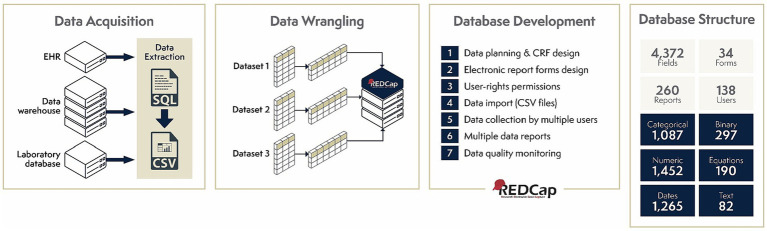
Over the course of the experience, the possible benefits and challenges of this type of research support approach were identified and discussed, leading to a set of recommended strategies to enhance collaboration within the research institution. Demographic and clinical data from COVID-19 hospitalizations were compiled in a database including adults and a minority of children and adolescents with laboratory confirmed COVID-19, covering 2020-2022, with approximately 350 fields per patient. To date, this database has been used in 16 published studies. Additionally, we assessed 700 adults 6 to 11 months after hospitalization through comprehensive, multidisciplinary in-person evaluations; this database, comprising around 2000 fields per subject, was used in 15 publications. Furthermore, thousands of blood samples collected during the acute phase and follow-up assessments remain stored for future investigations. To date, more than 3,700 aliquots have been used in ongoing research investigating various aspects of COVID-19. Lastly, the mapping of the overall research output revealed that between 2020 and 2022 our academic system produced 1,394 scientific articles on COVID-19.
Research is a crucial component of an effective epidemic response, and the preparation process should include a well-defined plan for organizing and sharing resources. The initiatives described in the present paper were successful in our aim to foster large-scale research in our institution. Although a single model may not be appropriate for all contexts, cross-disciplinary collaboration and open data sharing should make health research systems more efficient to generate the best evidence.
COVID-19 大流行促使全球研究努力降低感染影响,突显了跨学科合作的潜力,可提高研究质量和效率。
在 FMUSP-HC 学术医疗系统中,我们实施了创新的流程管理方案,用于收集、组织和分析 2020 年至 2022 年期间 4500 多名确诊 SARS-CoV-2 感染住院患者的人口统计学数据、COVID 相关数据和生物材料。该策略主要规划了三个方面:组织一个包含医院数据的数据库;建立一个多学科工作队,在出院后进行随访评估;以及组织一个生物库。此外,还在机构学术论文数字图书馆内创建了一个 COVID-19 专题收藏,以绘制研究成果图。
在经验过程中,确定并讨论了这种研究支持方法的可能好处和挑战,从而提出了一系列增强研究机构内合作的建议策略。COVID-19 住院患者的人口统计学和临床数据已汇编到一个数据库中,该数据库包括成年人和少数实验室确诊 COVID-19 的儿童和青少年,涵盖 2020 年至 2022 年,每位患者约有 350 个字段。迄今为止,该数据库已用于 16 项已发表的研究。此外,我们通过全面的多学科现场评估,对 700 名成年人进行了 6 至 11 个月的随访评估;该数据库,每个受试者约有 2000 个字段,已用于 15 项出版物。此外,在急性和随访评估期间收集的数千个血液样本仍可用于未来的研究。迄今为止,已使用 3700 多个样本进行了正在进行的研究,以调查 COVID-19 的各个方面。最后,对整体研究成果的映射显示,在 2020 年至 2022 年期间,我们的学术系统发表了 1394 篇关于 COVID-19 的科学文章。
研究是有效应对疫情的关键组成部分,准备过程应包括组织和共享资源的明确计划。本文中描述的举措成功地促进了我们机构的大规模研究。尽管单一模式可能并不适用于所有情况,但跨学科合作和开放数据共享应使卫生研究系统更有效地生成最佳证据。