
基于 RNA 的骨组织形态计量学:方法及其在解释成骨不全症 G610C 小鼠模型中青春期后骨量增加的应用。
RNA-based bone histomorphometry: method and its application to explaining postpubertal bone gain in a G610C mouse model of osteogenesis imperfecta.
机构信息
Eunice Kennedy Shriver National institute of Child Health and Human Development, National Institutes of Health, Bethesda, MD 20892, United States.
National Institute of Dental and Craniofacial Research, National Institutes of Health, Bethesda, MD 20892, United States.
出版信息
J Bone Miner Res. 2024 Mar 22;39(2):177-189. doi: 10.1093/jbmr/zjad004.
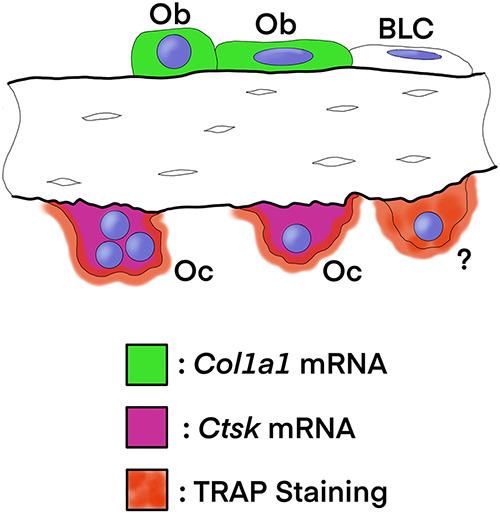
Bone histomorphometry is a well-established approach to assessing skeletal pathology, providing a standard evaluation of the cellular components, architecture, mineralization, and growth of bone tissue. However, it depends in part on the subjective interpretation of cellular morphology by an expert, which introduces bias. In addition, diseases like osteogenesis imperfecta (OI) and fibrous dysplasia are accompanied by changes in the morphology and function of skeletal tissue and cells, hindering consistent evaluation of some morphometric parameters and interpretation of the results. For instance, traditional histomorphometry combined with collagen turnover markers suggested that reduced bone formation in classical OI is accompanied by increased bone resorption. In contrast, the well-documented postpubertal reduction in fractures would be easier to explain by reduced bone resorption after puberty, highlighting the need for less ambiguous measurements. Here we propose an approach to histomorphometry based on in situ mRNA hybridization, which uses Col1a1 as osteoblast and Ctsk as osteoclast markers. This approach can be fully automated and eliminates subjective identification of bone surface cells. We validate these markers based on the expression of Bglap, Ibsp, and Acp5. Comparison with traditional histological and tartrate-resistant acid phosphatase staining of the same sections suggests that mRNA-based analysis is more reliable. Unlike inconclusive traditional histomorphometry of mice with α2(I)-Gly610 to Cys substitution in the collagen triple helix, mRNA-based measurements reveal reduced osteoclastogenesis in 11-wk-old animals consistent with the postpubertal catch-up osteogenesis observed by microCT. We optimize the technique for cryosections of mineralized bone and sections of paraffin-embedded decalcified tissue, simplifying and broadening its applications. We illustrate the application of the mRNA-based approach to human samples using the example of a McCune-Albright syndrome patient. By eliminating confounding effects of altered cellular morphology and the need for subjective morphological evaluation, this approach may provide a more reproducible and accessible evaluation of bone pathology.
骨组织形态计量学是评估骨骼病理学的一种成熟方法,可对骨组织的细胞成分、结构、矿化和生长进行标准评估。然而,它部分依赖于专家对细胞形态的主观解释,这引入了偏差。此外,成骨不全症(OI)和纤维结构不良等疾病伴随着骨骼组织和细胞形态和功能的变化,阻碍了一些形态计量参数的一致评估和结果的解释。例如,传统的组织形态计量学结合胶原蛋白周转率标志物表明,经典 OI 中的骨形成减少伴随着骨吸收的增加。相比之下,有充分文献记载的青春期后骨折减少更容易用青春期后骨吸收减少来解释,这突出了需要进行更明确的测量。在这里,我们提出了一种基于原位 mRNA 杂交的组织形态计量学方法,该方法使用 Col1a1 作为成骨细胞和 Ctsk 作为破骨细胞标志物。这种方法可以完全自动化,并消除对骨表面细胞的主观识别。我们基于 Bglap、Ibsp 和 Acp5 的表达来验证这些标志物。与传统的组织学和相同切片中耐酒石酸酸性磷酸酶染色的比较表明,基于 mRNA 的分析更可靠。与胶原三螺旋中α2(I)-甘氨酸 610 至半胱氨酸取代的小鼠传统组织形态计量学的不确定结果不同,基于 mRNA 的测量揭示了 11 周龄动物中破骨细胞生成减少,这与微 CT 观察到的青春期后追赶性成骨一致。我们对矿化骨的冷冻切片和脱钙石蜡包埋组织切片进行了技术优化,简化并拓宽了其应用。我们通过 McCune-Albright 综合征患者的例子说明了基于 mRNA 的方法在人类样本中的应用。通过消除细胞形态改变的混杂影响和对主观形态学评估的需求,这种方法可能为骨骼病理学提供更具可重复性和可及性的评估。
 Zotero 插件