Institute for Extra-cutting-edge Science and Technology Avant-garde Research (X-star), Japan Agency for Marine-Earth Science & Technology (JAMSTEC), Yokosuka, Kanagawa, Japan.
Marine Works Japan Ltd., Yokosuka, Kanagawa, Japan.
Int J Syst Evol Microbiol. 2024 Mar;74(3). doi: 10.1099/ijsem.0.006288.
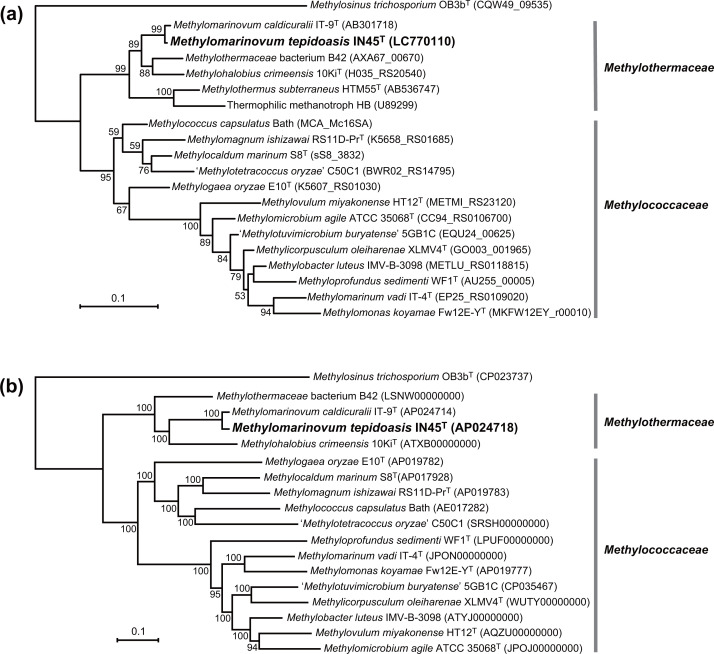
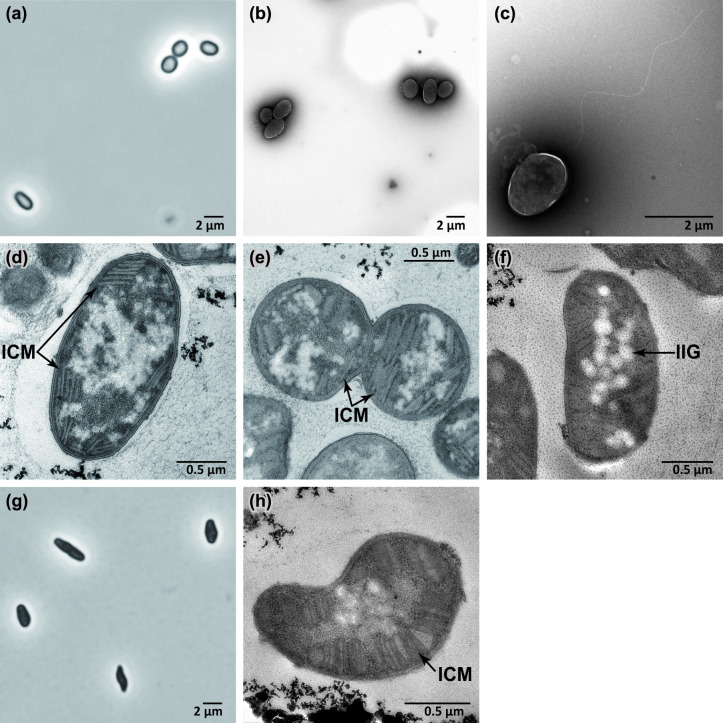
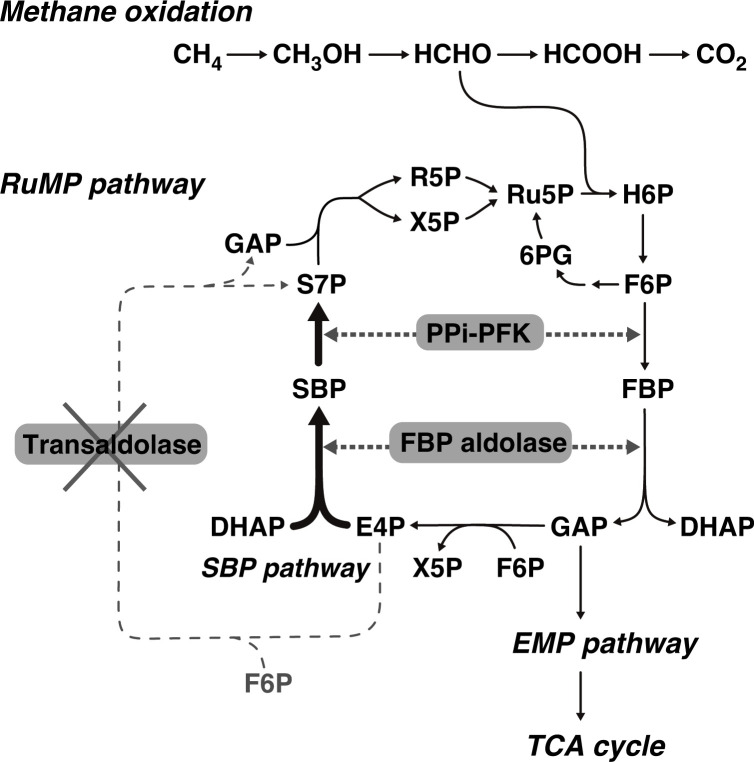
A novel aerobic methanotrophic bacterium, designated as strain IN45, was isolated from colonisation systems deployed at the Iheya North deep-sea hydrothermal field in the mid-Okinawa Trough. IN45 was a moderately thermophilic obligate methanotroph that grew only on methane or methanol at temperatures between 25 and 56 °C (optimum 45-50 °C). It was an oval-shaped, Gram-reaction-negative, motile bacterium with a single polar flagellum and an intracytoplasmic membrane system. It required 1.5-4.0 % (w/v) NaCl (optimum 2-3 %) for growth. The major phospholipid fatty acids were Cω7, C and Cω7. The major isoprenoid quinone was Q-8. The 16S rRNA gene sequence comparison revealed 99.1 % sequence identity with IT-9, the only species of the genus with a validly published name within the family . The complete genome sequence of IN45 consisted of a 2.42-Mbp chromosome (DNA G+C content, 64.1 mol%) and a 20.5-kbp plasmid. The genome encodes genes for particulate methane monooxygenase and two types of methanol dehydrogenase ( and ). Genes involved in the ribulose monophosphate pathway for carbon assimilation are encoded, but the transaldolase gene was not found. The genome indicated that IN45 performs partial denitrification of nitrate to NO, and its occurrence was indirectly confirmed by NO production in cultures grown with nitrate. Genomic relatedness indices between the complete genome sequences of IN45 and IT-9, such as digital DNA-DNA hybridisation (51.2 %), average nucleotide identity (92.94 %) and average amino acid identity (93.21 %), indicated that these two methanotrophs should be separated at the species level. On the basis of these results, strain IN45 represents a novel species, for which we propose the name sp. nov. with IN45 (=JCM 35101 =DSM 113422) as the type strain.
一株新型好氧甲烷营养菌,命名为 IN45 株,从冲绳海槽中 Iheya 北深海热液场的定植系统中分离得到。IN45 是一种中度嗜热的专性甲烷营养菌,只能在 25-56°C(最佳温度为 45-50°C)的甲烷或甲醇上生长。它是一个椭圆形、革兰氏阴性、运动的细菌,具有一个单一的极鞭毛和一个细胞内膜系统。它需要 1.5-4.0%(w/v)的 NaCl(最佳 2-3%)才能生长。主要的磷脂脂肪酸是 Cω7、C 和 Cω7。主要的异戊二烯醌是 Q-8。16S rRNA 基因序列比较显示与唯一具有有效发表名称的属内种 IT-9 的序列同一性为 99.1%。IN45 的全基因组序列由一个 2.42-Mbp 的染色体(DNA G+C 含量,64.1 mol%)和一个 20.5-kbp 的质粒组成。基因组编码颗粒状甲烷单加氧酶和两种类型的甲醇脱氢酶( 和 )的基因。编码参与碳同化的核酮糖单磷酸途径的基因,但未发现转醛酶基因。基因组表明,IN45 将硝酸盐部分还原为 NO,其发生情况通过在含有硝酸盐的培养物中产生 NO 间接证实。IN45 的全基因组序列与 IT-9 的全基因组序列之间的基因组相关指数,如数字 DNA-DNA 杂交(51.2%)、平均核苷酸同一性(92.94%)和平均氨基酸同一性(93.21%)表明,这两种甲烷营养菌应该在种水平上分开。基于这些结果,菌株 IN45 代表一个新种,我们建议将其命名为 sp. nov.,以 IN45(=JCM 35101 =DSM 113422)作为模式株。