Department of Physiotherapy and Rehabilitation, Faculty of Health Sciences, Izmir Katip Celebi University, Izmir, Turkey.
Graduate School of Health Sciences, Dokuz Eylül University, Izmir, Turkey.
Acta Neurol Belg. 2024 Jun;124(3):957-964. doi: 10.1007/s13760-024-02515-y. Epub 2024 Mar 14.
Balance confidence is an essential component of fall risk assessment in persons with multiple sclerosis (pwMS).
The aims of this cross-sectional study were to 1) investigate the ability of the 16-item Activities-specific Balance Confidence scale (ABC-16), 6-item Activities-specific Balance Confidence scale (ABC-6), and each item of the ABC-16 for distinguishing fallers and 2) determine cutoff scores for these scales to discriminate fallers and non-fallers in pwMS.
One hundred and fifty-six participants [fallers/non-fallers: 60 (38.5%)/96 (61.5%), median EDSS: 1.5] were enrolled. Balance confidence was assessed using the ABC-16 and ABC-6. The self-reported number of falls in the past three months was recorded. Descriptive assessments, including walking, balance, and cognition were performed. Logistic regression and receiver operating characteristic analyses were conducted to estimate the sensitivities and specificities of the ABC-16 and ABC-6.
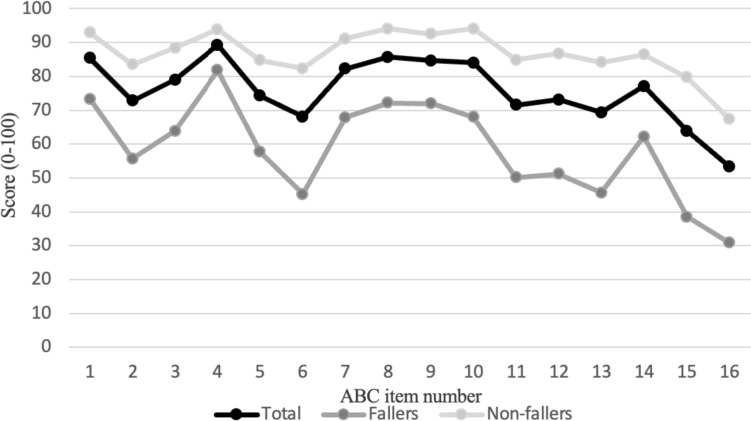
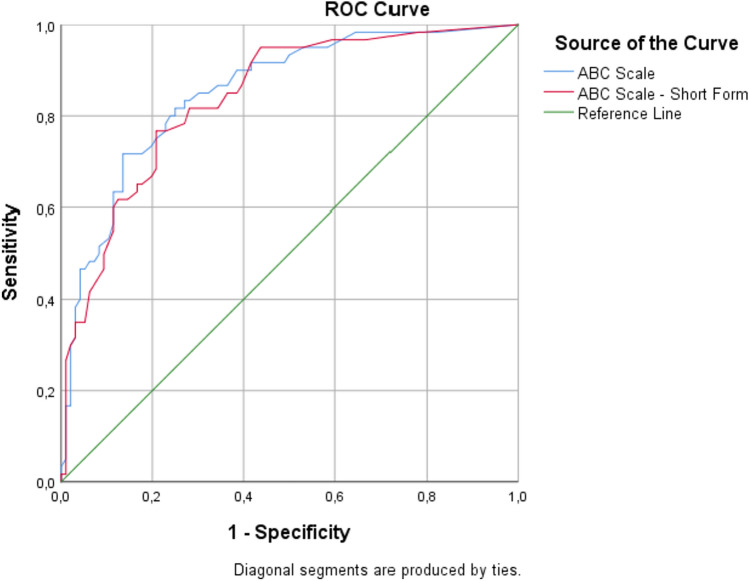
Both the ABC-16 (AUC: 0.85) and ABC-6 (AUC: 0.84) had the discriminative ability for falls. Each item of the ABC-16 scale was a significantly related to falls [odds ratio (OR) range: 1.38 to 1.89]. Items 8 and 10 had the highest odds ratio (OR: 1.85; 95%CI: 1.47-2.33, OR: 1.89; 95%CI: 1.49-2.40; respectively). We found cutoff scores of ≤ 70 of 100 (sensitivity: 71.67, specificity: 86.46) and ≤ 65/100 (sensitivity: 76.67, specificity: 79.17) in discrimination between fallers and non-fallers for the ABC-16 and ABC-6, respectively.
Both original and short forms of the ABC scale are an efficient tool for discriminating fallers and non-fallers in pwMS. Although all items are related to falls, outdoor walking activities have the strongest associations with falls than other items.
平衡信心是多发性硬化症患者(pwMS)跌倒风险评估的重要组成部分。
本横断面研究旨在 1)探讨 16 项特定活动平衡信心量表(ABC-16)、6 项特定活动平衡信心量表(ABC-6)和 ABC-16 中的每个项目区分跌倒者的能力,2)确定这些量表的截断值以区分 pwMS 中的跌倒者和非跌倒者。
纳入 156 名参与者[跌倒者/非跌倒者:60(38.5%)/96(61.5%),中位数 EDSS:1.5]。使用 ABC-16 和 ABC-6 评估平衡信心。记录过去三个月内的跌倒次数。进行描述性评估,包括行走、平衡和认知能力。进行逻辑回归和受试者工作特征分析,以估计 ABC-16 和 ABC-6 的灵敏度和特异性。
ABC-16(AUC:0.85)和 ABC-6(AUC:0.84)均具有跌倒的区分能力。ABC-16 量表的每个项目均与跌倒显著相关[比值比(OR)范围:1.38 至 1.89]。第 8 项和第 10 项的 OR 值最高(OR:1.85;95%CI:1.47-2.33,OR:1.89;95%CI:1.49-2.40)。我们发现 ABC-16 的临界值为≤70/100(灵敏度:71.67%,特异性:86.46%)和≤65/100(灵敏度:76.67%,特异性:79.17%),分别用于区分跌倒者和非跌倒者。ABC-6。
ABC 量表的原始和简短形式都是区分 pwMS 中跌倒者和非跌倒者的有效工具。尽管所有项目均与跌倒有关,但户外活动与跌倒的关联最强,而其他项目则次之。