University of Texas MD Anderson Cancer Center, Houston, TX.
Guy's and St Thomas Hospitals, London, United Kingdom.
JCO Glob Oncol. 2024 Mar;10:e2300376. doi: 10.1200/GO.23.00376.
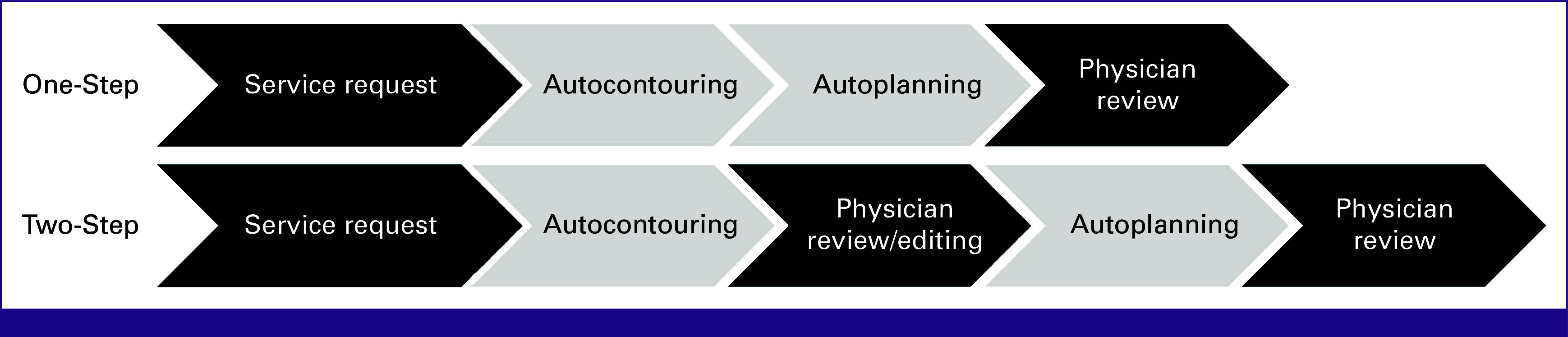
Increased automation has been identified as one approach to improving global cancer care. The Radiation Planning Assistant (RPA) is a web-based tool offering automated radiotherapy (RT) contouring and planning to low-resource clinics. In this study, the RPA workflow and clinical acceptability were assessed by physicians around the world.
The RPA output for 75 cases was reviewed by at least three physicians; 31 radiation oncologists at 16 institutions in six countries on five continents reviewed RPA contours and plans for clinical acceptability using a 5-point Likert scale.
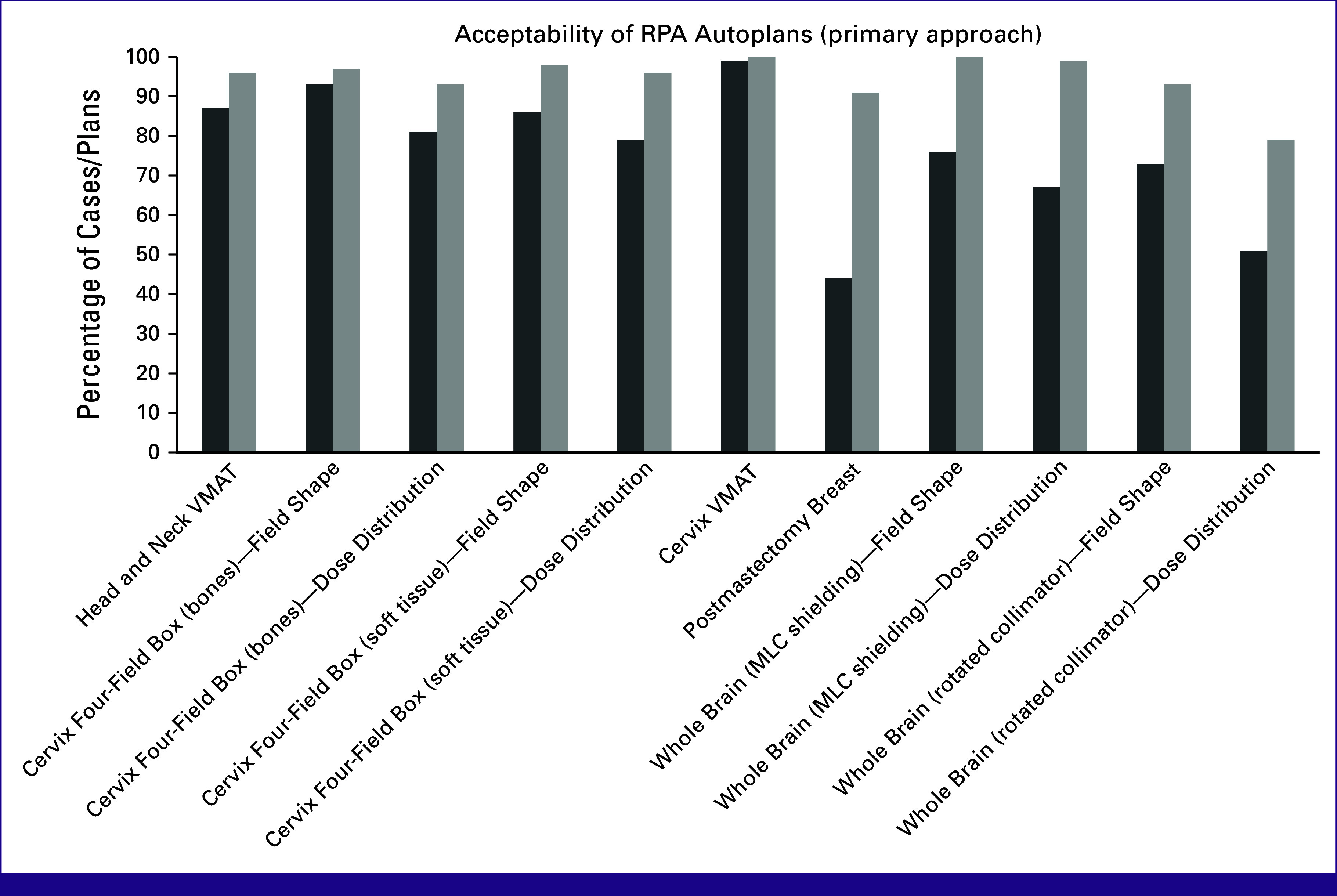
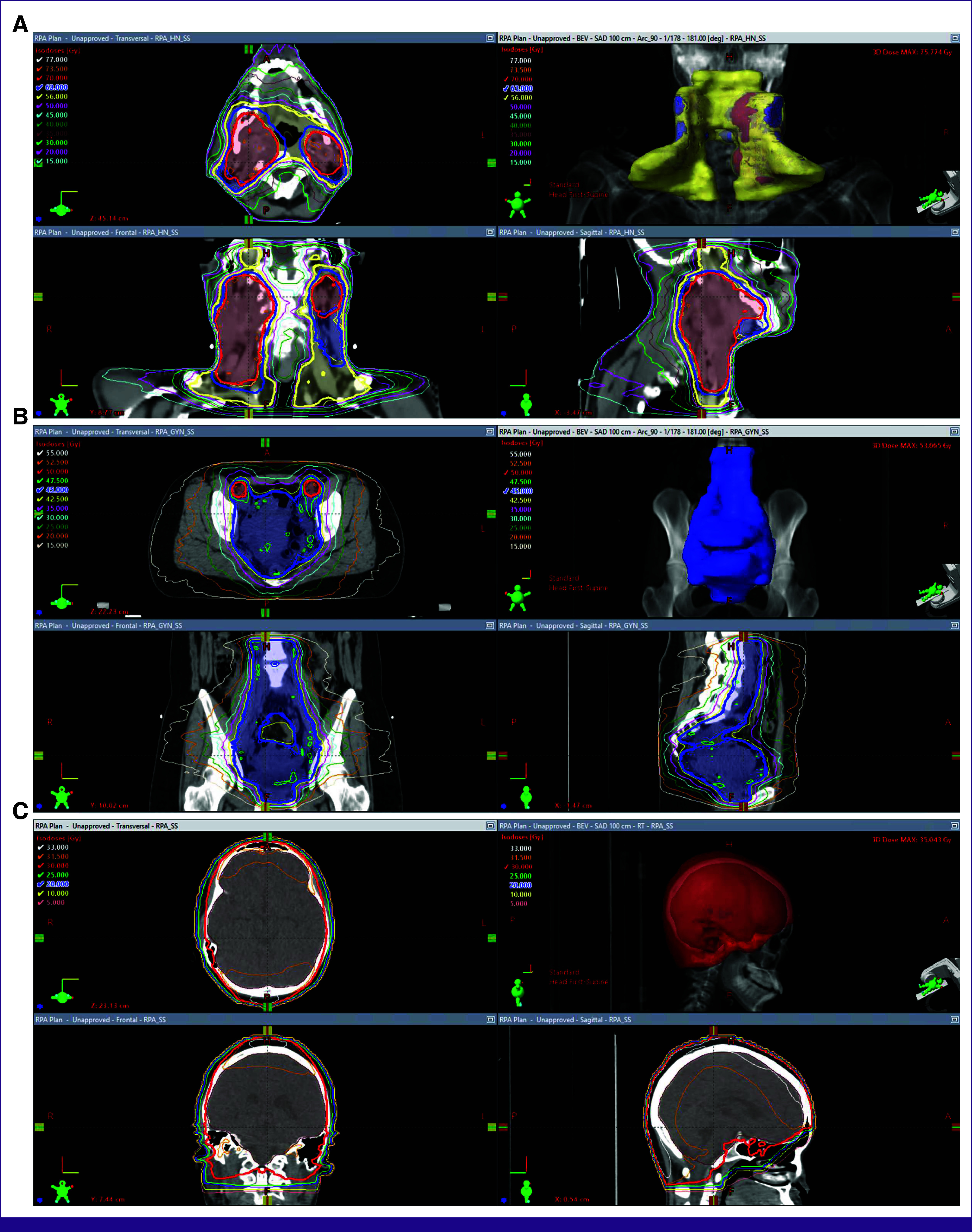
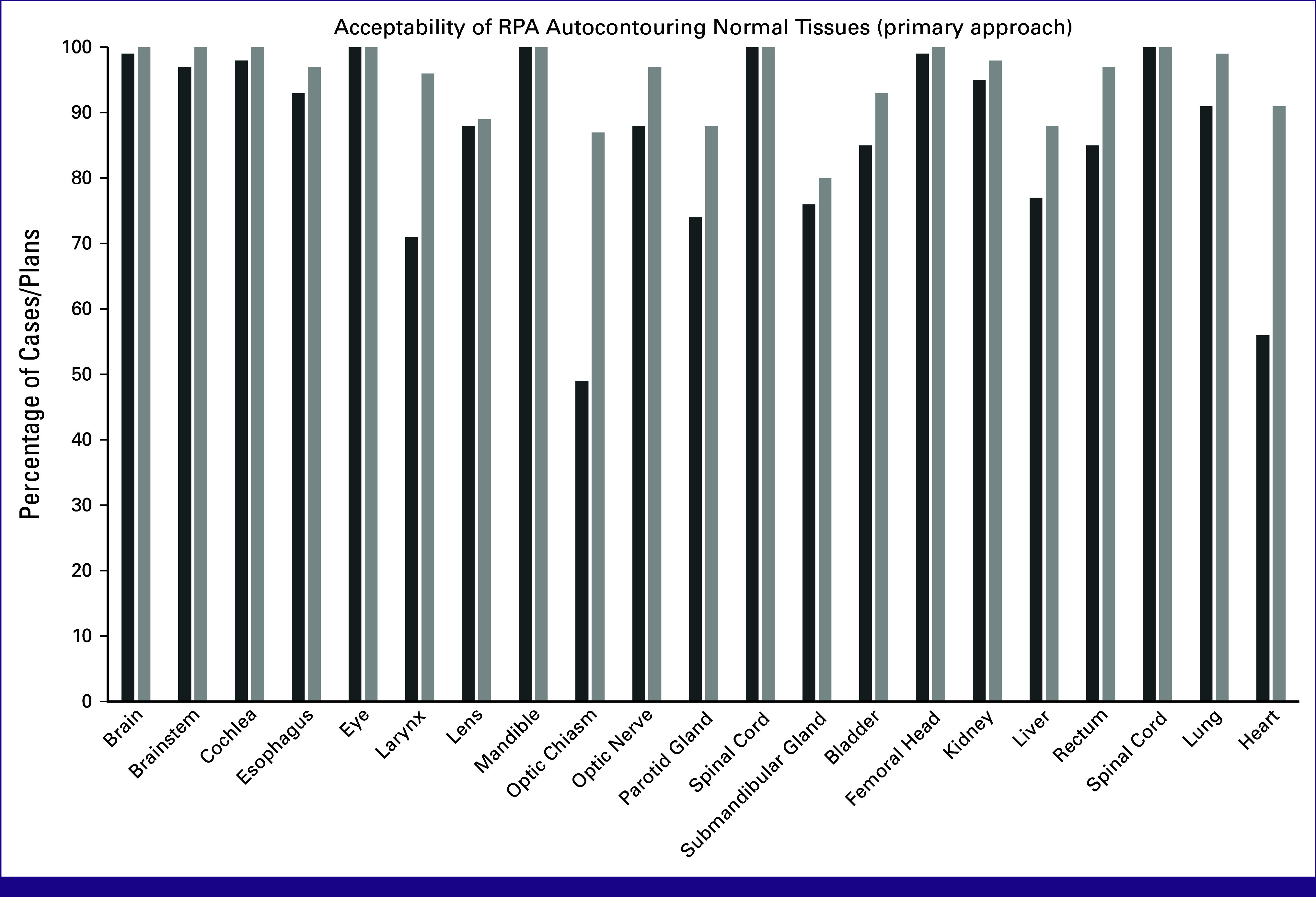
For cervical cancer, RPA plans using bony landmarks were scored as usable as-is in 81% (with minor edits 93%); using soft tissue contours, plans were scored as usable as-is in 79% (with minor edits 96%). For postmastectomy breast cancer, RPA plans were scored as usable as-is in 44% (with minor edits 91%). For whole-brain treatment, RPA plans were scored as usable as-is in 67% (with minor edits 99%). For head/neck cancer, the normal tissue autocontours were acceptable as-is in 89% (with minor edits 97%). The clinical target volumes (CTVs) were acceptable as-is in 40% (with minor edits 93%). The volumetric-modulated arc therapy (VMAT) plans were acceptable as-is in 87% (with minor edits 96%). For cervical cancer, the normal tissue autocontours were acceptable as-is in 92% (with minor edits 99%). The CTVs for cervical cancer were scored as acceptable as-is in 83% (with minor edits 92%). The VMAT plans for cervical cancer were acceptable as-is in 99% (with minor edits 100%).
The RPA, a web-based tool designed to improve access to high-quality RT in low-resource settings, has high rates of clinical acceptability by practicing clinicians around the world. It has significant potential for successful implementation in low-resource clinics.
提高自动化水平已被确定为改善全球癌症治疗的方法之一。Radiation Planning Assistant(RPA)是一种基于网络的工具,可为资源匮乏的诊所提供自动化放射治疗(RT)勾画和计划。在这项研究中,全球的医生评估了 RPA 的工作流程和临床可接受性。
至少有三位医生对 75 例 RPA 结果进行了审查;来自六大洲五个国家 16 个机构的 31 名肿瘤放射科医师使用 5 分李克特量表对 RPA 轮廓和计划的临床可接受性进行了评估。
对于宫颈癌,使用骨性标志的 RPA 计划评分中有 81%(轻微修改后为 93%)为可直接使用;使用软组织轮廓的计划评分中有 79%(轻微修改后为 96%)为可直接使用。对于乳腺癌根治术后,RPA 计划评分中有 44%(轻微修改后为 91%)为可直接使用。对于全脑治疗,RPA 计划评分中有 67%(轻微修改后为 99%)为可直接使用。对于头颈部癌症,正常组织自动勾画可直接使用,评分为 89%(轻微修改后为 97%)。临床靶区(CTV)可直接使用,评分为 40%(轻微修改后为 93%)。容积旋转调强弧形治疗(VMAT)计划可直接使用,评分为 87%(轻微修改后为 96%)。对于宫颈癌,正常组织自动勾画可直接使用,评分为 92%(轻微修改后为 99%)。宫颈癌 CTV 可直接使用,评分为 83%(轻微修改后为 92%)。宫颈癌 VMAT 计划可直接使用,评分为 99%(轻微修改后为 100%)。
Radiation Planning Assistant(RPA)是一种基于网络的工具,旨在改善资源匮乏环境中高质量 RT 的可及性,得到了全球执业医生的高度临床认可。它在资源匮乏的诊所中具有成功实施的巨大潜力。