The University of Texas MD Anderson Cancer Center UTHealth Graduate School of Biomedical Sciences, Houston, Texas, USA.
Department of Radiation Physics, The University of Texas MD Anderson Cancer Center, Houston, Texas, USA.
J Appl Clin Med Phys. 2022 Sep;23(9):e13712. doi: 10.1002/acm2.13712. Epub 2022 Jul 8.
To develop an automated workflow for rectal cancer three-dimensional conformal radiotherapy (3DCRT) treatment planning that combines deep learning (DL) aperture predictions and forward-planning algorithms.
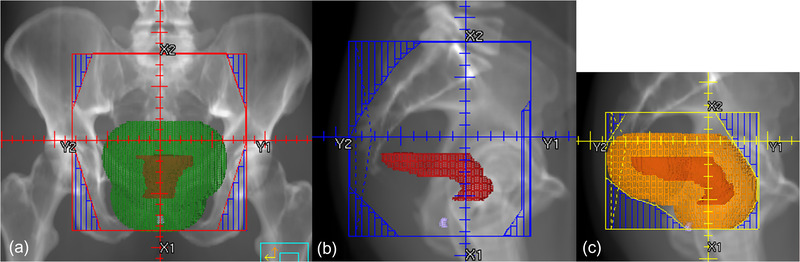
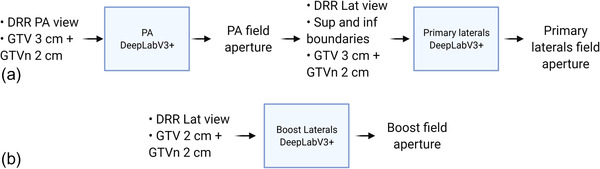
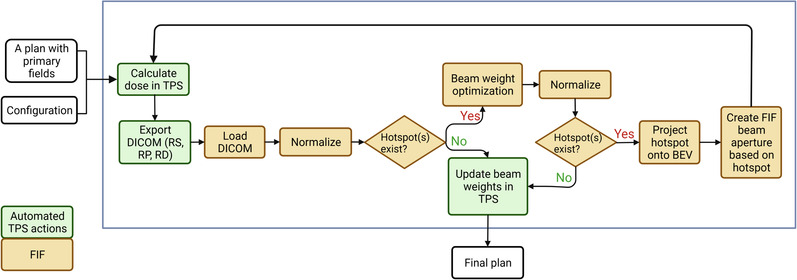
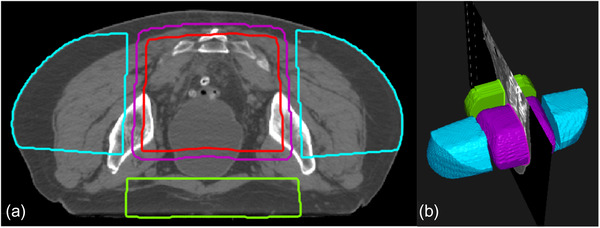
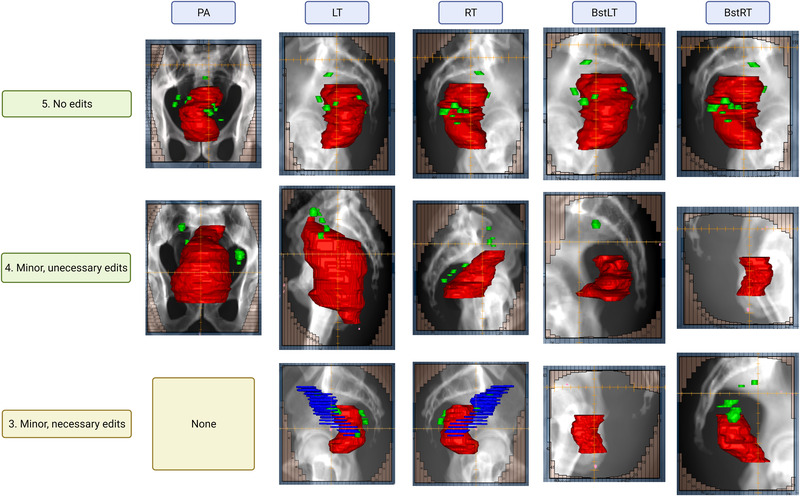
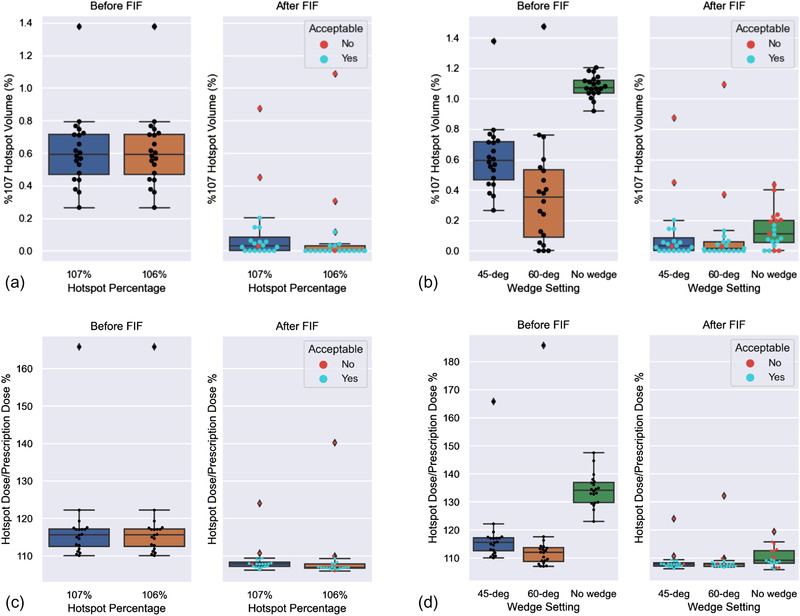
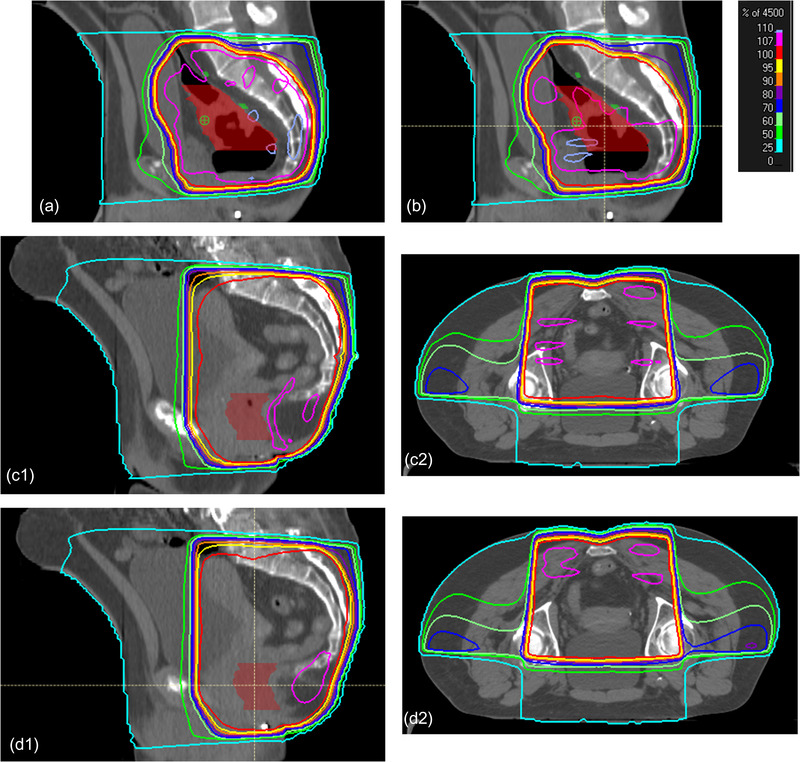
We designed an algorithm to automate the clinical workflow for 3DCRT planning with field aperture creations and field-in-field (FIF) planning. DL models (DeepLabV3+ architecture) were trained, validated, and tested on 555 patients to automatically generate aperture shapes for primary (posterior-anterior [PA] and opposed laterals) and boost fields. Network inputs were digitally reconstructed radiographs, gross tumor volume (GTV), and nodal GTV. A physician scored each aperture for 20 patients on a 5-point scale (>3 is acceptable). A planning algorithm was then developed to create a homogeneous dose using a combination of wedges and subfields. The algorithm iteratively identifies a hotspot volume, creates a subfield, calculates dose, and optimizes beam weight all without user intervention. The algorithm was tested on 20 patients using clinical apertures with varying wedge angles and definitions of hotspots, and the resulting plans were scored by a physician. The end-to-end workflow was tested and scored by a physician on another 39 patients.
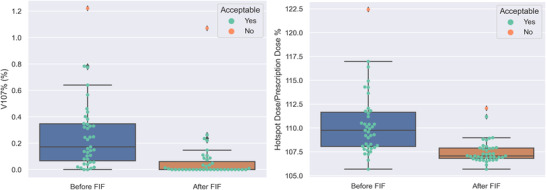
The predicted apertures had Dice scores of 0.95, 0.94, and 0.90 for PA, laterals, and boost fields, respectively. Overall, 100%, 95%, and 87.5% of the PA, laterals, and boost apertures were scored as clinically acceptable, respectively. At least one auto-plan was clinically acceptable for all patients. Wedged and non-wedged plans were clinically acceptable for 85% and 50% of patients, respectively. The hotspot dose percentage was reduced from 121% (σ = 14%) to 109% (σ = 5%) of prescription dose for all plans. The integrated end-to-end workflow of automatically generated apertures and optimized FIF planning gave clinically acceptable plans for 38/39 (97%) of patients.
We have successfully automated the clinical workflow for generating radiotherapy plans for rectal cancer for our institution.
开发一种结合深度学习(DL)孔径预测和正向规划算法的直肠癌三维适形放疗(3DCRT)治疗计划的自动化工作流程。
我们设计了一种算法,用于自动化 3DCRT 计划的临床工作流程,包括野孔径创建和场内(FIF)计划。DL 模型(DeepLabV3+ 架构)在 555 名患者中进行了训练、验证和测试,以自动生成主野(前后位 [PA] 和对侧侧野)和加量野的孔径形状。网络输入是数字重建射线照片、大体肿瘤体积(GTV)和淋巴结 GTV。一位医生对 20 名患者的每个孔径进行了 5 分制评分(>3 为可接受)。然后开发了一种规划算法,通过使用楔形和子野的组合来创建均匀剂量。该算法迭代地识别热点体积,创建子野,计算剂量,并优化射束权重,而无需用户干预。该算法在 20 名患者中使用具有不同楔形角度和热点定义的临床孔径进行了测试,并由医生对生成的计划进行了评分。最后,医生对另外 39 名患者的端到端工作流程进行了测试和评分。
预测的孔径在 PA、侧野和加量野的 Dice 评分分别为 0.95、0.94 和 0.90。总体而言,PA、侧野和加量野的 100%、95%和 87.5%的孔径分别被评为临床可接受。所有患者至少有一个自动计划是临床可接受的。楔形和非楔形计划对 85%和 50%的患者分别是临床可接受的。所有计划的热点剂量百分比从处方剂量的 121%(σ=14%)降低到 109%(σ=5%)。自动生成孔径和优化的 FIF 计划的集成端到端工作流程为 39 名患者中的 38 名(97%)提供了临床可接受的计划。
我们已经成功地为我们的机构自动化了生成直肠癌放疗计划的临床工作流程。