State Key Laboratory of Biocontrol, Institute of Aquatic Economic Animals and Guangdong Province Key Laboratory of Aquatic Economic Animals, School of Life Sciences, Sun Yat-sen University, Guangzhou, Guangdong 510275, China.
Area of Ecology and Biodiversity, School of Biological Sciences, University of Hong Kong, Hong Kong SAR 999077, China.
Zool Res. 2024 Mar 18;45(2):314-328. doi: 10.24272/j.issn.2095-8137.2023.222.
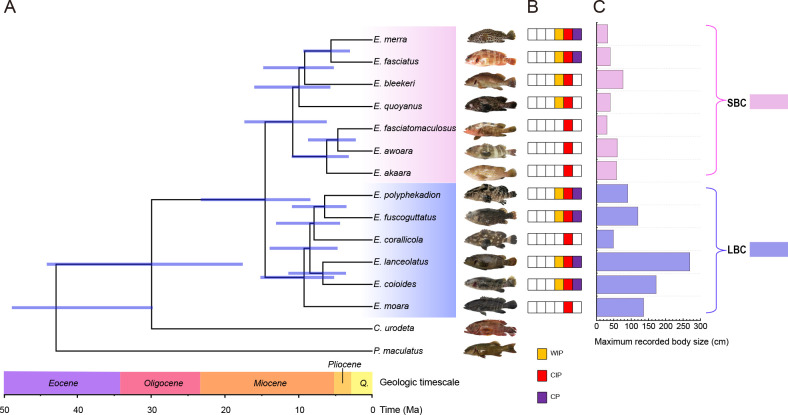
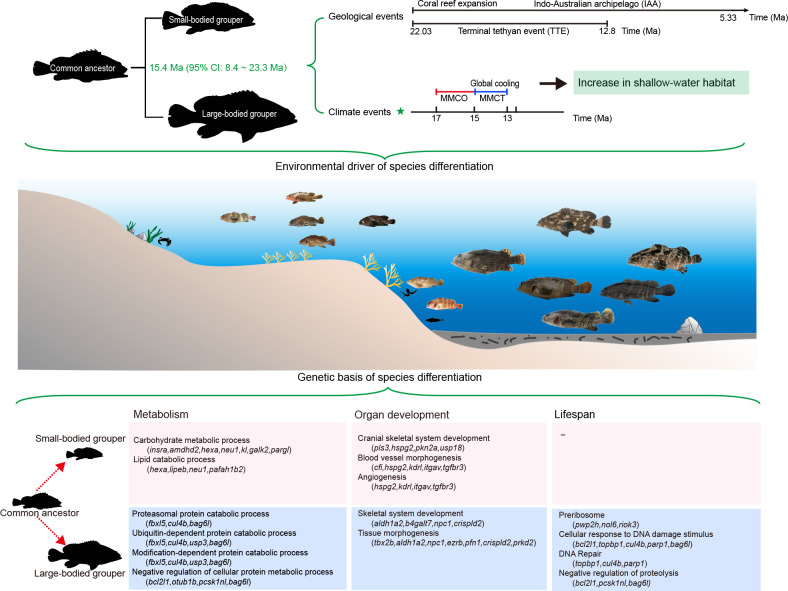
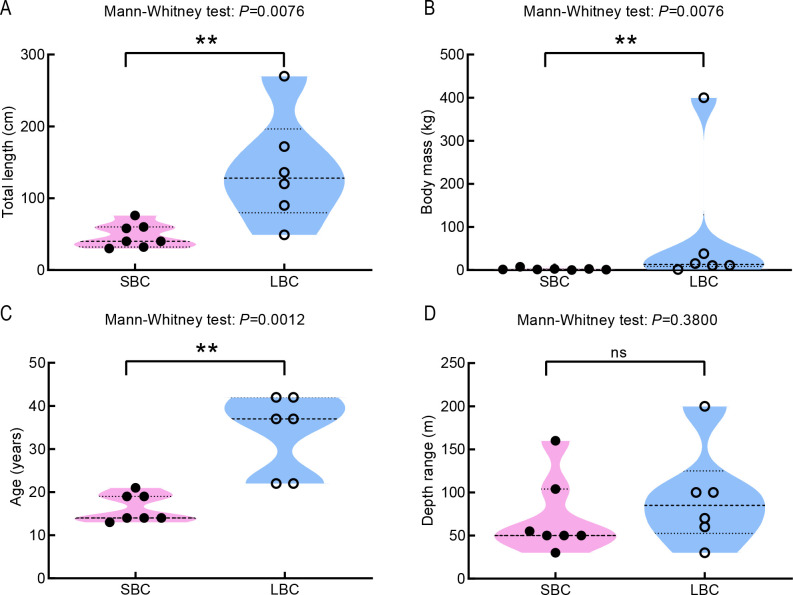
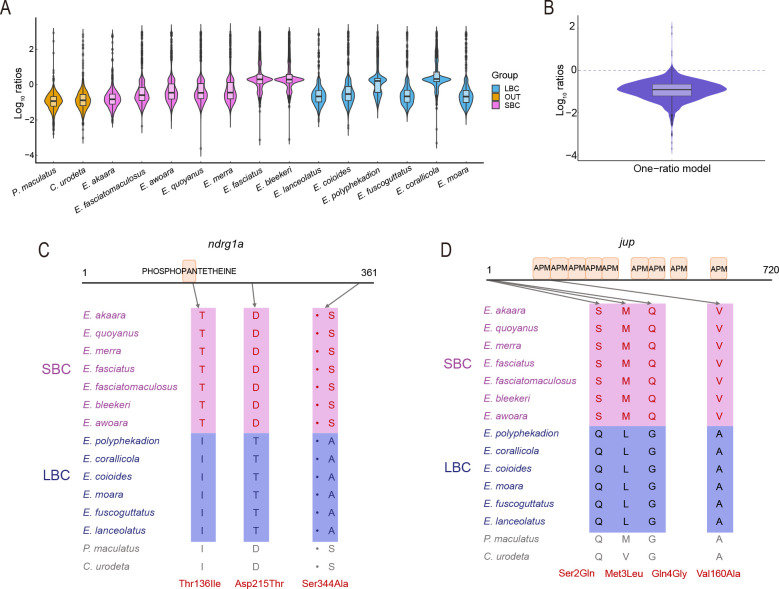
Animal body size variation is of particular interest in evolutionary biology, but the genetic basis remains largely unknown. Previous studies have shown the presence of two parallel evolutionary genetic clusters within the fish genus with evident divergence in body size, providing an excellent opportunity to investigate the genetic basis of body size variation in vertebrates. Herein, we performed phylotranscriptomic analysis and reconstructed the phylogeny of 13 epinephelids originating from the South China Sea. Two genetic clades with an estimated divergence time of approximately 15.4 million years ago were correlated with large and small body size, respectively. A total of 180 rapidly evolving genes and two positively selected genes were identified between the two groups. Functional enrichment analyses of these candidate genes revealed distinct enrichment categories between the two groups. These pathways and genes may play important roles in body size variation in groupers through complex regulatory networks. Based on our results, we speculate that the ancestors of the two divergent groups of groupers may have adapted to different environments through habitat selection, leading to genetic variations in metabolic patterns, organ development, and lifespan, resulting in body size divergence between the two locally adapted populations. These findings provide important insights into the genetic mechanisms underlying body size variation in groupers and species differentiation.
动物体型变异在进化生物学中特别有趣,但遗传基础在很大程度上仍不清楚。先前的研究表明,在鱼类属中存在两个平行的进化遗传聚类,其体型明显分化,为研究脊椎动物体型变异的遗传基础提供了极好的机会。在此,我们对来自南海的 13 种石斑鱼进行了系统发生转录组学分析和系统发育重建。两个遗传聚类与大、小体型分别相关,估计分化时间约为 1540 万年前。在这两个群体之间共鉴定到 180 个快速进化的基因和两个正选择基因。对这些候选基因的功能富集分析显示,两组之间存在明显的富集类别。这些途径和基因可能通过复杂的调控网络在石斑鱼的体型变异中发挥重要作用。基于我们的结果,我们推测,这两个分化的石斑鱼群体的祖先可能通过栖息地选择适应了不同的环境,导致代谢模式、器官发育和寿命的遗传变异,从而导致两个局部适应种群的体型分化。这些发现为石斑鱼和物种分化的体型变异遗传机制提供了重要的见解。