Réanimation Polyvalente, Hôpital Louis Pasteur, CH de Chartres, Le Coudray, France.
Unité de Recherche CEReSS-EA3279, Aix-Marseille Université, Marseille, France.
Crit Care. 2024 Mar 14;28(1):77. doi: 10.1186/s13054-024-04826-1.
Posttraumatic stress disorder (PTSD) after a stay in the intensive care unit (ICU) can affect one in five ICU survivors. At the beginning of the coronavirus disease 2019 (COVID-19) pandemic, admission to the ICU for COVID-19 was stressful due to the severity of this disease. This study assessed whether admission to the ICU for COVID-19 was associated with a higher prevalence of PTSD compared with other causes of ICU admission after adjustment for pre-ICU psychological factors.
This prospective observational comparative cohort study included 31 ICUs. Eligible patients were adult ICU survivors hospitalized during the first wave of COVID-19 pandemic in France, regardless of the reason for admission. The prevalence of presumptive diagnosis of PTSD at 6 months was assessed using the PTSD Checklist for DSM-5 (PCL-5). Sociodemographics, clinical data, history of childhood trauma (Childhood Trauma Questionnaire [CTQ]), and exposure to potentially traumatic events (Life Events Checklist for DSM-5 [LEC-5]) were assessed.
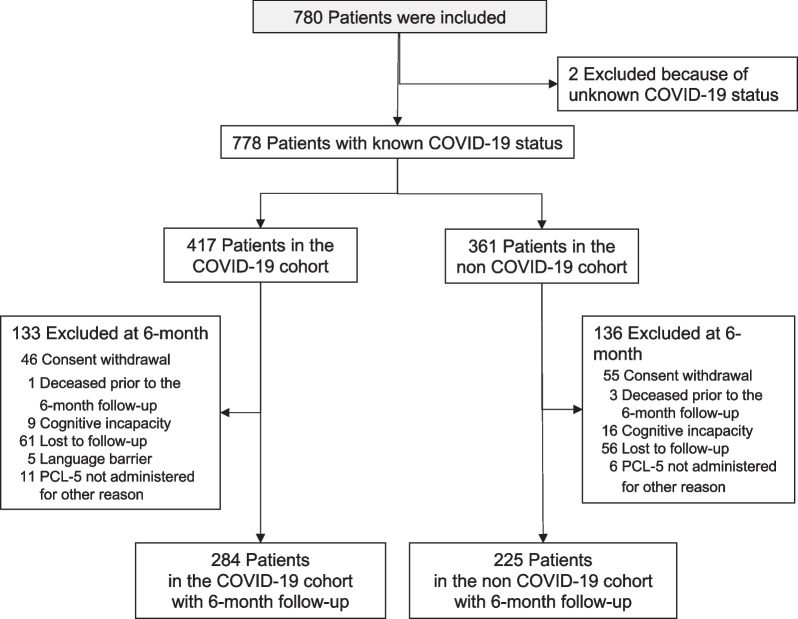
Of the 778 ICU survivors included during the first wave of COVID-19 pandemic in France, 417 and 361 were assigned to the COVID-19 and non-COVID-19 cohorts, respectively. Fourteen (4.9%) and 11 (4.9%), respectively, presented with presumptive diagnosis of PTSD at 6 months (p = 0.976). After adjusting for age, sex, severity score at admission, use of invasive mechanical ventilation, ICU duration, CTQ and LEC-5, COVID-19 status was not associated with presumptive diagnosis of PTSD using the PCL-5. Only female sex was associated with presumptive diagnosis of PTSD. However, COVID-19 patients reported significantly more intrusion and avoidance symptoms than non-COVID patients (39% vs. 29%, p = 0.015 and 27% vs. 19%, p = 0.030), respectively. The median PCL-5 score was higher in the COVID-19 than non-COVID-19 cohort (9 [3, 20] vs. 4 [2, 16], p = 0.034).
Admission to the ICU for COVID-19 was not associated with a higher prevalence of PTSD compared with admission for another cause during the first wave of the COVID-19 pandemic in France. However, intrusion and avoidance symptoms were more frequent in COVID-19 patients than in non-COVID-19 patients.
Clinicaltrials.gov Identifier NCT03991611, registered on June 19, 2019.
在重症监护病房(ICU)停留后发生创伤后应激障碍(PTSD),可能会影响五分之一的 ICU 幸存者。在 2019 年冠状病毒病(COVID-19)大流行开始时,由于该病的严重程度,因 COVID-19 而入住 ICU 会带来压力。本研究评估了与其他 ICU 入住原因相比,因 COVID-19 而入住 ICU 是否与 PTSD 的更高患病率相关,同时调整了 ICU 前的心理因素。
本前瞻性观察性比较队列研究纳入了 31 个 ICU。合格的患者为在法国 COVID-19 大流行第一波期间住院的成年 ICU 幸存者,不论入住原因。使用 DSM-5 创伤后应激障碍检查表(PCL-5)评估 6 个月时 PTSD 的疑似诊断的患病率。评估了人口统计学,临床数据,童年创伤史(童年创伤问卷[CTQ])和潜在创伤性事件的暴露(DSM-5 生活事件检查表[LEC-5])。
在法国 COVID-19 大流行的第一波期间,纳入了 778 名 ICU 幸存者,其中 417 名和 361 名分别被分配到 COVID-19 组和非 COVID-19 组。分别有 14 名(4.9%)和 11 名(4.9%)在 6 个月时出现 PTSD 的疑似诊断(p=0.976)。在校正年龄,性别,入院严重程度评分,使用有创机械通气,ICU 持续时间,CTQ 和 LEC-5 后,COVID-19 状态与使用 PCL-5 进行的 PTSD 疑似诊断无关。仅女性性别与 PTSD 的疑似诊断相关。但是,COVID-19 患者报告的闯入和回避症状明显多于非 COVID 患者(分别为 39%比 29%,p=0.015 和 27%比 19%,p=0.030)。COVID-19 组的 PCL-5 中位数高于非 COVID-19 组(9 [3,20] vs. 4 [2,16],p=0.034)。
与 COVID-19 大流行第一波期间因其他原因入住 ICU 相比,因 COVID-19 入住 ICU 并未导致 PTSD 的患病率更高。但是,COVID-19 患者的闯入和回避症状比非 COVID-19 患者更为常见。
Clinicaltrials.gov 标识符 NCT03991611,于 2019 年 6 月 19 日注册。