Peng Xiaolong, Srivastava Shraddha, Sutton Falon, Zhang Yongkuan, Badran Bashar W, Kautz Steven A
Department of Psychiatry and Behavioral Sciences, Neuro-X Lab, Medical University of South Carolina, Charleston, SC, United States.
Ralph H. Johnson VA Medical Center, Charleston, SC, United States.
Front Hum Neurosci. 2024 Feb 29;18:1340374. doi: 10.3389/fnhum.2024.1340374. eCollection 2024.
Balance and mobility impairments are prevalent post-stroke and a large number of survivors require walking assistance at 6 months post-stroke which diminishes their overall quality of life. Personalized interventions for gait and balance rehabilitation are crucial. Recent evidence indicates that stroke lesions in primary motor pathways, such as corticoreticular pathways (CRP) and corticospinal tract (CST), may lead to reliance on alternate motor pathways as compensation, but the current evidence lacks comprehensive knowledge about the underlying neural mechanisms.
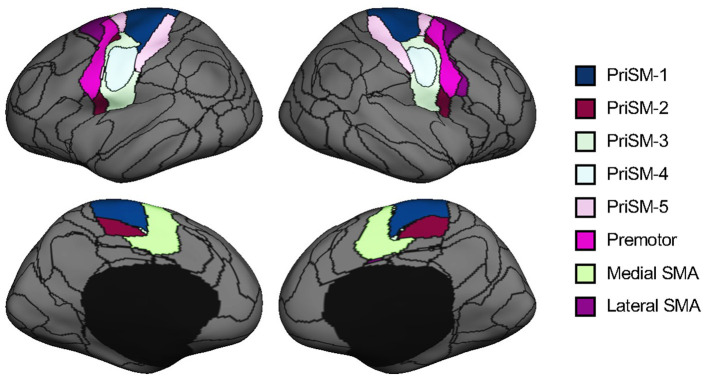
In this study, we investigate the functional connectivity (FC) changes within the motor network derived from an individualized cortical parcellation approach in 33 participants with chronic stroke compared to 17 healthy controls. The correlations between altered motor FC and gait deficits (i.e., walking speed and walking balance) were then estimated in the stroke population to understand the compensation mechanism of the motor network in motor function rehabilitation post-stroke.
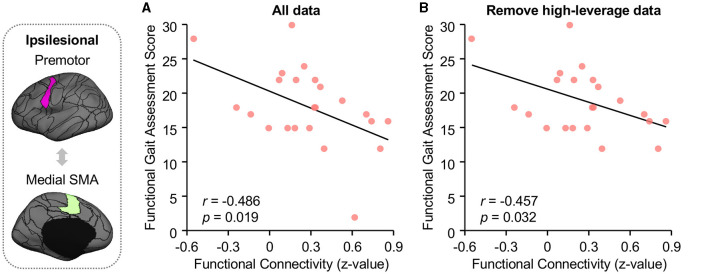
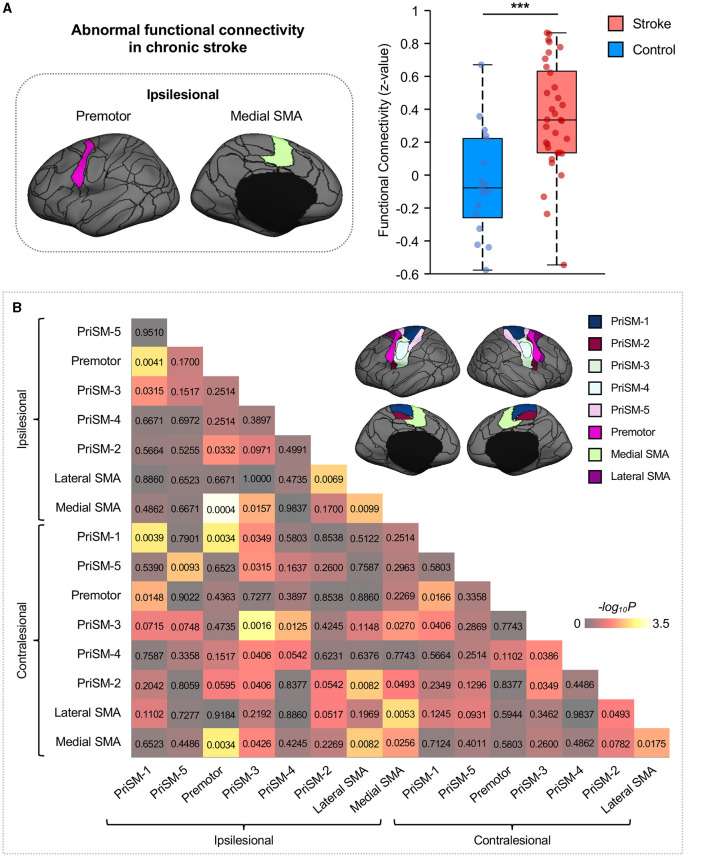
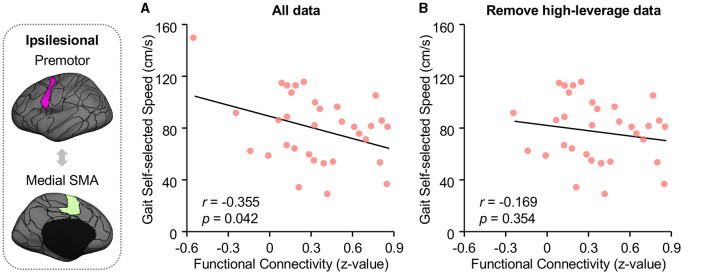
Our results demonstrated significant FC increases between ipsilesional medial supplementary motor area (SMA) and premotor in stroke compared to healthy controls. Furthermore, we also revealed a negative correlation between ipsilesional SMA-premotor FC and self-selected walking speed, as well as the Functional Gait Assessment (FGA) scores.
The increased FC between the ipsilesional SMA and premotor regions could be a compensatory mechanism within the motor network following a stroke when the individual can presumably no longer rely on the more precise CST modulation of movements to produce a healthy walking pattern. These findings enhance our understanding of individualized motor network FC changes and their connection to gait and walking balance impairments post-stroke, improving stroke rehabilitation interventions.
平衡和运动能力受损在中风后很常见,大量幸存者在中风后6个月需要行走辅助,这降低了他们的整体生活质量。针对步态和平衡康复的个性化干预至关重要。最近的证据表明,初级运动通路中的中风损伤,如皮质网状通路(CRP)和皮质脊髓束(CST),可能导致依赖替代运动通路作为补偿,但目前的证据缺乏对潜在神经机制的全面了解。
在本研究中,我们调查了33名慢性中风患者与17名健康对照者相比,采用个性化皮质分区方法得出的运动网络内的功能连接(FC)变化。然后在中风人群中估计运动FC改变与步态缺陷(即步行速度和步行平衡)之间的相关性,以了解中风后运动网络在运动功能康复中的补偿机制。
我们的结果表明,与健康对照相比,中风患者患侧内侧辅助运动区(SMA)和运动前区之间的FC显著增加。此外,我们还发现患侧SMA-运动前区FC与自我选择的步行速度以及功能步态评估(FGA)评分之间存在负相关。
患侧SMA和运动前区之间FC的增加可能是中风后运动网络内的一种补偿机制,此时个体可能不再能够依赖更精确的CST运动调制来产生健康的步行模式。这些发现增强了我们对个性化运动网络FC变化及其与中风后步态和步行平衡障碍之间联系的理解,改善了中风康复干预措施。