Tang Zhiqing, Liu Tianhao, Long Junzi, Ren Weijing, Liu Ying, Li Hui, Han Kaiyue, Liao Xingxing, Zhang Xiaonian, Lu Haitao, Zhang Hao
School of Rehabilitation, Capital Medical University, Beijing, China.
Beijing Bo'ai Hospital, China Rehabilitation Research Center, Beijing, China.
Front Neurosci. 2025 Mar 20;19:1558069. doi: 10.3389/fnins.2025.1558069. eCollection 2025.
The aim of this study was to investigate the characteristics of brain activity changes in patients with post-stroke balance dysfunction and their relationship with clinical assessment, and to construct a classification model based on the extreme Gradient Boosting (XGBoost) algorithm to discriminate between stroke patients and healthy controls (HCs).
In the current study, twenty-six patients with post-stroke balance dysfunction and twenty-four HCs were examined by resting-state functional magnetic resonance imaging (rs-fMRI). Static amplitude of low frequency fluctuation (sALFF), static fractional ALFF (sfALFF), static regional homogeneity (sReHo), dynamic ALFF (dALFF), dynamic fALFF (dfALFF) and dynamic ReHo (dReHo) values were calculated and compared between the two groups. The values of the imaging metrics for the brain regions with significant differences were used in Pearson correlation analyses with the Berg Balance Scale (BBS) scores and as features in the construction of the XGBoost model.
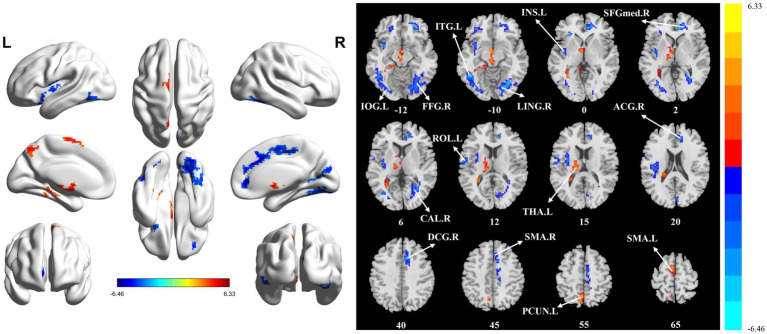
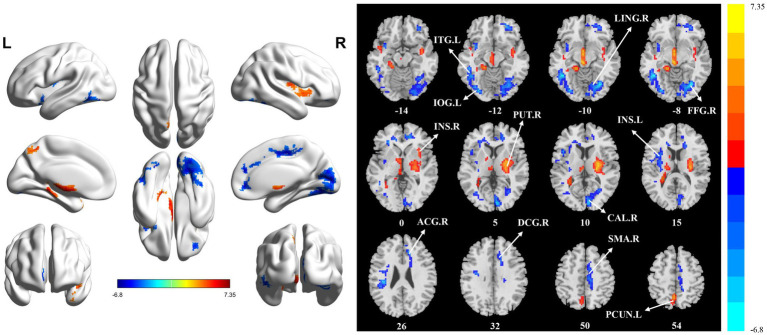
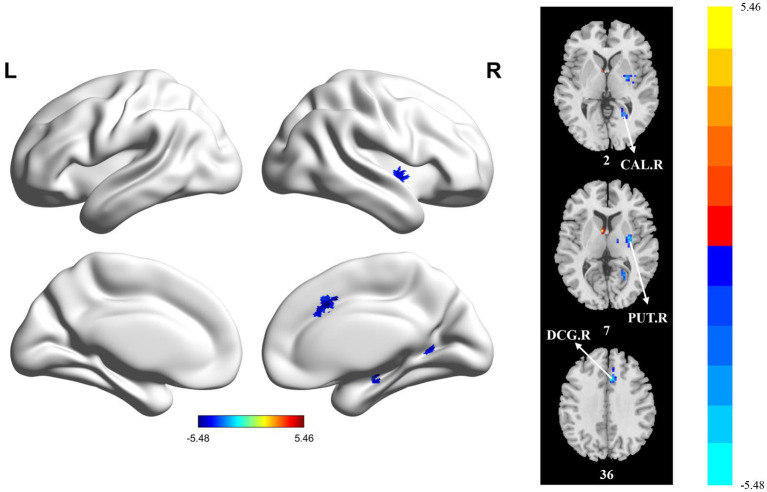
Compared to HCs, the brain regions with significant functional abnormalities in patients with post-stroke balance dysfunction were mainly involved bilateral insula, right fusiform gyrus, right lingual gyrus, left thalamus, left inferior occipital gyrus, left inferior temporal gyrus, right calcarine fissure and surrounding cortex, left precuneus, right median cingulate and paracingulate gyri, right anterior cingulate and paracingulate gyri, bilateral supplementary motor area, right putamen, and left cerebellar crus II. XGBoost results show that the model constructed based on static imaging features has the best classification prediction performance.
In conclusion, this study provided evidence of functional abnormalities in local brain regions in patients with post-stroke balance dysfunction. The results suggested that the abnormal brain regions were mainly related to visual processing, motor execution, motor coordination, sensorimotor control and cognitive function, which contributed to our understanding of the neuropathological mechanisms of post-stroke balance dysfunction. XGBoost is a promising machine learning method to explore these changes.
本研究旨在探讨中风后平衡功能障碍患者脑活动变化的特征及其与临床评估的关系,并基于极端梯度提升(XGBoost)算法构建分类模型,以区分中风患者和健康对照者(HCs)。
在本研究中,对26例中风后平衡功能障碍患者和24例HCs进行了静息态功能磁共振成像(rs-fMRI)检查。计算并比较了两组的低频振幅(sALFF)、分数低频振幅(sfALFF)、局部一致性(sReHo)、动态低频振幅(dALFF)、动态分数低频振幅(dfALFF)和动态局部一致性(dReHo)值。将两组间存在显著差异的脑区的成像指标值与伯格平衡量表(BBS)评分进行Pearson相关分析,并作为构建XGBoost模型的特征。
与HCs相比,中风后平衡功能障碍患者存在显著功能异常的脑区主要包括双侧岛叶、右侧梭状回、右侧舌回、左侧丘脑、左侧枕下回、左侧颞下回、右侧距状裂及其周围皮质、左侧楔前叶、右侧中央旁扣带回和前扣带回、右侧前扣带回和前扣带回、双侧辅助运动区、右侧壳核以及左侧小脑 Crus II。XGBoost结果显示,基于静态成像特征构建的模型具有最佳的分类预测性能。
总之,本研究为中风后平衡功能障碍患者局部脑区的功能异常提供了证据。结果表明,异常脑区主要与视觉处理、运动执行、运动协调、感觉运动控制和认知功能有关,这有助于我们理解中风后平衡功能障碍的神经病理机制。XGBoost是一种探索这些变化的有前景的机器学习方法。