Department of Orthopedic Surgery, Cleveland Clinic Foundation, Orthopedic and Rheumatology Institute, Cleveland, OH, 44195, USA.
Clinical Affairs, Zimmer Biomet, Warsaw, IN, 46580, USA.
Eur J Orthop Surg Traumatol. 2024 May;34(4):1979-1985. doi: 10.1007/s00590-024-03894-x. Epub 2024 Mar 15.
Obesity has been identified as a risk factor for postoperative complications in patients undergoing total hip arthroplasty (THA). This study aimed to investigate patient-reported outcomes, pain, and satisfaction as a function of body mass index (BMI) class in patients undergoing THA.
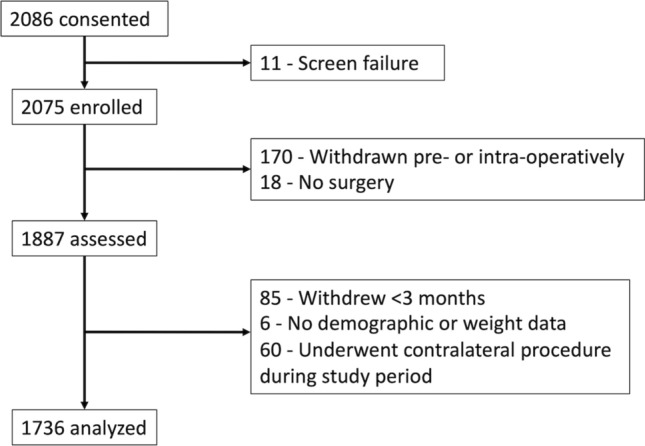
1736 patients within a prospective observational study were categorized into BMI classes. Pre- and postoperative Hip disability and Osteoarthritis Outcome Score for Joint Replacement (HOOS JR), satisfaction, and pain scores were compared by BMI class using one-way ANOVA.
Healthy weight patients reported the highest preoperative HOOS JR (56.66 ± 13.35) compared to 45.51 ± 14.45 in Class III subjects. Healthy weight and Class III patients reported the lowest (5.65 ± 2.01) and highest (7.06 ± 1.98, p < 0.0001) preoperative pain, respectively. Changes in HOOS JR scores from baseline suggest larger improvements with increasing BMI class, where Class III patients reported an increase of 33.7 ± 15.6 points at 90 days compared to 26.1 ± 17.1 in healthy weight individuals (p = 0.002). Fewer healthy weight patients achieved the minimal clinically important difference (87.4%) for HOOS JR compared to Class II (96.5%) and III (94.7%) obesity groups at 90 days postoperatively. Changes in satisfaction and pain scores were largest in the Class III patients. Overall, no functional outcomes varied by BMI class postoperatively.
Patients of higher BMI class reported greater improvements following THA. While risk/benefit shared decision-making remains a personalized requirement of THA, this study highlights that utilization of BMI cutoff may not be warranted based on pain and functional improvement.
肥胖已被确定为全髋关节置换术(THA)患者术后并发症的一个风险因素。本研究旨在调查 THA 患者的身体质量指数(BMI)类别与患者报告的结果、疼痛和满意度之间的关系。
在一项前瞻性观察研究中,将 1736 名患者分为 BMI 类别。使用单因素方差分析比较 BMI 类别与术前和术后髋关节残疾和骨关节炎结果评分-关节置换术(HOOS JR)、满意度和疼痛评分。
健康体重患者报告的术前 HOOS JR 最高(56.66±13.35),而 III 类患者为 45.51±14.45。健康体重和 III 类患者报告的术前疼痛最低(5.65±2.01)和最高(7.06±1.98,p<0.0001)。从基线到 HOOS JR 评分的变化表明,BMI 类别越高,改善越大,其中 III 类患者在 90 天时报告增加了 33.7±15.6 分,而健康体重患者增加了 26.1±17.1 分(p=0.002)。在术后 90 天时,健康体重患者达到 HOOS JR 最小临床重要差异(87.4%)的比例低于 II 类(96.5%)和 III 类(94.7%)肥胖组。满意度和疼痛评分的变化在 III 类患者中最大。总体而言,术后 BMI 类别对功能结果没有影响。
BMI 较高的患者在接受 THA 后报告有更大的改善。虽然风险/获益共同决策仍然是 THA 的个性化要求,但本研究强调,根据疼痛和功能改善,可能不需要基于 BMI 截止值进行决策。