Westat, Rockville, Maryland, USA.
Helix, San Mateo, California, USA.
Influenza Other Respir Viruses. 2024 Mar;18(3):e13269. doi: 10.1111/irv.13269.
Although psychiatric disorders have been associated with reduced immune responses to other vaccines, it remains unknown whether they influence COVID-19 vaccine effectiveness (VE). This study evaluated risk of COVID-19 hospitalization and estimated mRNA VE stratified by psychiatric disorder status.
In a retrospective cohort analysis of the VISION Network in four US states, the rate of laboratory-confirmed COVID-19-associated hospitalization between December 2021 and August 2022 was compared across psychiatric diagnoses and by monovalent mRNA COVID-19 vaccination status using Cox proportional hazards regression.
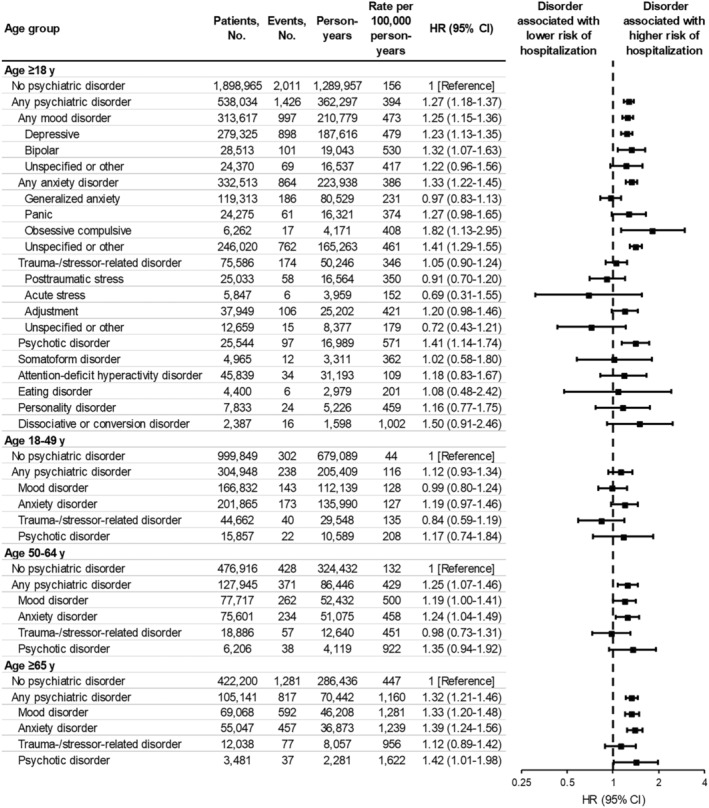
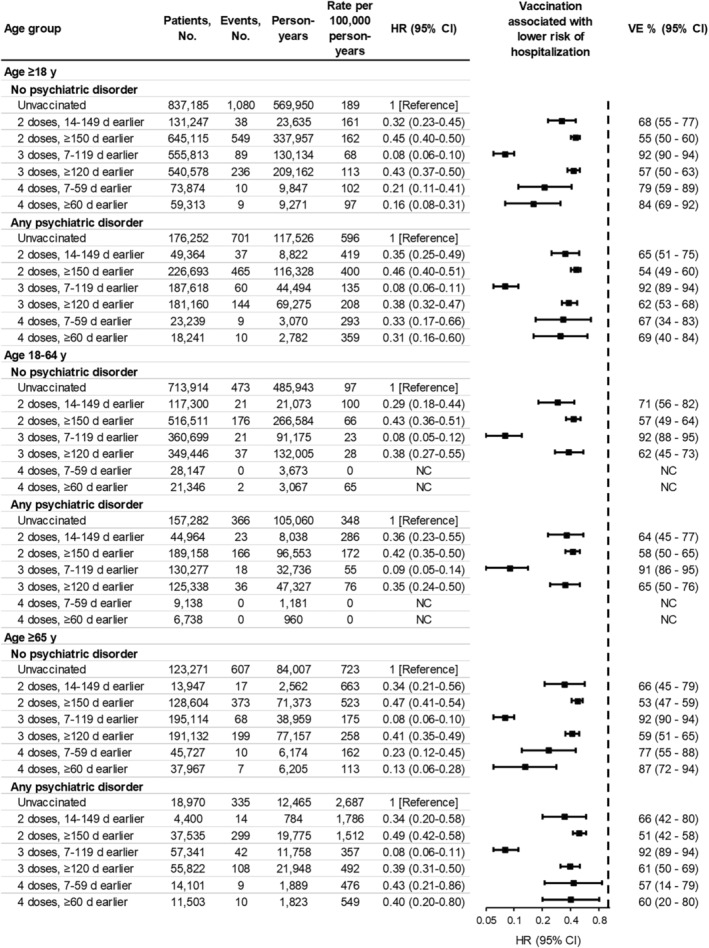
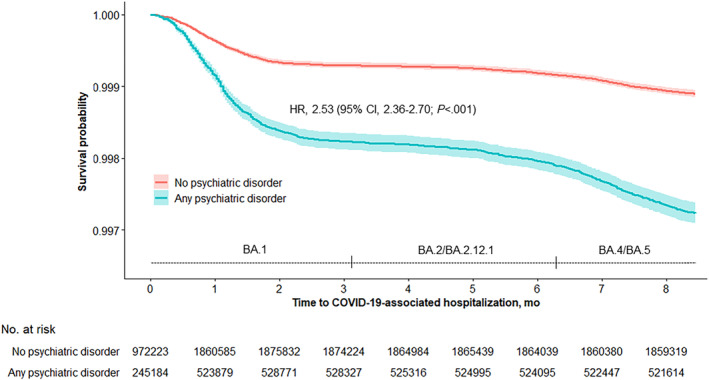
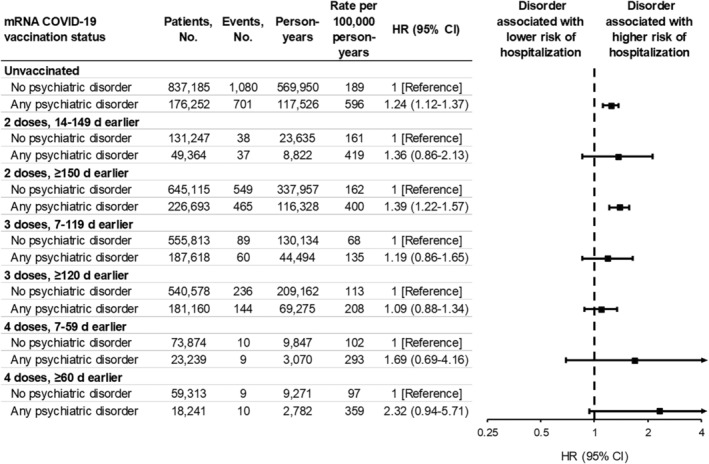
Among 2,436,999 adults, 22.1% had ≥1 psychiatric disorder. The incidence of COVID-19-associated hospitalization was higher among patients with any versus no psychiatric disorder (394 vs. 156 per 100,000 person-years, p < 0.001). Any psychiatric disorder (adjusted hazard ratio [aHR], 1.27; 95% CI, 1.18-1.37) and mood (aHR, 1.25; 95% CI, 1.15-1.36), anxiety (aHR, 1.33, 95% CI, 1.22-1.45), and psychotic (aHR, 1.41; 95% CI, 1.14-1.74) disorders were each significant independent predictors of hospitalization. Among patients with any psychiatric disorder, aHRs for the association between vaccination and hospitalization were 0.35 (95% CI, 0.25-0.49) after a recent second dose, 0.08 (95% CI, 0.06-0.11) after a recent third dose, and 0.33 (95% CI, 0.17-0.66) after a recent fourth dose, compared to unvaccinated patients. Corresponding VE estimates were 65%, 92%, and 67%, respectively, and were similar among patients with no psychiatric disorder (68%, 92%, and 79%).
Psychiatric disorders were associated with increased risk of COVID-19-associated hospitalization. However, mRNA vaccination provided similar protection regardless of psychiatric disorder status, highlighting its benefit for individuals with psychiatric disorders.
尽管精神疾病与其他疫苗的免疫反应减弱有关,但目前尚不清楚它们是否会影响 COVID-19 疫苗的有效性(VE)。本研究评估了 COVID-19 住院风险,并按精神障碍状况分层估计了 mRNA VE。
在四个美国州的 VISION 网络的回顾性队列分析中,使用 Cox 比例风险回归比较了 2021 年 12 月至 2022 年 8 月期间实验室确诊的 COVID-19 相关住院率,比较了不同精神疾病诊断和单价 mRNA COVID-19 疫苗接种状态。
在 2436999 名成年人中,22.1%有≥1 种精神障碍。与无精神障碍者相比,任何精神障碍者(每 100000 人年 394 例与 156 例,p<0.001)COVID-19 相关住院率更高。任何精神障碍(调整后的危险比[aHR],1.27;95%CI,1.18-1.37)和情绪(aHR,1.25;95%CI,1.15-1.36)、焦虑(aHR,1.33,95%CI,1.22-1.45)和精神病(aHR,1.41;95%CI,1.14-1.74)障碍都是住院的独立显著预测因素。在有任何精神障碍的患者中,与未接种疫苗者相比,最近接种第二剂后疫苗接种与住院的关联的 aHR 为 0.35(95%CI,0.25-0.49),最近接种第三剂后为 0.08(95%CI,0.06-0.11),最近接种第四剂后为 0.33(95%CI,0.17-0.66)。相应的 VE 估计值分别为 65%、92%和 67%,在无精神障碍的患者中相似(68%、92%和 79%)。
精神障碍与 COVID-19 相关住院风险增加相关。然而,mRNA 疫苗接种提供了相似的保护,无论精神障碍状况如何,这突出了其对精神障碍患者的益处。