Cugnetto Marilyn L, Morris Eric M J, Bonfield Siobain F, Gates Jesse, Morrison Ilona, Newman Ellie R, Nicholls Julia D, Soares Lisa M, Antonucci Megan T, Clemente Jacinta R, Garratt Claire L M, Goldstone Eliot, Pavone David A, Farhall John
Mental Health Division, Northern Health, Epping, Victoria, Australia.
Department of Psychology, Counselling & Therapy, School of Psychology & Public Health, La Trobe University, Bundoora, Victoria, Australia.
JMIR Res Protoc. 2024 Mar 18;13:e49849. doi: 10.2196/49849.
Psychological interventions, along with antipsychotic medications, are recommended for adults diagnosed with a psychotic disorder. While initially designed to mitigate positive symptoms, psychological interventions targeting personal recovery were developed and aligned with the recovery framework that many mental health services have adopted. Acceptance and Commitment Therapy (ACT) for psychosis is one such intervention that shows promise when delivered in an individual format. There is preliminary evidence that ACT for psychosis in a group format improves recovery.
This trial aims to evaluate the effectiveness of the "Recovery ACT" group program on personal recovery among adults living with a psychotic disorder.
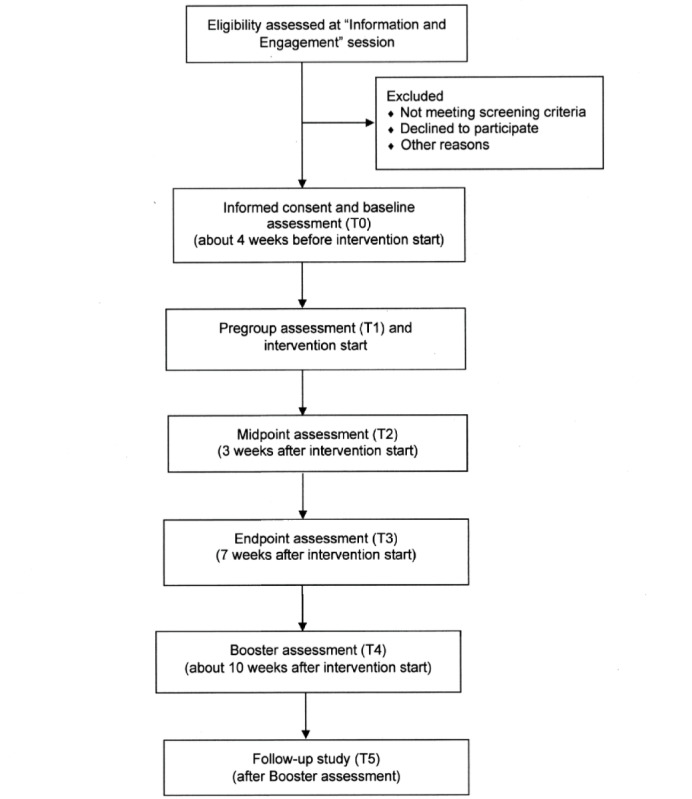
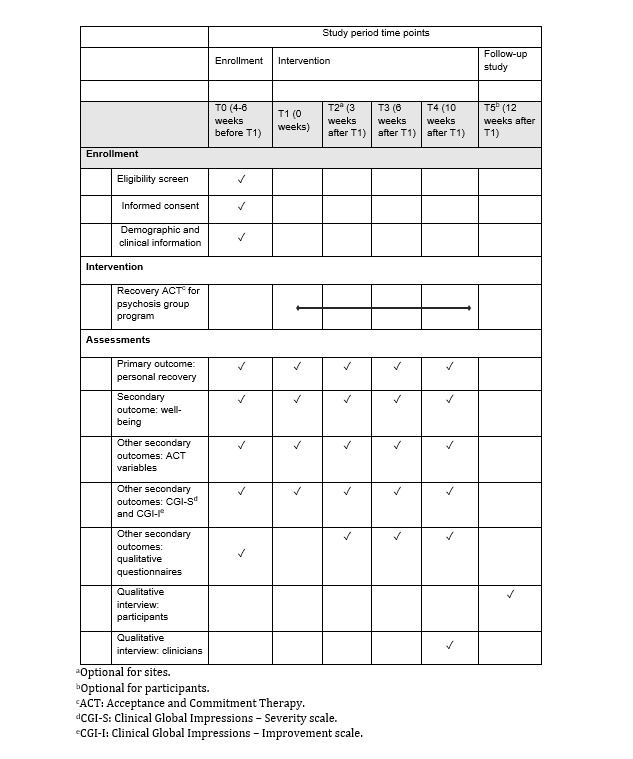
Our unfunded study is a multiagency, prospective, nonrandomized, waitlist control, single-group trial of the Recovery ACT group program. The program involves 7 weekly group sessions of 90 minutes duration and a 90-minute booster session held 1 month later. We intend to recruit 160 adults living with a psychotic disorder who enroll in a group that is offered as a routine clinical service at participating public mental health services in Melbourne, Victoria, Australia. The 4 assessment time points are 4-6 weeks before the start of the group program, at the start of the group program, at the end of the group program, and at the booster session. There is an optional midgroup assessment and follow-up study. The primary outcome is personal recovery. Secondary outcomes include participants' well-being and psychological flexibility processes. Qualitative data are also collected from participants and facilitators.
Recruitment began in September 2019 and is ongoing until 2024, subsequent to a 24-month disruption due to the COVID-19 pandemic. As of the submission of this paper, 93 participants consented to the evaluation, 65 completed T1 measures, and 40 had a complete data set for the proposed analyses.
This is the first trial evaluating the effectiveness of the Recovery ACT group program on personal recovery for adults living with a psychotic disorder. Findings will contribute to knowledge about psychosocial interventions for adults living with psychosis. This trial may also serve as an example of a partnership between clinicians and academics that can facilitate the translation of research into practice.
Australian New Zealand Clinical Trials Registry ACTRN12620000223932; https://anzctr.org.au/Trial/Registration/TrialReview.aspx?ACTRN=12620000223932.
INTERNATIONAL REGISTERED REPORT IDENTIFIER (IRRID): DERR1-10.2196/49849.
对于被诊断患有精神障碍的成年人,推荐采用心理干预措施与抗精神病药物相结合的治疗方法。虽然心理干预最初旨在减轻阳性症状,但针对个人康复的心理干预措施已经得到发展,并与许多心理健康服务机构所采用的康复框架相一致。针对精神病的接纳与承诺疗法(ACT)就是这样一种干预措施,以个体形式实施时显示出了前景。有初步证据表明,团体形式的针对精神病的ACT能促进康复。
本试验旨在评估“康复ACT”团体项目对患有精神障碍的成年人个人康复的有效性。
我们这项无资金资助的研究是一项多机构、前瞻性、非随机、等待名单对照的“康复ACT”团体项目单组试验。该项目包括为期7周、每周一次、每次90分钟的团体课程,以及1个月后举行的一次90分钟的强化课程。我们打算招募160名患有精神障碍的成年人,他们将参加在澳大利亚维多利亚州墨尔本的参与公共心理健康服务机构作为常规临床服务提供的团体。4个评估时间点分别为团体项目开始前4 - 6周、团体项目开始时、团体项目结束时以及强化课程时。有一个可选的团体中期评估和随访研究。主要结局是个人康复。次要结局包括参与者的幸福感和心理灵活性过程。还从参与者和 facilitators 收集定性数据。
招募工作于2019年9月开始,在因2019冠状病毒病大流行中断24个月后,一直持续到2024年。截至本文提交时,93名参与者同意参与评估,65人完成了T1测量,40人有用于拟议分析的完整数据集。
这是第一项评估“康复ACT”团体项目对患有精神障碍的成年人个人康复有效性的试验。研究结果将有助于增进对患有精神病的成年人心理社会干预措施的了解。这项试验也可作为临床医生与学者之间合作的一个范例,这种合作有助于将研究转化为实践。
澳大利亚新西兰临床试验注册中心ACTRN12620000223932;https://anzctr.org.au/Trial/Registration/TrialReview.aspx?ACTRN=12620000223932。
国际注册报告识别码(IRRID):DERR1-10.2196/49849。