Shandong University of Traditional Chinese Medicine, Jinan, Shandong Province, China.
BMC Neurol. 2024 Mar 18;24(1):98. doi: 10.1186/s12883-024-03599-y.
Complex interactions between the immune system and the brain may affect neural development, survival, and function, with etiological and therapeutic implications for neurodegenerative diseases. However, previous studies investigating the association between immune inflammation and Alzheimer's disease (AD) have yielded inconsistent results.
We applied Mendelian randomization (MR) to examine the causal relationship between immune cell traits and AD risk using genetic variants as instrumental variables. MR is an epidemiological study design based on genetic information that reduces the effects of confounding and reverse causation. We analyzed the causal associations between 731 immune cell traits and AD risk based on publicly available genetic data.
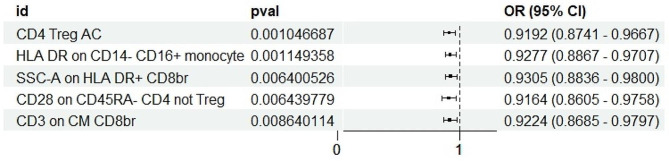
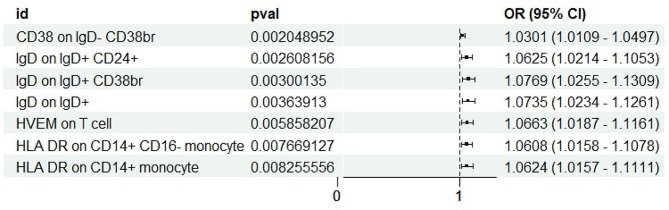
We observed that 5 immune cell traits conferred protection against AD, while 7 immune cell traits increased the risk of AD. These immune cell traits mainly involved T cell regulation, monocyte activation and B cell differentiation. Our findings suggest that immune regulation may influence the development of AD and provide new insights into potential targets for AD prevention and treatment. We also conducted various sensitivity analyses to test the validity and robustness of our results, which revealed no evidence of pleiotropy or heterogeneity.
Our research shows that immune regulation is important for AD and provides new information on potential targets for AD prevention and treatment. However, this study has limitations, including the possibility of reverse causality, lack of validation in independent cohorts, and potential confounding by population stratification. Further research is needed to validate and amplify these results and to elucidate the potential mechanisms of the immune cell-AD association.
免疫系统和大脑之间的复杂相互作用可能会影响神经的发育、存活和功能,这对神经退行性疾病的病因和治疗都有影响。然而,之前研究免疫炎症与阿尔茨海默病(AD)之间关系的研究结果并不一致。
我们应用孟德尔随机化(MR)方法,利用遗传变异作为工具变量,研究免疫细胞特征与 AD 风险之间的因果关系。MR 是一种基于遗传信息的流行病学研究设计,可以减少混杂和反向因果关系的影响。我们根据公开的遗传数据,分析了 731 种免疫细胞特征与 AD 风险之间的因果关系。
我们发现 5 种免疫细胞特征可以预防 AD,而 7 种免疫细胞特征会增加 AD 的风险。这些免疫细胞特征主要涉及 T 细胞调节、单核细胞激活和 B 细胞分化。我们的研究结果表明,免疫调节可能会影响 AD 的发展,并为 AD 的预防和治疗提供新的潜在靶点。我们还进行了各种敏感性分析来测试我们结果的有效性和稳健性,结果没有发现多效性或异质性的证据。
我们的研究表明,免疫调节对 AD 很重要,并为 AD 的预防和治疗提供了新的信息。然而,这项研究存在一些局限性,包括可能存在反向因果关系、在独立队列中缺乏验证以及可能存在群体分层的混杂。需要进一步的研究来验证和扩大这些结果,并阐明免疫细胞与 AD 之间关联的潜在机制。