Li Wenyi, Jiang Jiwei, Zou Xinying, Zhang Yuan, Sun Mengfan, Jia Ziyan, Li Wei, Xu Jun
Department of Neurology, Beijing Tiantan Hospital, Capital Medical University, Beijing, China.
China National Clinical Research Center for Neurological Diseases, Beijing, China.
Front Neurosci. 2022 Aug 2;16:961164. doi: 10.3389/fnins.2022.961164. eCollection 2022.
We aimed to characterize the potential risk factors and cerebral perfusion of patients with subjective cognitive decline (SCD).
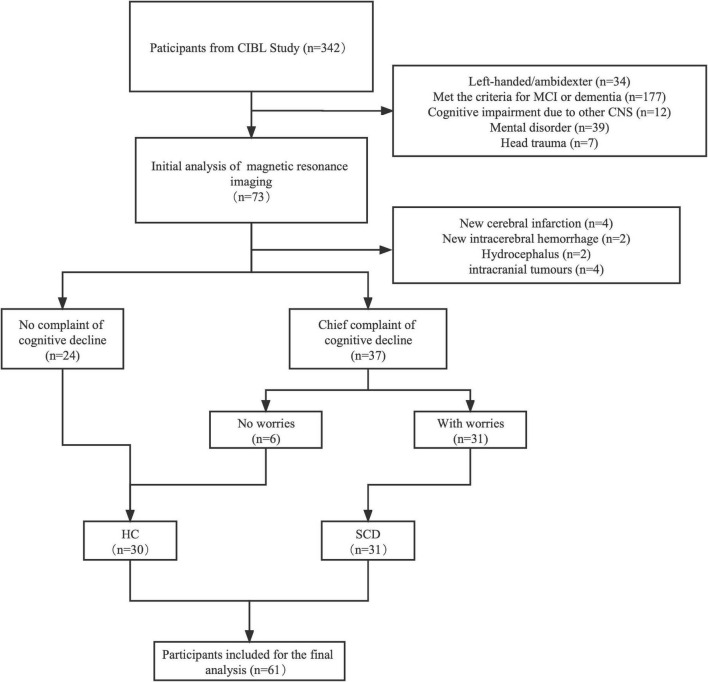
This prospective study enrolled consecutive patients from the Chinese Imaging, Biomarkers, and Lifestyle (CIBL) Cohort of Alzheimer's disease between February 2021 and March 2022. Patients who met the SCD diagnostic criteria were categorized into the SCD group, while those without cognitive complaints or any concerns were assigned to the healthy control (HC) group. The demographic and clinical characteristics and cerebral blood flow (CBF) from pseudo-continuous arterial spin labeling (pCASL) in standard cognitive regions were compared between these two groups. A multivariate analysis was performed to identify independent factors associated with SCD.
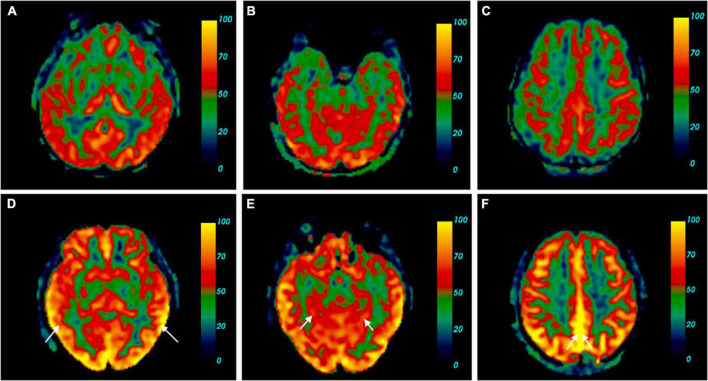
The frequency of family history of dementia in the SCD group was higher compared with the HC group ( = 0.016). The CBF of left hippocampus ( = 0.023), left parahippocampal gyrus ( = 0.004), left precuneus ( = 0.029), left middle temporal gyrus ( = 0.022), right parahippocampal gyrus ( = 0.018), and right precuneus ( = 0.024) in the SCD group were significantly increased than those in the HC group. The multivariate logistic regression analyses demonstrated that the family history of dementia [ = 4.284 (1.096-16.747), = 0.036] and the CBF of left parahippocampal gyrus [ = 1.361 (1.006-1.840), = 0.045] were independently associated with SCD.
This study demonstrated that the family history of dementia and the higher CBF within the left parahippocampal gyrus were independent risk factors associated with patients with SCD, which could help in the early identification of the SCD and in intervening during this optimal period.
我们旨在确定主观认知衰退(SCD)患者的潜在风险因素及脑灌注情况。
这项前瞻性研究纳入了2021年2月至2022年3月期间来自中国阿尔茨海默病影像、生物标志物和生活方式(CIBL)队列的连续患者。符合SCD诊断标准的患者被归入SCD组,而无认知主诉或任何担忧的患者被分配到健康对照组(HC组)。比较了两组的人口统计学和临床特征以及标准认知区域的伪连续动脉自旋标记(pCASL)脑血流量(CBF)。进行多变量分析以确定与SCD相关的独立因素。
SCD组痴呆家族史的频率高于HC组(P = 0.016)。SCD组左侧海马(P = 0.023)、左侧海马旁回(P = 0.004)、左侧楔前叶(P = 0.029)、左侧颞中回(P = 0.022)、右侧海马旁回(P = 0.018)和右侧楔前叶(P = 0.024)的CBF显著高于HC组。多变量逻辑回归分析表明,痴呆家族史[比值比 = 4.284(1.096 - 16.747),P = 0.036]和左侧海马旁回的CBF[比值比 = 1.361(1.006 - 1.840),P = 0.045]与SCD独立相关。
本研究表明,痴呆家族史和左侧海马旁回较高的CBF是与SCD患者相关的独立风险因素,这有助于早期识别SCD并在此最佳时期进行干预。