
高分辨率荧光成像肺泡支架作为评估肺损伤的新工具。
High resolution fluorescence imaging of the alveolar scaffold as a novel tool to assess lung injury.
机构信息
Wallenberg Centre for Molecular Medicine, Lund University, Lund, Sweden.
Department of Clinical Sciences, Lund University, Lund, Sweden.
出版信息
Sci Rep. 2024 Mar 20;14(1):6662. doi: 10.1038/s41598-024-57313-6.
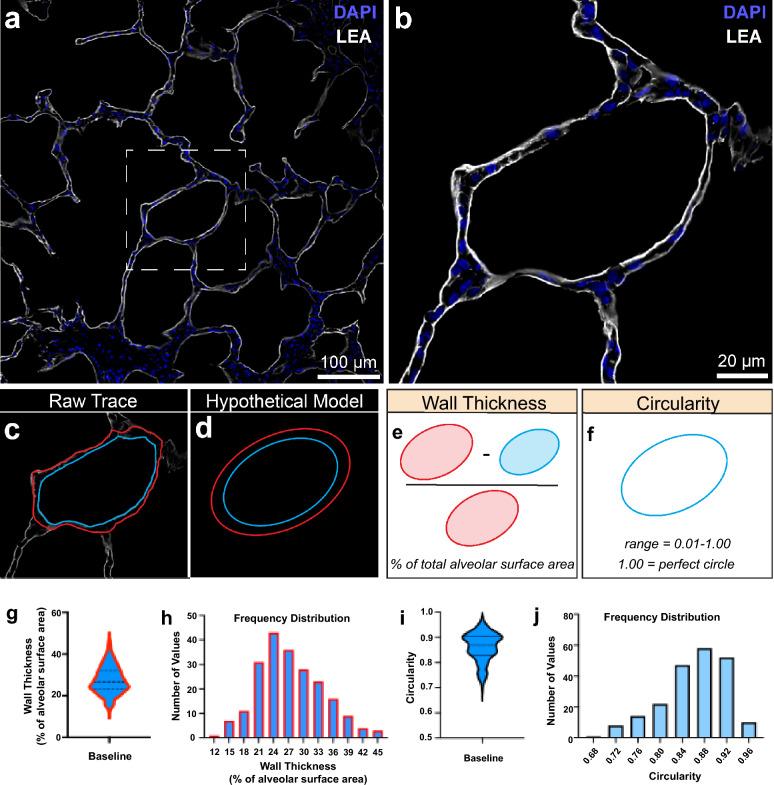
Acute lung injury (ALI) represents an aetiologically diverse form of pulmonary damage. Part of the assessment and diagnosis of ALI depends on skilled observer-based scoring of brightfield microscopy tissue sections. Although this readout is sufficient to determine gross alterations in tissue structure, its categorical scores lack the sensitivity to describe more subtle changes in lung morphology. To generate a more sensitive readout of alveolar perturbation we carried out high resolution immunofluorescence imaging on 200 μm lung vibratome sections from baseline and acutely injured porcine lung tissue, stained with a tomato lectin, Lycopersicon Esculentum Dylight-488. With the ability to resolve individual alveoli along with their inner and outer wall we generated continuous readouts of alveolar wall thickness and circularity. From 212 alveoli traced from 10 baseline lung samples we established normal distributions for alveolar wall thickness (27.37; 95% CI [26.48:28.26]) and circularity (0.8609; 95% CI [0.8482:0.8667]) in healthy tissue. Compared to acutely injured lung tissue baseline tissue exhibited a significantly lower wall thickness (26.86 ± 0.4998 vs 50.55 ± 4.468; p = 0.0003) and higher degree of circularityϕ≤ (0.8783 ± 0.01965 vs 0.4133 ± 0.04366; p < 0.0001). These two components were subsequently combined into a single more sensitive variable, termed the morphological quotient (MQ), which exhibited a significant negative correlation (R = 0.9919, p < 0.0001) with the gold standard of observer-based scoring. Through the utilisation of advanced light imaging we show it is possible to generate sensitive continuous datasets describing fundamental morphological changes that arise in acute lung injury. These data represent valuable new analytical tools that can be used to precisely benchmark changes in alveolar morphology both in disease/injury as well as in response to treatment/therapy.
急性肺损伤 (ALI) 代表了一种病因多样的肺部损伤形式。ALI 的评估和诊断部分取决于基于熟练观察者的亮场显微镜组织切片评分。尽管这种读数足以确定组织结构的大体改变,但它的分类评分缺乏描述肺形态更细微变化的敏感性。为了生成更敏感的肺泡扰动读数,我们对来自基线和急性损伤猪肺组织的 200μm 肺振动切片进行了高分辨率免疫荧光成像,并用番茄凝集素 Lycopersicon Esculentum Dylight-488 染色。由于能够分辨单个肺泡及其内外壁,我们生成了肺泡壁厚度和圆形度的连续读数。从 10 个基线肺样本中追踪到的 212 个肺泡,我们建立了健康组织中肺泡壁厚度(27.37;95%置信区间 [26.48:28.26])和圆形度(0.8609;95%置信区间 [0.8482:0.8667])的正态分布。与急性损伤肺组织相比,基线组织的壁厚度明显较低(26.86±0.4998 与 50.55±4.468;p=0.0003),圆形度较高(0.8783±0.01965 与 0.4133±0.04366;p<0.0001)。这两个分量随后被组合成一个更敏感的单一变量,称为形态商 (MQ),它与基于观察者评分的金标准呈显著负相关(R=0.9919,p<0.0001)。通过利用先进的光学成像,我们证明可以生成敏感的连续数据集,描述急性肺损伤中出现的基本形态变化。这些数据代表了有价值的新分析工具,可以用于精确基准化肺泡形态在疾病/损伤以及对治疗/疗法的反应中的变化。




 Zotero 插件