Barajas-Aguilar Aaron H, Zion Jasen, Sequeira Ian, Barabas Andrew Z, Taniguchi Takashi, Watanabe Kenji, Barrett Eric B, Scaffidi Thomas, Sanchez-Yamagishi Javier D
Department of Physics and Astronomy, University of California, Irvine, Irvine, CA, USA.
T. J. Watson Laboratory of Applied Physics, California Institute of Technology, Pasadena, CA, USA.
Nat Commun. 2024 Mar 21;15(1):2550. doi: 10.1038/s41467-024-46819-2.
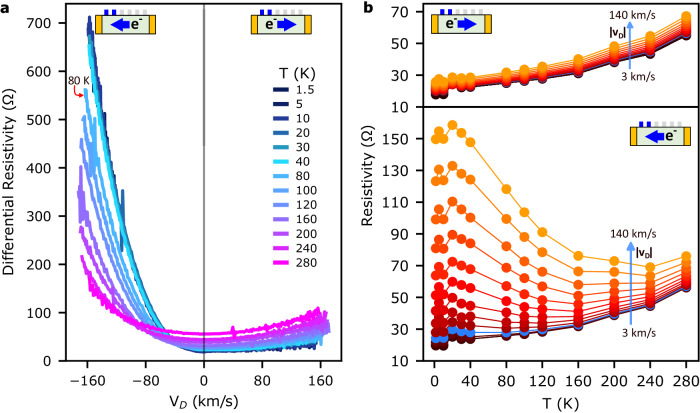
In graphene devices, the electronic drift velocity can easily exceed the speed of sound in the material at moderate current biases. Under these conditions, the electronic system can efficiently amplify acoustic phonons, leading to an exponential growth of sound waves in the direction of the carrier flow. Here, we show that such phonon amplification can significantly modify the electrical properties of graphene devices. We observe a superlinear growth of the resistivity in the direction of the carrier flow when the drift velocity exceeds the speed of sound - resulting in a sevenfold increase over a distance of 8 µm. The resistivity growth is observed at carrier densities away from the Dirac point and is enhanced at cryogenic temperatures. We develop a theoretical model for the resistivity growth due to the electrical amplification of acoustic phonons - reaching frequencies up to 2.2 THz - where the wavelength is controlled by gate-tunable transitions across the Fermi surface. These findings provide a route to on-chip high-frequency sound generation and detection in the THz frequency range.
在石墨烯器件中,在中等电流偏置下,电子漂移速度很容易超过材料中的声速。在这些条件下,电子系统可以有效地放大声学声子,导致声波在载流子流动方向上呈指数增长。在此,我们表明这种声子放大可以显著改变石墨烯器件的电学性质。当漂移速度超过声速时,我们观察到在载流子流动方向上电阻率呈超线性增长——在8微米的距离内增加了七倍。在远离狄拉克点的载流子密度下观察到电阻率增长,并且在低温下增强。我们开发了一个由于声学声子的电放大导致电阻率增长的理论模型——达到高达2.2太赫兹的频率——其中波长由费米面两侧的栅极可调跃迁控制。这些发现为太赫兹频率范围内的片上高频声音产生和检测提供了一条途径。