
早期运动发育与儿童和青少年运动行为关联中的遗传混杂。
Genetic confounding in the association of early motor development with childhood and adolescent exercise behavior.
机构信息
School of Exercise and Health, Shanghai University of Sport, Shanghai, China.
Department of Biological Psychology, Vrije Universiteit Amsterdam, van der Boechorststraat 7, H541, Medical Faculty Building, Amsterdam, 1081 BT, Netherlands.
出版信息
Int J Behav Nutr Phys Act. 2024 Mar 21;21(1):33. doi: 10.1186/s12966-024-01583-w.
INTRODUCTION
Early motor development has been found to be a predictor of exercise behavior in children and adolescents, but whether this reflects a causal effect or confounding by genetic or shared environmental factors remains to be established.
METHODS
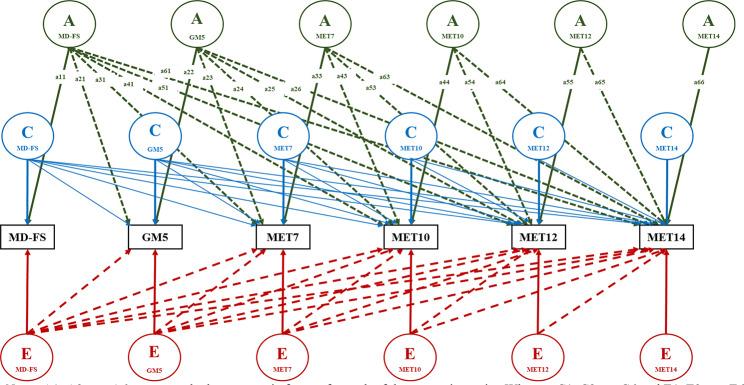
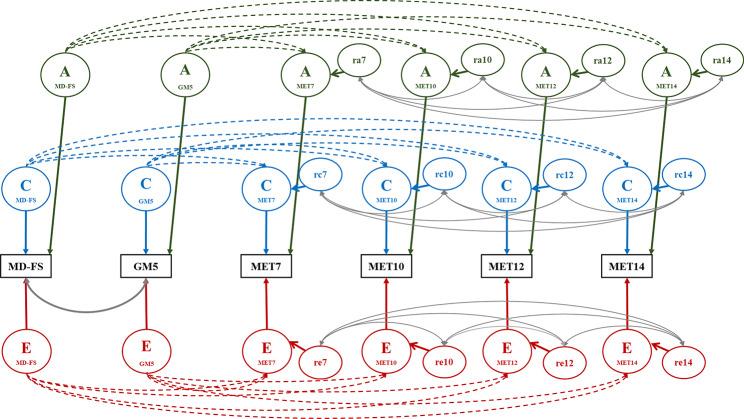
For 20,911 complete twin pairs from the Netherlands Twin Register a motor development score was obtained from maternal reports on the timing of five motor milestones. During a 12-year follow-up, subsamples of the mothers reported on the twins' ability to perform seven gross motor skills ability (N = 17,189 pairs), and weekly minutes of total metabolic equivalents of task (MET) spent on sports and exercise activities at age 7 (N = 3632 pairs), age 10 (N = 3735 pairs), age 12 (N = 7043 pairs), and age 14 (N = 3990 pairs). Multivariate phenotypic and genetic regression analyses were used to establish the predictive strength of the two motor development traits for future exercise behavior, the contribution of genetic and shared environmental factors to the variance in all traits, and the contribution of familial confounding to the phenotypic prediction.
RESULTS
Significant heritability (h) and shared environmental (c) effects were found for early motor development in boys and girls (h = 43-65%; c = 16-48%). For exercise behavior, genetic influences increased with age (boys: h = 22% to h = 51%; girls: h = 3% to h = 18%) paired to a parallel decrease in the influence of the shared environment (boys: c = 68% to c = 19%; girls: c = 80% to c = 48%). Early motor development explained 4.3% (p < 0.001) of the variance in future exercise behavior in boys but only 1.9% (p < 0.001) in girls. If the effect in boys was due to a causal effect of motor development on exercise behavior, all of the factors influencing motor development would, through the causal chain, also influence future exercise behavior. Instead, only the genetic parts of the regression of exercise behavior on motor development were significant. Shared and unique environmental parts of the regression were largely non-significant, which is at odds with the causal hypothesis.
CONCLUSION
No support was found for a direct causal effect in the association between rapid early motor development on future exercise behavior. In boys, early motor development appears to be an expression of the same genetic factors that underlie the heritability of childhood and early adolescent exercise behavior.
简介
早期运动发育已被发现可预测儿童和青少年的运动行为,但这是否反映了因果效应,或者是否受到遗传或共同环境因素的影响仍有待确定。
方法
从荷兰双胞胎登记处的 20911 对完整双胞胎中,母亲报告了 5 项运动里程碑的时间,以获得运动发育评分。在 12 年的随访期间,母亲的子样本报告了双胞胎在 7 岁(N=17189 对)、10 岁(N=3735 对)、12 岁(N=7043 对)和 14 岁(N=3990 对)时进行 7 项粗大运动技能的能力,每周进行总代谢当量(MET)的分钟数运动和锻炼活动。使用多元表型和遗传回归分析来确定两个运动发育特征对未来运动行为的预测强度、遗传和共同环境因素对所有特征的方差的贡献,以及家族性混杂对表型预测的贡献。
结果
男孩和女孩的早期运动发育均显示出显著的遗传(h)和共同环境(c)效应(h=43-65%;c=16-48%)。对于运动行为,遗传影响随着年龄的增加而增加(男孩:h=22%至 h=51%;女孩:h=3%至 h=18%),共同环境的影响呈平行下降(男孩:c=68%至 c=19%;女孩:c=80%至 c=48%)。早期运动发育解释了男孩未来运动行为变异的 4.3%(p<0.001),而在女孩中仅解释了 1.9%(p<0.001)。如果男孩中的这种影响归因于运动发育对运动行为的因果效应,那么影响运动发育的所有因素都将通过因果链影响未来的运动行为。相反,只有运动行为对运动发育的回归的遗传部分具有统计学意义。回归的共享和独特环境部分大部分没有统计学意义,这与因果假设不符。
结论
没有证据支持快速早期运动发育与未来运动行为之间存在直接因果关系。在男孩中,早期运动发育似乎是构成儿童和青少年早期运动行为遗传的相同遗传因素的表现。


 Zotero 插件