Research Centre for Sports Coaching, Carnegie School of Sport, Leeds Beckett University, Headingley Campus, Churchwood Avenue, Leeds, LS26 3QT, UK.
Queen Ethelburga's Collegiate, York, UK.
Sports Med. 2023 Nov;53(11):2191-2256. doi: 10.1007/s40279-023-01886-1. Epub 2023 Aug 5.
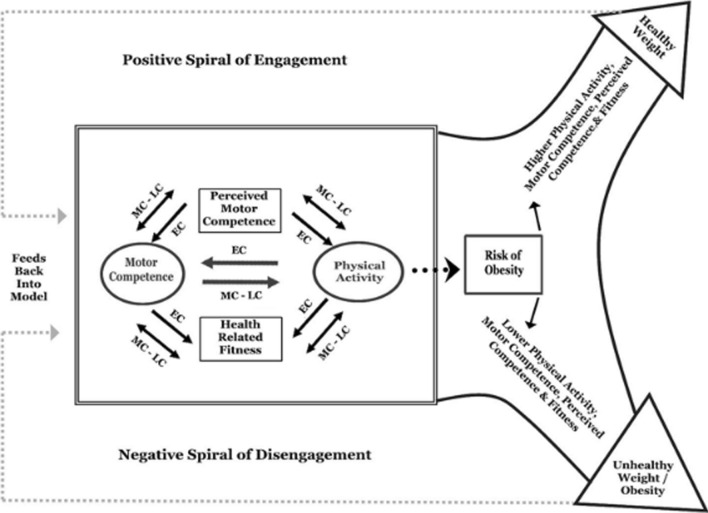
Motor competence is an integral component of the health and performance of youth. Numerous studies support the hypothesis that motor competence interacts with perceived motor competence and physical fitness during childhood to induce positive (e.g. healthy weight status) or negative (e.g. reduced physical activity engagement) trajectories. Yet, while adolescence is a key period of rapid growth and maturation, no systematic reviews and meta-analyses have examined the association between motor competence and physical activity, physical fitness and psychosocial characteristics solely within adolescents.
This study aimed to (1) analyse the scientific literature evaluating associations between motor competence and physical activity, physical fitness and/or psychosocial characteristics amongst adolescents; (2) evaluate the associations between motor competence and physical activity, physical fitness characteristics and/or psychosocial characteristics amongst adolescents; and (3) investigate the impact of moderator variables (i.e., age, sex, type of motor competence assessment) on the associations.
A systematic search of electronic databases was conducted, followed by a qualitative synthesis of study methods. Random-effects meta-analyses were performed to establish the magnitude and orientation of pooled correlation coefficients between motor competence and physical activity, physical fitness and psychosocial characteristics of adolescents, whilst considering potential moderators (i.e., age, sex, type of motor competence assessment).
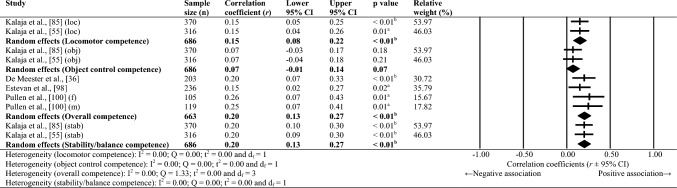
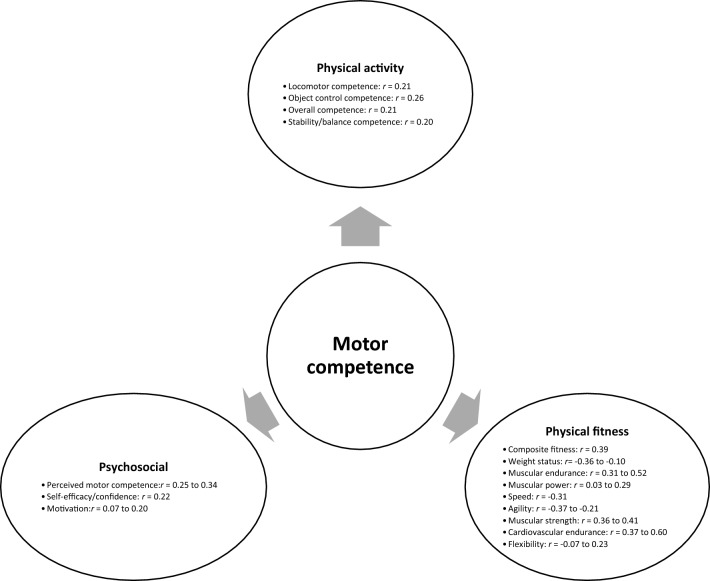
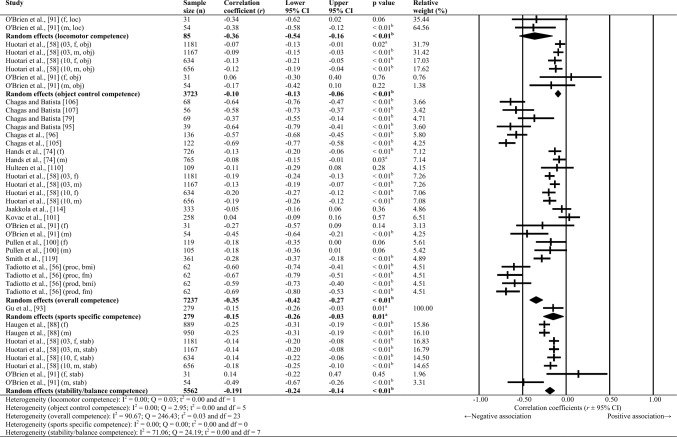
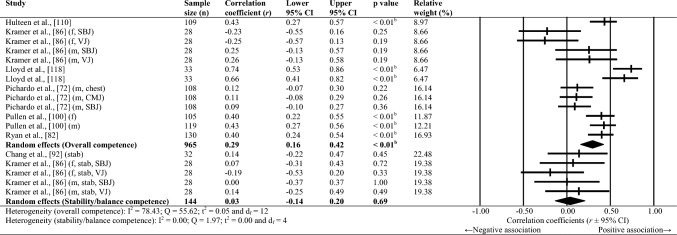
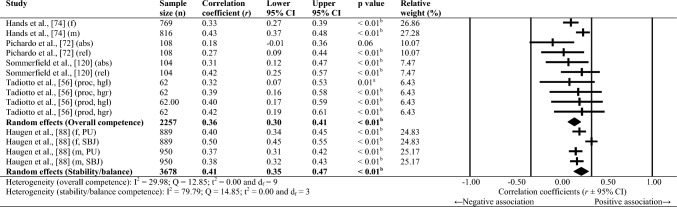
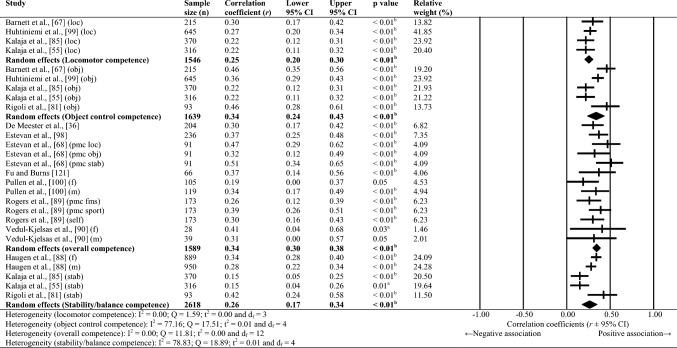
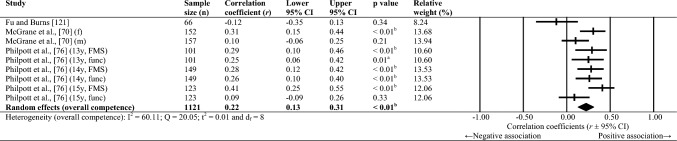
Sixty-one studies were included, totalling 22,256 adolescents. Twenty-seven different assessments of motor competence were used, with 31 studies utilising product-orientated (i.e. outcome) motor competence assessments. Meta-analyses of 43 studies showed that motor competence was positively associated with physical activity (r = 0.20 to 0.26), some physical fitness characteristics (e.g. muscular strength, cardiovascular endurance; r = 0.03 to 0.60) and psychosocial characteristics (r = 0.07 to 0.34), and inversely associated with weight status (r = - 0.36 to - 0.10), speed (r = - 0.31) and agility (r = - 0.37 to 0.41). Associations with flexibility were unclear.
The results of this systematic review and meta-analysis support the hypothesised interactions of motor competence with physical activity (positive), physical fitness (positive except for weight status, speed and agility) and psychosocial characteristics (positive) in adolescence. However, methodological approaches vary considerably (e.g. variety of motor competence assessments utilised), with limitations of the current literature including an inadequate assessment of motor competence, a lack of longitudinal observations and a failure to account for biological maturation. Future research assessing associations between motor competence and physical activity, physical fitness and psychosocial characteristics of adolescents should include longitudinal observations of a combined motor competence assessment (i.e. process and product) and account for biological maturation. Improved evaluation using these recommendations could provide more accurate data, leading to more targeted interventions to improve adolescents' physical and psychosocial outcomes.
CRD42021233441 (PROSPERO ID).
运动能力是青少年健康和表现的一个组成部分。许多研究支持这样一种假设,即运动能力与感知运动能力和儿童时期的身体素质相互作用,从而导致积极的(例如健康体重状况)或消极的(例如减少体育活动参与)轨迹。然而,尽管青春期是快速生长和成熟的关键时期,但没有系统的综述和荟萃分析仅在青少年中检查运动能力与身体活动、身体素质和心理社会特征之间的关系。
本研究旨在:(1)分析评估青少年运动能力与身体活动、身体素质和/或心理社会特征之间关系的科学文献;(2)评估青少年运动能力与身体活动、身体素质特征和/或心理社会特征之间的关系;(3)研究调节变量(即年龄、性别、运动能力评估类型)对这些关系的影响。
对电子数据库进行了系统检索,随后对研究方法进行了定性综合。对青少年运动能力与身体活动、身体素质和心理社会特征之间的相关性进行了随机效应荟萃分析,同时考虑了潜在的调节变量(即年龄、性别、运动能力评估类型)。
共纳入 61 项研究,总计 22256 名青少年。使用了 27 种不同的运动能力评估方法,其中 31 项研究使用了以产品为导向(即结果)的运动能力评估方法。对 43 项研究的荟萃分析表明,运动能力与身体活动(r=0.20 至 0.26)、一些身体素质特征(如肌肉力量、心血管耐力;r=0.03 至 0.60)和心理社会特征(r=0.07 至 0.34)呈正相关,与体重状况(r=-0.36 至-0.10)、速度(r=-0.31)和敏捷性(r=-0.37 至 0.41)呈负相关。与柔韧性的关系尚不清楚。
本系统评价和荟萃分析的结果支持运动能力与身体活动(正相关)、身体素质(正相关,除体重状况、速度和敏捷性外)和心理社会特征(正相关)在青春期相互作用的假设。然而,方法学方法差异很大(例如,使用的运动能力评估方法种类繁多),当前文献的局限性包括对运动能力的评估不足、缺乏纵向观察以及未能考虑到生物成熟度。未来评估青少年运动能力与身体活动、身体素质和心理社会特征之间关系的研究应包括对综合运动能力评估(即过程和产品)的纵向观察,并考虑到生物成熟度。使用这些建议进行改进评估可以提供更准确的数据,从而更有针对性地干预以改善青少年的身体和心理社会结果。
CRD42021233441(PROSPERO 注册号)。