Langmann Fie, Ibsen Daniel B, Tjønneland Anne, Olsen Anja, Overvad Kim, Dahm Christina C
Department of Public Health, Aarhus University, Bartholins Allé 2, 8000 Aarhus, Denmark.
Steno Diabetes Center Aarhus, Aarhus University Hospital, Palle-Juul Jensens Blvd. 11, Entrance A, 8200 Aarhus, Denmark.
Dialogues Health. 2023 Aug 19;3:100151. doi: 10.1016/j.dialog.2023.100151. eCollection 2023 Dec.
The EAT-Lancet reference diet has been proposed as a healthy dietary pattern to reduce food-related climate impacts, but little is known regarding associations with bodyweight development. This study investigated adherence to the EAT-Lancet diet in midlife and development in weight and waist circumference (WC) after five years.
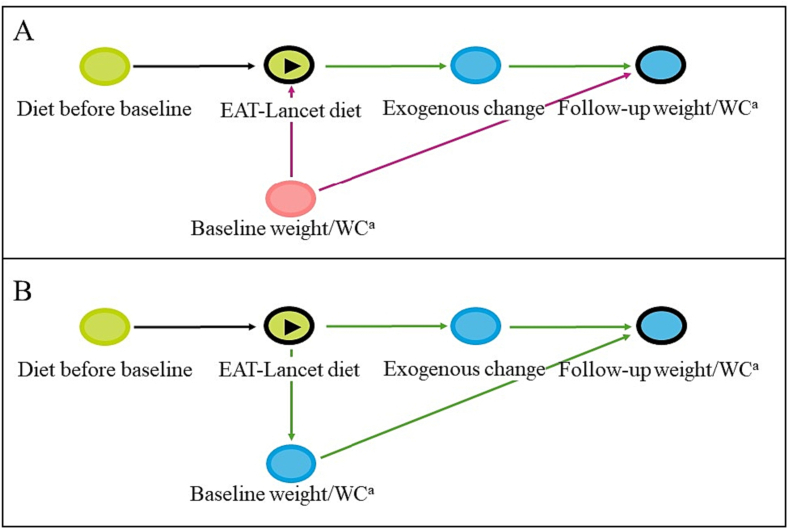
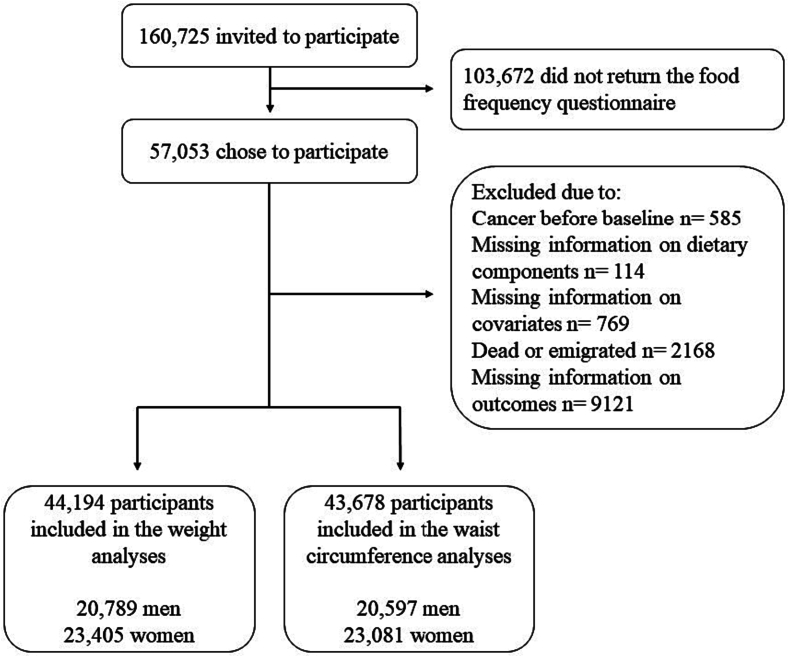
The Danish Diet, Cancer and Health cohort recruited participants in 1993-1997. At baseline, data on diet, lifestyle, and anthropometry were collected. Participants self-reported weight and WC five years later. In total, 44,194 participants were included in analyses of weight (43,678 for WC). Baseline adherence to the EAT-Lancet diet was scored 0-14 points. Multiple linear regression was used to estimate associations between the EAT-Lancet diet and development in weight and WC after five years. Poisson regression was used to estimate risk ratios (RR) of obesity (≥30 kg/m) or elevated WC.
Adherence to the EAT-Lancet diet was not associated with follow-up weight, adjusting for baseline weight and confounders (11-14 vs 0-7 points β: -0.08, 95% CI: -0.27, 0.11 kg), but was associated with lower follow-up WC adjusting for baseline WC and confounders (β: -0.38, 95% CI: -0.69, -0.07 cm), and was associated with lower risk of obesity and elevated WC (RR 0.89, 95% CI: 0.82, 0.98, and 0.95, 95% CI: 0.93, 0.96, respectively).
Adherence to the EAT-Lancet diet in midlife was associated with lower WC but not weight after five years follow up, taking baseline into account. Our findings suggest that greater adherence to the EAT-Lancet diet does not contribute to development of obesity.
“柳叶刀-饮食与健康委员会”参考饮食被提议作为一种健康的饮食模式,以减少与食物相关的气候影响,但关于其与体重发展的关联却知之甚少。本研究调查了中年时期对“柳叶刀-饮食与健康委员会”饮食的依从性以及五年后的体重和腰围(WC)变化情况。
丹麦饮食、癌症与健康队列研究于1993年至1997年招募参与者。在基线时,收集了饮食、生活方式和人体测量学数据。参与者在五年后自行报告体重和腰围。总共有44194名参与者纳入体重分析(43678名纳入腰围分析)。对“柳叶刀-饮食与健康委员会”饮食的基线依从性评分为0至14分。采用多元线性回归来估计“柳叶刀-饮食与健康委员会”饮食与五年后体重和腰围变化之间的关联。采用泊松回归来估计肥胖(≥30kg/m²)或腰围增加的风险比(RR)。
在对基线体重和混杂因素进行调整后,对“柳叶刀-饮食与健康委员会”饮食的依从性与随访体重无关(11 - 14分与0 - 7分相比,β:-0.08,95%CI:-0.27,0.11kg),但在对基线腰围和混杂因素进行调整后,与较低的随访腰围相关(β:-0.38,95%CI:-0.69,-0.07cm),并且与肥胖和腰围增加的风险较低相关(RR分别为0.89,95%CI:0.82,0.98;以及0.95,95%CI:0.93,0.96)。
考虑到基线情况,中年时期对“柳叶刀-饮食与健康委员会”饮食的依从性与五年随访后的较低腰围相关,但与体重无关。我们的研究结果表明,更高程度地依从“柳叶刀-饮食与健康委员会”饮食不会导致肥胖的发生。