Pérez Raquel Alves, Tejada Cesar Augusto Oviedo, Triaca Lívia Madeira, Bertoldi Andréa Dâmaso, Dos Santos Anderson Moreira Aristides
Posgraduate Program in Economics, Federal University of Pelotas (Universidade Federal de Pelotas - UFPel), Rio Grande do Sul, Brazil.
Department of Economics, Federal University of Rio Grande Foundation (Fundação Universidade Federal do Rio Grande - FURG), Rio Grande, Brazil.
Dialogues Health. 2022 Apr 12;1:100009. doi: 10.1016/j.dialog.2022.100009. eCollection 2022 Dec.
This study analyzed socioeconomic inequality in self-rated health for older adults (aged fifty or over) in Brazil.
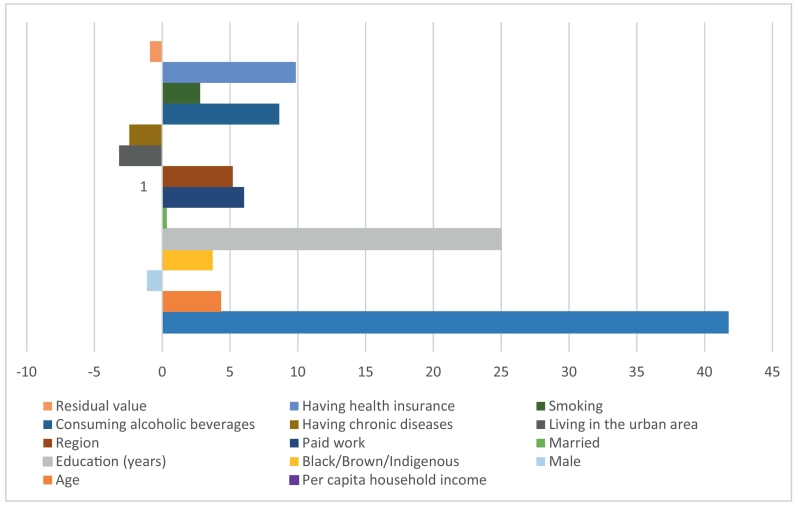
Data from the 2015-2016 Brazilian Longitudinal Study of Aging (ELSI-Brazil). Socioeconomic inequality in self-rated health was measured using the concentration index, which was decomposed to analyze the contribution of different factors.
This study revealed that 11.5% of the older adults interviewed reported their health as poor and very poor. For the complete sample, the estimated concentration index, -0.2434, indicated that there is a concentration of poor and very poor self-rated health among older and poorer adults. Income, education and having a private health insurance plan are the factors that contributed most to the observed inequality.
The decomposition showed that there are avoidable inequalities in relation to socioeconomic status for older adults in Brazil. These factors can guide the formulation of social and health policies aimed at reducing health inequalities.
本研究分析了巴西老年人(50岁及以上)自评健康方面的社会经济不平等状况。
数据来自2015 - 2016年巴西老龄化纵向研究(ELSI - 巴西)。自评健康方面的社会经济不平等状况采用集中指数进行衡量,并对其进行分解以分析不同因素的贡献。
本研究显示,接受访谈的老年人中有11.5%将自己的健康状况报告为差或非常差。对于整个样本,估计的集中指数为 -0.2434,表明自评健康状况差和非常差的情况集中在年龄较大且较贫困的成年人中。收入、教育程度和拥有私人医疗保险计划是导致观察到的不平等现象的最主要因素。
分解结果表明,巴西老年人在社会经济地位方面存在可避免的不平等现象。这些因素可为旨在减少健康不平等的社会和卫生政策的制定提供指导。