Liu Jianing, Xu Jiahuan, Guan Shibo, Wang Wei
Institute of Respiratory and Critical Care Medicine, The First Hospital of China Medical University, Shenyang, Liaoning, China.
Front Med (Lausanne). 2024 Mar 7;11:1354489. doi: 10.3389/fmed.2024.1354489. eCollection 2024.
Obstructive sleep apnea (OSA) and metabolic syndrome (MetS) often coexist, and the causal relationship between them is not yet clear; treatments for OSA include continuous positive airway pressure (CPAP), mandibular advancement device (MAD), surgery, and lifestyle intervention and so on. However, the effects of different treatments on metabolic syndrome in OSA patients are still under debate.
Review the effects of different treatments on metabolic syndrome in OSA patients by meta-analysis.
we searched articles in PubMed, Embase, Cochrane Library, CNKI, CBM, and Wanfang data from database construction to Feb. 2024.RevMan5.4 and Stata software were used to conduct a meta-analysis of 22 articles.
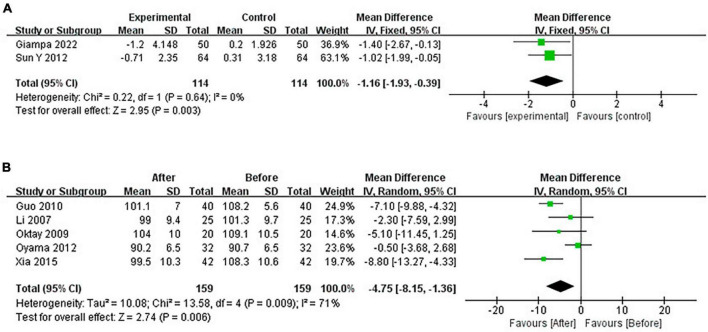
A total of 22 articles were finally included. The results showed that CPAP treatment could reduce the prevalence of metabolic syndrome in OSA patients in randomized controlled trials (RCTs) (RR = 0.82 [95% CI, 0.75 to 0.90]; < 0.01) and single-arm studies (RR = 0.73 [95% CI, 0.63 to 0.84]; < 0.01). As for metabolic syndrome components, CPAP treatment reduces blood pressure, fasting glucose (FG), triglycerides (TG), and waist circumference (WC) but can't affect high-density lipoprotein cholesterol (HDL-C) levels. Lifestyle intervention could significantly reduce the prevalence of metabolic syndrome in OSA patients (RR = 0.60 [95% CI, 0.48 to 0.74]; < 0.01) and can lower blood pressure, fasting glucose, and waist circumference but can't affect the lipid metabolism of OSA patients. Upper airway surgery can only reduce TG levels in OSA patients (MD = -0.74 [95% CI, -1.35 to -0.13]; = 0.02) and does not affect other components of metabolic syndrome. There is currently no report on the impact of upper airway surgery on the prevalence of metabolic syndrome. No study has reported the effect of MAD on metabolic syndrome in OSA patients.
We confirmed that both CPAP and lifestyle intervention can reduce the prevalence of MetS in OSA patients. CPAP treatment can lower blood pressure, fasting glucose, waist circumference, and triglyceride levels in OSA patients. Lifestyle intervention can lower blood pressure, fasting glucose, and waist circumference in OSA patients. Upper airway surgery can only reduce TG levels in OSA patients.
https://www.crd.york.ac.uk/PROSPERO/, identifier CRD42022326857.
阻塞性睡眠呼吸暂停(OSA)与代谢综合征(MetS)常并存,二者因果关系尚不明确;OSA的治疗方法包括持续气道正压通气(CPAP)、下颌前移装置(MAD)、手术及生活方式干预等。然而,不同治疗方法对OSA患者代谢综合征的影响仍存在争议。
通过荟萃分析综述不同治疗方法对OSA患者代谢综合征的影响。
检索了从数据库建立至2024年2月期间PubMed、Embase、Cochrane图书馆、中国知网、中国生物医学文献数据库和万方数据中的文章。使用RevMan5.4和Stata软件对22篇文章进行荟萃分析。
最终共纳入22篇文章。结果显示,在随机对照试验(RCT)(RR = 0.82 [95%CI,0.75至0.90];P < 0.01)和单臂研究(RR = 0.73 [95%CI,0.63至0.84];P < 0.01)中,CPAP治疗可降低OSA患者代谢综合征的患病率。至于代谢综合征的组成成分,CPAP治疗可降低血压、空腹血糖(FG)、甘油三酯(TG)和腰围(WC),但不影响高密度脂蛋白胆固醇(HDL-C)水平。生活方式干预可显著降低OSA患者代谢综合征的患病率(RR = 0.60 [95%CI,0.48至0.74];P < 0.01),并可降低血压、空腹血糖和腰围,但不影响OSA患者脂质代谢。上气道手术仅能降低OSA患者的TG水平(MD = -0.74 [95%CI,-1.35至-0.13];P = 0.02),不影响代谢综合征的其他组成成分。目前尚无关于上气道手术对代谢综合征患病率影响的报道。尚无研究报道MAD对OSA患者代谢综合征的影响。
我们证实CPAP和生活方式干预均可降低OSA患者MetS的患病率。CPAP治疗可降低OSA患者的血压、空腹血糖、腰围和甘油三酯水平。生活方式干预可降低OSA患者的血压、空腹血糖和腰围。上气道手术仅能降低OSA患者的TG水平。