Liao Qiuyan, Li Aisen, Huang Arui, Wang Jiaqiang, Chang Kai, Li Hehua, Yao Pengfei, Zhong Cheng, Xie Peidong, Wang Jinfeng, Li Zhen, Li Qianqian
Hubei Key Lab on Organic and Polymeric Opto-Electronic Materials, Department of Chemistry, TaiKang Center for Life and Medical Sciences, Wuhan University Wuhan 430072 China
Joint School of National University of Singapore and Tianjin University, International Campus of Tianjin University Fuzhou 350207 China.
Chem Sci. 2024 Feb 2;15(12):4364-4373. doi: 10.1039/d3sc05533g. eCollection 2024 Mar 20.
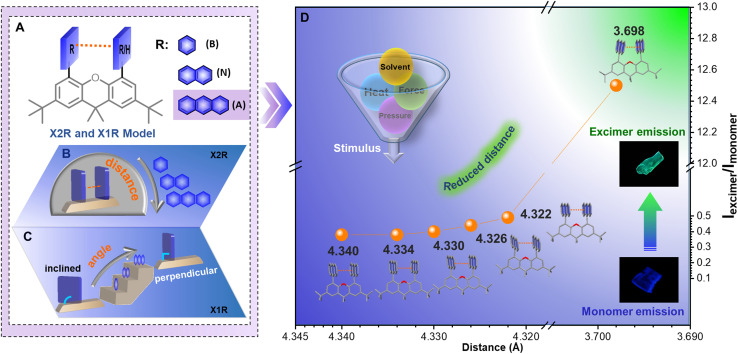
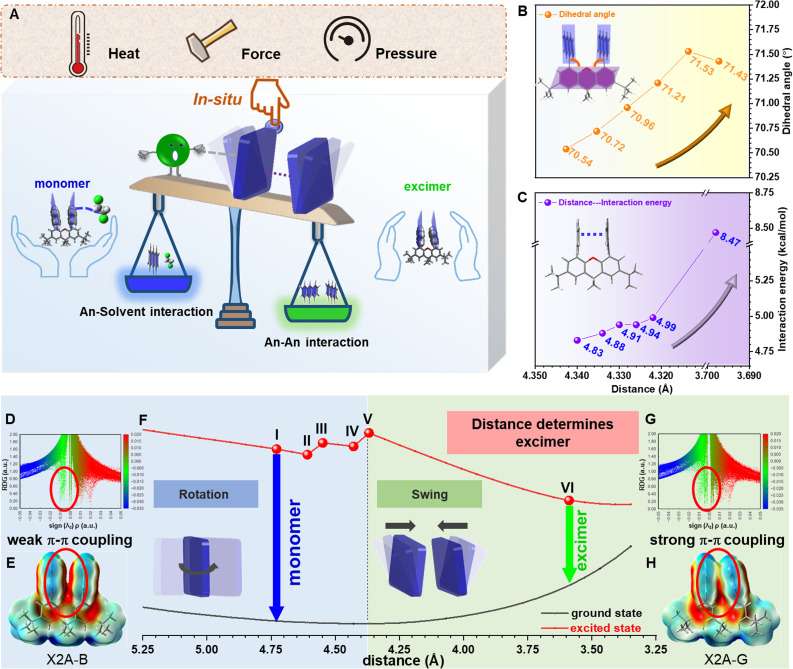
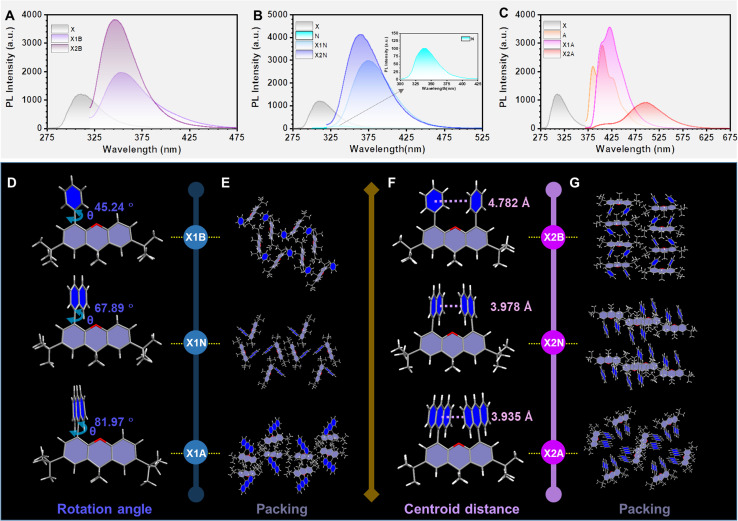
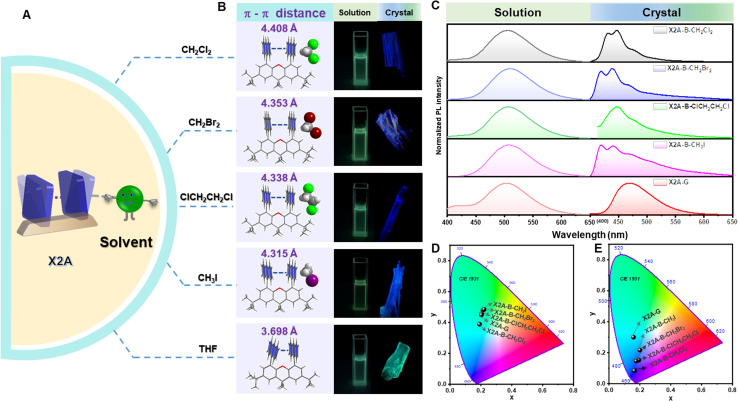
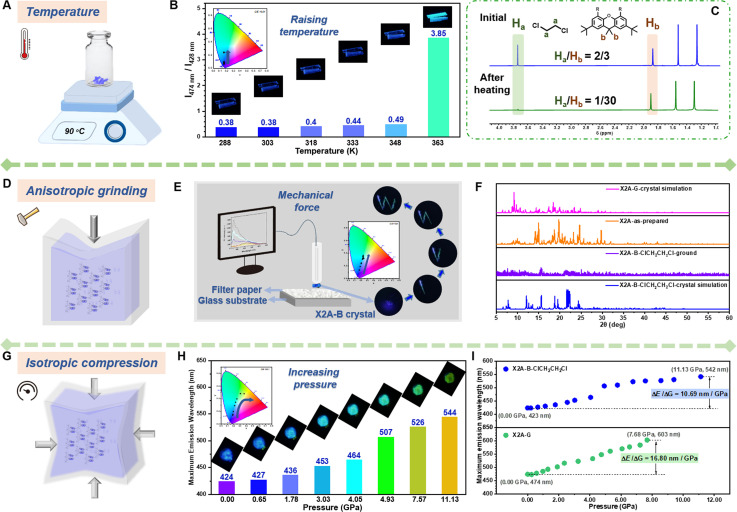
π-π coupling as a common interaction plays a key role in emissions, transport and mechanical properties of organic materials. However, the precise control of π-π coupling is still challenging owing to the possible interference from other intermolecular interactions in the aggregated state, usually resulting in uncontrollable emission properties. Herein, with the rational construction of intramolecular dimer models and crystal engineering, π-π coupling can be subtly modulated by conformation variation with balanced π-π and π-solvent interactions and visualized by green-to-blue emission switching. Moreover, it can rapidly respond to temperature, pressure and mechanical force, affording a facile way to modulate π-π coupling . This work contributes to a deeper understanding of the internal mechanism of molecular motions in aggregated states.
π-π耦合作为一种常见的相互作用,在有机材料的发光、传输和机械性能中起着关键作用。然而,由于聚集态中其他分子间相互作用可能产生干扰,精确控制π-π耦合仍然具有挑战性,这通常会导致发光性能无法控制。在此,通过合理构建分子内二聚体模型和晶体工程,π-π耦合可以通过具有平衡的π-π和π-溶剂相互作用的构象变化进行精细调节,并通过绿色到蓝色的发射切换实现可视化。此外,它可以对温度、压力和机械力快速响应,为调节π-π耦合提供了一种简便的方法。这项工作有助于更深入地理解聚集态分子运动的内部机制。