Benny Alfy, Ramakrishnan Remya, Hariharan Mahesh
School of Chemistry, Indian Institute of Science Education and Research Thiruvananthapuram Vithura Thiruvananthapuram Kerala 695551 India
Chem Sci. 2021 Mar 17;12(14):5064-5072. doi: 10.1039/d1sc00520k. eCollection 2021 Apr 14.
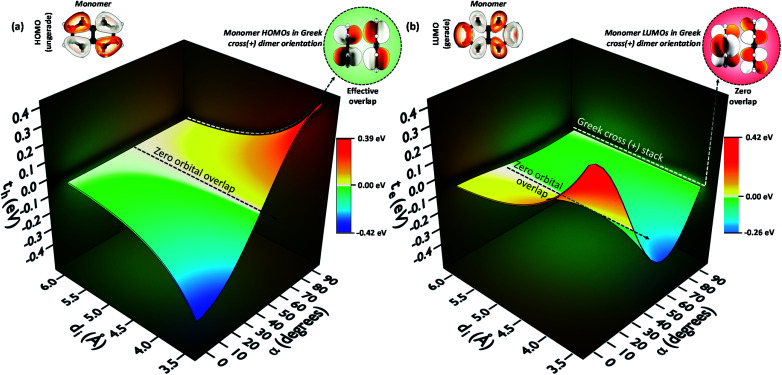
The topology of frontier molecular orbitals (FMOs) induces highly sensitive charge transfer coupling with variation in the intermolecular arrangement. A consistent optoelectronic property correlated to a specific aggregate architecture independent of the nature of the monomer is a rare phenomenon. Our theoretical investigation on stacked dimeric systems of linear []acenes ( = 2-5) and selected non-linear acenes with a D point group reveals that the Greek cross (+) stacked orientation, irrespective of the molecular candidate, exhibits mutually exclusive hole and electron transfer couplings. The deactivation of either hole or electron transfer coupling is a consequence of the zero inter-orbital overlap between the highest occupied molecular orbitals (HOMOs) or lowest unoccupied molecular orbitals (LUMOs) of the monomers possessing gerade symmetry. In the Greek cross (+) stacked alignment, the (4 + 2) π-electronic acene systems with an odd number of benzenoids exhibit exclusive electron transfer coupling, while the even numbered acenes exhibit selective hole transfer coupling. The trend is reversed for representative 4 π-electronic acene systems. The effect of mutually exclusive charge transfer coupling in the hopping regime of charge transport was evaluated using semiclassical Marcus theory, and selective charge carrier mobility was exhibited by the Greek cross (+) stacks of the considered acene candidates. Additionally, the characteristic charge transfer coupling of the orthogonal acene stacks resulted in negligible short-range exciton coupling, inciting null exciton splitting at short interplanar distances. Engineering chromophores in precise angular orientations ensuring characteristic emergent properties can have tremendous potential in the rational design of advanced optoelectronic materials.
前沿分子轨道(FMOs)的拓扑结构会随着分子间排列的变化而诱导出高度敏感的电荷转移耦合。与特定聚集体结构相关且独立于单体性质的一致光电性质是一种罕见现象。我们对线性并苯( = 2 - 5)的堆叠二聚体系统以及具有D点群的选定非线性并苯进行的理论研究表明,希腊十字(+)堆叠取向,无论分子候选物如何,都表现出互斥的空穴和电子转移耦合。空穴或电子转移耦合的失活是由于具有 gerade 对称性的单体的最高占据分子轨道(HOMOs)或最低未占据分子轨道(LUMOs)之间的轨道间重叠为零。在希腊十字(+)堆叠排列中,具有奇数个苯环的(4 + 2)π - 电子并苯系统表现出排他性的电子转移耦合,而偶数并苯表现出选择性的空穴转移耦合。对于代表性的4π - 电子并苯系统,趋势相反。使用半经典马库斯理论评估了电荷转移耦合在电荷传输跳跃机制中的互斥效应,并且所考虑的并苯候选物的希腊十字(+)堆叠表现出选择性的电荷载流子迁移率。此外,正交并苯堆叠的特征电荷转移耦合导致短程激子耦合可忽略不计,在短平面间距处激发零激子分裂。以精确的角取向设计发色团以确保特征性的涌现性质在先进光电材料的合理设计中具有巨大潜力。