Yamashita Wakana, Ojima Shinjiro, Tamura Azumi, Azam Aa Haeruman, Kondo Kohei, Yuancheng Zhang, Cui Longzhu, Shintani Masaki, Suzuki Masato, Takahashi Yoshimasa, Watashi Koichi, Tsuneda Satoshi, Kiga Kotaro
Research Center for Drug and Vaccine Development, National Institute of Infectious Diseases, Tokyo 162-8640, Japan.
Department of Life Science and Medical Bioscience, Waseda University, 2-2 Wakamatsu-cho, Shinjuku-ku, Tokyo 162-8480, Japan.
Biodes Res. 2024 Mar 20;6:0028. doi: 10.34133/bdr.0028. eCollection 2024.
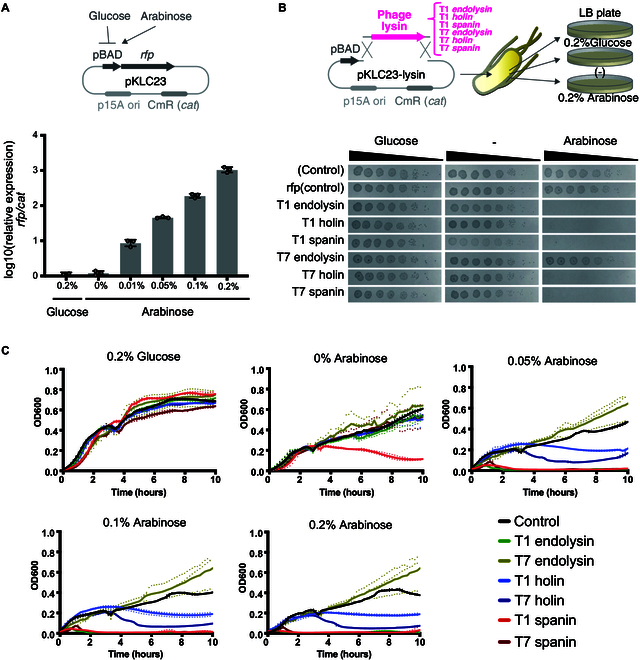
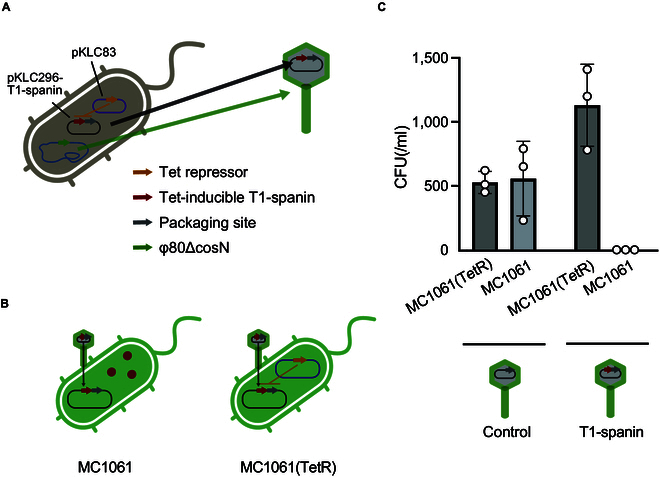
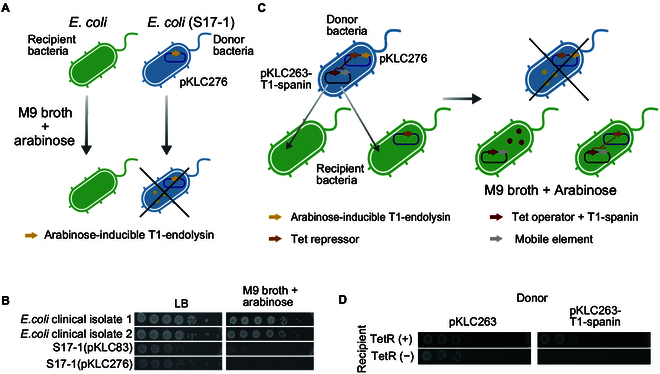
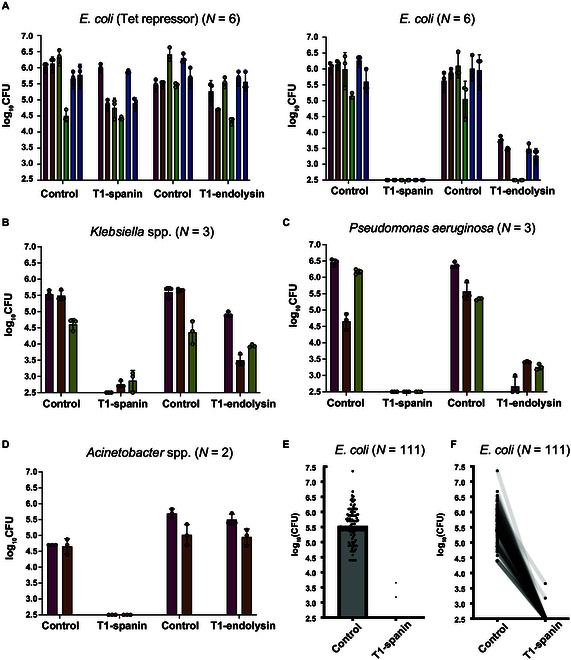
The global increase in the prevalence of drug-resistant bacteria has necessitated the development of alternative treatments that do not rely on conventional antimicrobial agents. Using bacteriophage-derived lytic enzymes in antibacterial therapy shows promise; however, a thorough comparison and evaluation of their bactericidal efficacy are lacking. This study aimed to compare and investigate the bactericidal activity and spectrum of such lytic enzymes, with the goal of harnessing them for antibacterial therapy. First, we examined the bactericidal activity of spanins, endolysins, and holins derived from 2 model phages, T1 and T7. Among these, T1-spanin exhibited the highest bactericidal activity against Subsequently, we expressed T1-spanin within bacterial cells and assessed its bactericidal activity. T1-spanin showed potent bactericidal activity against all clinical isolates tested, including bacterial strains of 111 , 2 spp., 3 spp., and 3 . In contrast, T1 phage-derived endolysin showed bactericidal activity against and , yet its efficacy against other bacteria was inferior to that of T1-spanin. Finally, we developed a phage-based technology to introduce the T1-spanin gene into target bacteria. The synthesized non-proliferative phage exhibited strong antibacterial activity against the targeted bacteria. The potent bactericidal activity exhibited by spanins, combined with the novel phage synthetic technology, holds promise for the development of innovative antimicrobial agents.
全球耐药细菌患病率的增加使得有必要开发不依赖传统抗菌药物的替代治疗方法。在抗菌治疗中使用噬菌体衍生的裂解酶显示出前景;然而,目前缺乏对其杀菌效果的全面比较和评估。本研究旨在比较和研究此类裂解酶的杀菌活性和谱,以期将其用于抗菌治疗。首先,我们检测了源自2种模型噬菌体T1和T7的跨膜蛋白、内溶素和穿孔素的杀菌活性。其中,T1-跨膜蛋白对随后检测的所有菌株均表现出最高的杀菌活性。随后,我们在细菌细胞内表达T1-跨膜蛋白并评估其杀菌活性。T1-跨膜蛋白对所有测试的临床分离株均表现出强大的杀菌活性,包括111、2个属、3个属和3个属的细菌菌株。相比之下,源自T1噬菌体的内溶素对和表现出杀菌活性,但其对其他细菌的效力低于T1-跨膜蛋白。最后,我们开发了一种基于噬菌体的技术,将T1-跨膜蛋白基因导入靶细菌。合成的非增殖性噬菌体对靶细菌表现出强大的抗菌活性。跨膜蛋白表现出的强大杀菌活性,结合新型噬菌体合成技术,为创新抗菌剂的开发带来了希望。