Laboratory of Microbiology and Virology, Department of Molecular Medicine, Sapienza University of Rome, Viale Regina Elena, Roma, 324-00161, Italy.
Department of Public Health and Infectious Diseases, Sapienza University of Rome, Roma, Italy.
Eur J Clin Microbiol Infect Dis. 2024 May;43(5):979-989. doi: 10.1007/s10096-024-04812-z. Epub 2024 Mar 22.
This study aimed to investigate the prevalence and viral reactivations of clinical interest in the immunocompromised patient with particular focus on hematologic and solid organ transplant recipients.
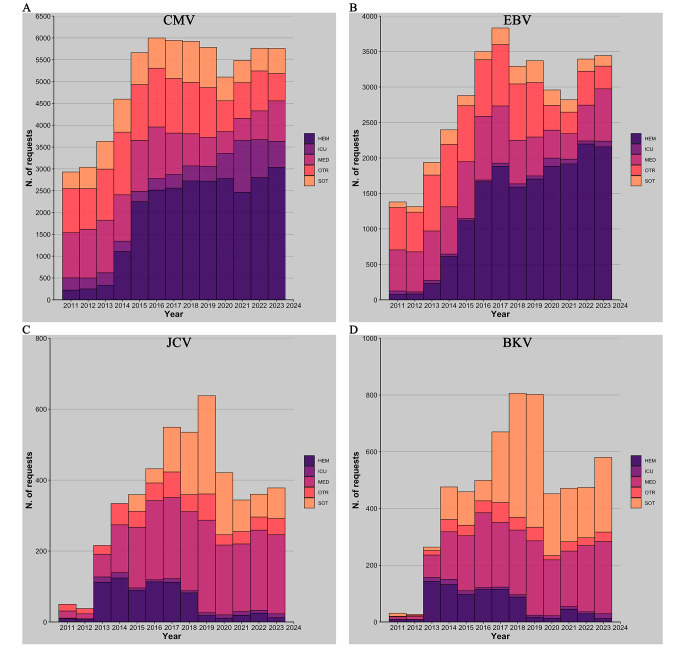
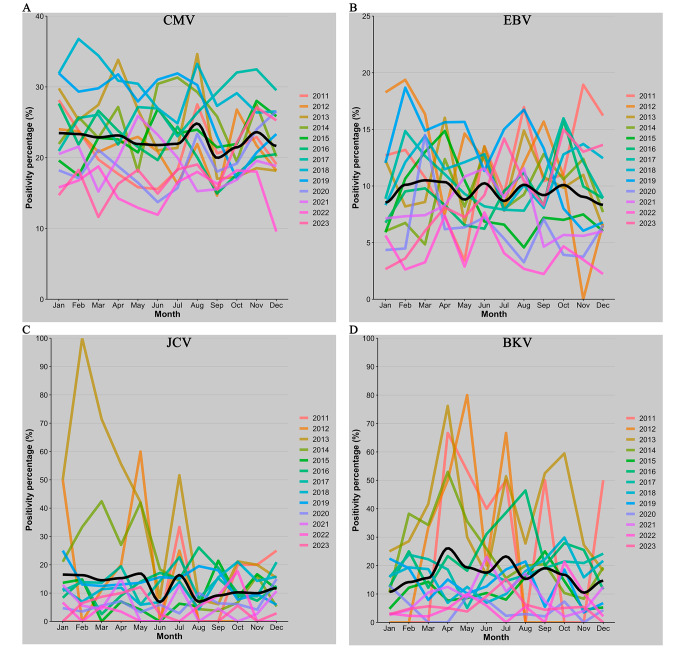
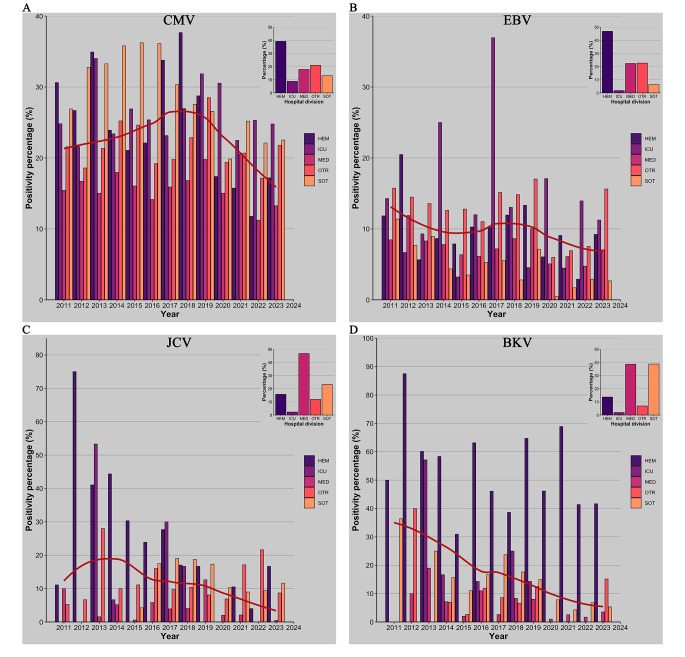
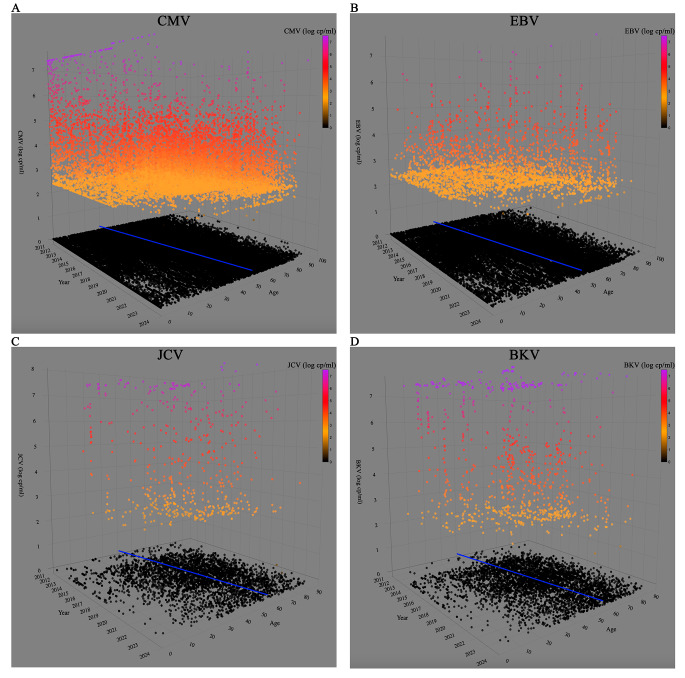
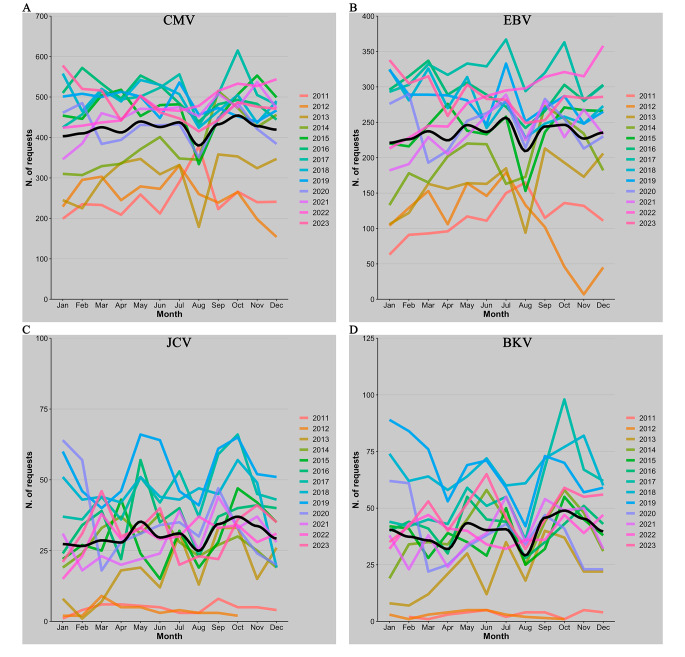
Molecular screening data of CMV, EBV, JCV and BKV from 2011 to 2023 were analyzed. This extensive time span allowed the access to more than 100,000 samples from over 20,000 patients treated at Policlinico Umberto I. It was possible to temporally investigate patient attendance patterns, average age distribution, seasonality of infections, and positivity rates of the analyzed viruses.
Between 2019 and 2022 a significant reduction in organ transplants performed and in the positive molecular detection of EBV, JCV and BKV was observed. Additionally, there has been a noteworthy decrease in CMV reactivations, with a reduction of up to 50% starting in 2019. A remarkable reduction of 39% in the rate of CMV viral reactivation has been also achieved in SOT between 2016 and 2023.
The years following 2019 were profoundly impacted by the COVID-19 pandemic era. This period resulted in a substantial reduction in healthcare services and hospital visits. Furthermore, the introduction of the drug Letermovir in Italy in 2019 demonstrated remarkable efficacy, evidenced by a reduction in CMV reactivations. Additionally, the adoption of a novel clinical approach centered on personalized therapy facilitated improved management of immunocompromised patients.
本研究旨在调查免疫功能低下患者(尤其是血液系统和实体器官移植受者)中具有临床意义的病毒再激活的流行情况。
分析了 2011 年至 2023 年巨细胞病毒(CMV)、EB 病毒(EBV)、JC 病毒(JCV)和 BK 病毒(BKV)的分子筛查数据。这一广泛的时间跨度使我们能够访问来自 Policlinico Umberto I 治疗的 20000 多名患者的超过 100000 个样本。我们可以对患者就诊模式、平均年龄分布、感染季节性以及分析病毒的阳性率进行时间性研究。
在 2019 年至 2022 年间,观察到器官移植数量和 EBV、JCV 和 BKV 的分子检测阳性率显著减少。此外,CMV 再激活也显著减少,自 2019 年以来减少了 50%。在 SOT 中,CMV 病毒再激活率也显著下降了 39%,从 2016 年至 2023 年。
2019 年以后的几年受到了 COVID-19 大流行时代的深刻影响。这一时期导致医疗服务和医院就诊大量减少。此外,2019 年在意大利引入了莱特莫韦(Letermovir)药物,证明了其疗效显著,CMV 再激活减少。此外,采用以个体化治疗为中心的新型临床方法有助于改善免疫功能低下患者的管理。