Department of Population and Public Health Sciences, Keck School of Medicine, University of Southern California, 1845 N Soto St., Los Angeles, CA, 90032, USA.
Department of Urban & Environmental Policy, Occidental College, Los Angeles, CA, USA.
Environ Health. 2024 Mar 23;23(1):31. doi: 10.1186/s12940-024-01071-5.
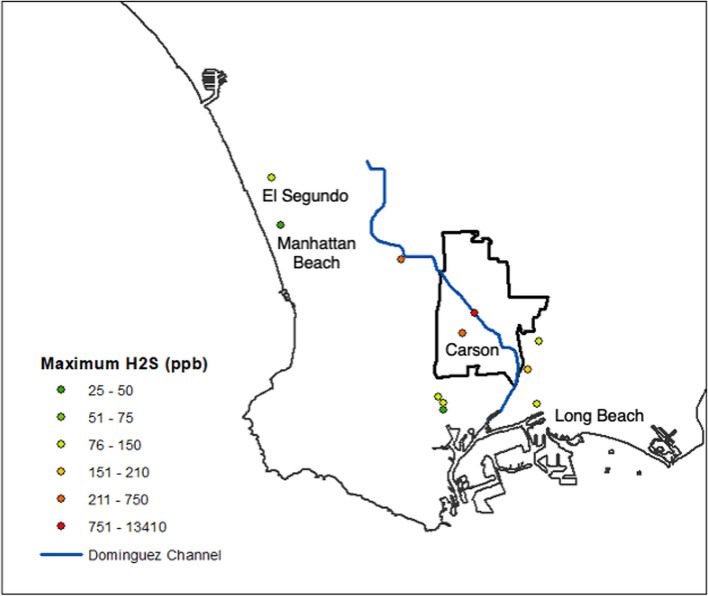
In early October 2021, thousands of residents in Carson, California began complaining of malodors and headaches. Hydrogen sulfide (HS), a noxious odorous gas, was measured at concentrations up to 7000 parts per billion (ppb) and remained above California's acute air quality standard of 30 ppb for a month. Intermittent elevations of HS continued for 3 months. After 2 months of malodor in this environmental justice community, a government agency attributed the HS to environmental pollution from a warehouse fire. Research has yielded conflicting results on the health effects of HS exposure at levels that were experienced during this event. This research fills a critical need for understanding how people perceive and experience emergent environmental health events and will help shape future responses.
Through a community-academic partnership, we conducted 6 focus groups with 33 participants who resided in the Carson area during the crisis. We sought to understand how this incident affected residents through facilitated discussion on topics including information acquisition, impressions of the emergency response, health symptoms, and ongoing impacts.
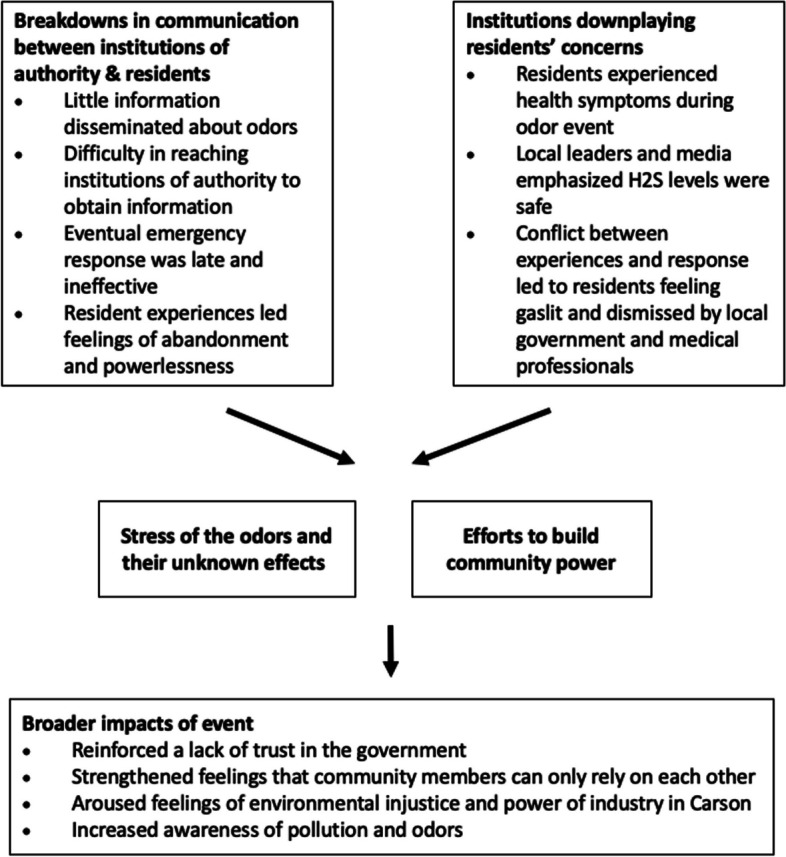
The majority of participants were women (n = 25), identified as Latina/o (n = 19), and rent their homes (n = 21). Participants described difficulty obtaining coherent information about the emergency, which resulted in feelings of abandonment. Most participants felt that local government and healthcare providers downplayed and/or disregarded their concerns despite ongoing odors and health symptoms. Participants described experiencing stress from the odors' unknown health effects and continued fear of future odor incidents. Residents sought to take control of the crisis through information sharing, community networking, and activism. Participants experienced longer term effects from this event, including increased awareness of pollution and reduced trust in local agencies.
This study demonstrates the necessity of clear, comprehensive, and prompt responses by relevant decisionmakers to chemical emergencies to appropriately address residents' fears, curb the spread of misinformation, and minimize adverse health effects. Participant responses also point to the benefit of supporting horizontal community networks for improved information sharing. By engaging directly with community members, researchers and disaster responders can better understand the various and complex impacts of chemical disasters and can improve response.
2021 年 10 月初,加利福尼亚州卡森数千名居民开始抱怨恶臭和头痛。硫化氢(HS)是一种有毒的有臭味的气体,其浓度高达 7000 十亿分之一(ppb),并在一个月内持续高于加利福尼亚州 30ppb 的急性空气质量标准。HS 的间歇性升高持续了 3 个月。在这个环境正义社区出现恶臭气味两个月后,一个政府机构将 HS 归因于仓库火灾造成的环境污染。在这次事件中,研究得出了关于 HS 暴露水平对健康影响的相互矛盾的结果。这项研究填补了人们对突发环境健康事件的看法和体验的理解的关键需求,并将有助于塑造未来的应对措施。
通过社区-学术伙伴关系,我们与居住在危机期间卡森地区的 33 名参与者进行了 6 次焦点小组讨论。我们试图通过关于获取信息、对紧急情况的印象、健康症状和持续影响等主题的讨论,了解这一事件对居民的影响。
大多数参与者是女性(n=25),被认定为拉丁裔(n=19),租住房(n=21)。参与者描述说,很难获得有关紧急情况的连贯信息,这导致了被抛弃的感觉。大多数参与者认为,尽管有持续的气味和健康症状,地方政府和医疗保健提供者还是轻视和/或忽视了他们的担忧。参与者描述了因对气味未知的健康影响感到压力和持续担心未来的气味事件。居民试图通过信息共享、社区网络和行动主义来控制危机。参与者经历了更长期的影响,包括对污染的认识增加和对当地机构的信任度降低。
这项研究表明,相关决策者需要对化学紧急情况做出清晰、全面和及时的反应,以适当解决居民的恐惧,遏制错误信息的传播,并最大限度地减少不良健康影响。参与者的反应也指出了支持水平社区网络以改善信息共享的好处。通过与社区成员直接接触,研究人员和灾难应对人员可以更好地了解化学灾难的各种复杂影响,并可以改善应对措施。