Hohenauer Erich, Bianchi G, Wellauer V, Taube W, Clijsen R
RESlab, University of Applied Sciences and Arts of Southern Switzerland, Weststrasse 8, CH-7302, Landquart, Switzerland.
International University of Applied Sciences THIM, Landquart, Switzerland.
BMC Sports Sci Med Rehabil. 2024 Mar 22;16(1):70. doi: 10.1186/s13102-024-00861-1.
Studies have investigated the effects of training under hypoxia (HYP) after several weeks in a male population. However, there is still a lack of knowledge on the acute hypoxic effects on physiology and muscle recovery in a female population.
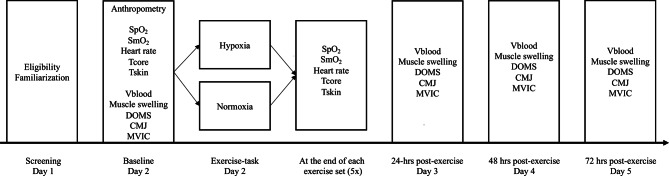
This randomized-controlled trial aimed to investigate the acute effects of muscle damaging exercise, performed in HYP and normoxia (CON), on physiological responses and recovery characteristics in healthy females. Key inclusion criteria were recreationally active female participants between the age of 18 to 35 years without any previous surgeries and injuries, whilst key exclusion criteria were acute pain situations, pregnancy, and medication intake. The females conducted a muscle-damaging protocol, comprising 5 × 20 drop-jumps, in either HYP (FiO: 12%) or CON (FiO: 21%). Physiological responses, including capillary oxygenation (SpO), muscle oxygenation (SmO), heart rate (HR), core- (Tcore) and skin- (Tskin) temperature were assessed at the end of each exercise set. Recovery characteristics were quantified by taking venous blood samples (serum creatine-kinase [CK], C-reactive protein [CRP] and blood sedimentation rate [BSR]), assessing muscle swelling of the quadriceps femoris muscle, maximum voluntary isometric contraction (MVIC) of the knee extensor muscles, countermovement jump (CMJ) performance and muscle soreness ratings (DOMS) at 24-, 48- and 72-hrs post-exercise.
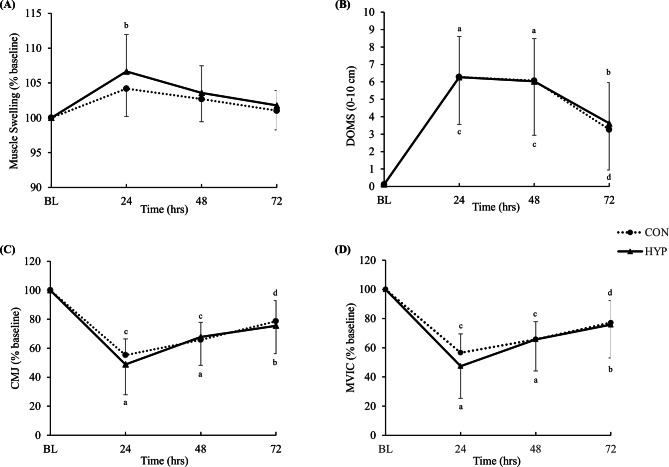
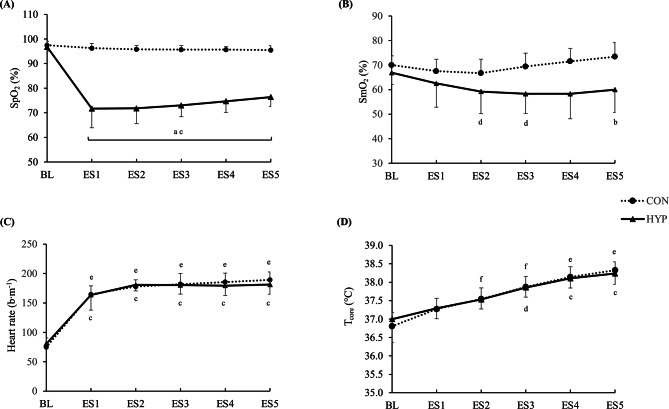
SpO (HYP: 76.7 ± 3.8%, CON: 95.5 ± 1.7%, p < 0.001) and SmO (HYP: 60.0 ± 9.3, CON: 73.4 ± 5.8%, p = 0.03) values were lower (p < 0.05) in HYP compared to CON at the end of the exercise-protocol. No physiological differences between HYP and CON were observed for HR, Tcore, and Tskin (all p > 0.05). There were also no differences detected for any recovery variable (CK, CRP, BSR, MVIC, CMJ, and DOMS) during the 72-hrs follow-up period between HYP and CON (all p > 0.05).
In conclusion, our results showed that muscle damaging exercise under HYP leads to reduced capillary and muscle oxygenation levels compared to normoxia with no difference in inflammatory response and muscle recovery during 72 h post-exercise.
NCT04902924, May 26th 2021.
此前已有研究对男性群体在数周的低氧环境下训练的效果进行了调查。然而,目前仍缺乏关于低氧对女性群体生理机能和肌肉恢复的急性影响的相关知识。
本随机对照试验旨在研究在低氧(HYP)和常氧(CON)环境下进行的肌肉损伤运动对健康女性生理反应和恢复特征的急性影响。主要纳入标准为年龄在18至35岁之间、无既往手术和损伤史且有运动习惯的女性参与者,而主要排除标准为急性疼痛情况、怀孕和正在服用药物。女性参与者在低氧(吸入氧分数:12%)或常氧(吸入氧分数:21%)环境下进行一项肌肉损伤方案,包括5组每组20次的深蹲跳。在每组运动结束时评估生理反应,包括毛细血管氧合(SpO)、肌肉氧合(SmO)、心率(HR)、核心体温(Tcore)和皮肤温度(Tskin)。通过采集静脉血样本(血清肌酸激酶[CK]、C反应蛋白[CRP]和血沉[BSR])、评估股四头肌的肌肉肿胀情况、膝关节伸肌的最大自主等长收缩(MVIC)、反向纵跳(CMJ)表现以及运动后24小时、48小时和72小时的肌肉酸痛评分(DOMS)来量化恢复特征。
在运动方案结束时,低氧组的SpO(HYP:76.7±3.8%,CON:95.5±1.7%,p<0.001)和SmO(HYP:60.0±9.3,CON:73.4±5.8%,p = 0.03)值低于常氧组(p<0.05)。在HR、Tcore和Tskin方面,低氧组和常氧组之间未观察到生理差异(所有p>0.05)。在72小时的随访期内,低氧组和常氧组在任何恢复变量(CK、CRP、BSR、MVIC、CMJ和DOMS)方面也未检测到差异(所有p>0.05)。
总之,我们的结果表明,与常氧环境相比,低氧环境下的肌肉损伤运动导致毛细血管和肌肉氧合水平降低,且运动后72小时内炎症反应和肌肉恢复无差异。
NCT04902924,2021年5月26日。