Department of Kinesiology, Faculty of Science, McMaster University, Hamilton, Ontario, Canada.
Health Sciences Library, McMaster University, Hamilton, Ontario, Canada.
Br J Sports Med. 2023 Sep;57(18):1211-1220. doi: 10.1136/bjsports-2023-106807. Epub 2023 Jul 6.
To determine how distinct combinations of resistance training prescription (RTx) variables (load, sets and frequency) affect muscle strength and hypertrophy.
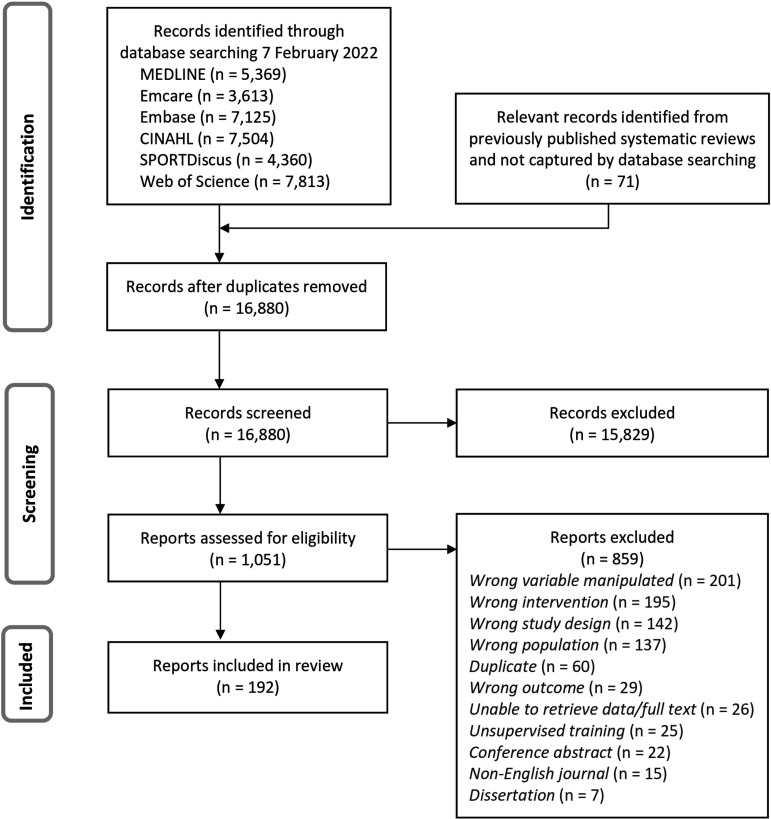
MEDLINE, Embase, Emcare, SPORTDiscus, CINAHL, and Web of Science were searched until February 2022.
Randomised trials that included healthy adults, compared at least 2 predefined conditions (non-exercise control (CTRL) and 12 RTx, differentiated by load, sets and/or weekly frequency), and reported muscle strength and/or hypertrophy were included.
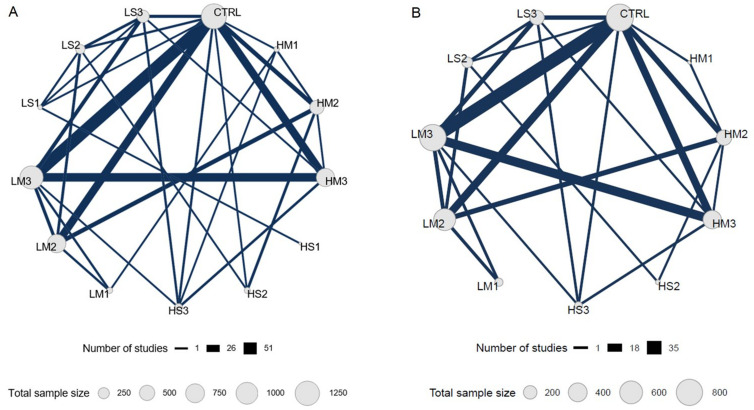
Systematic review and Bayesian network meta-analysis methodology was used to compare RTxs and CTRL. Surface under the cumulative ranking curve values were used to rank conditions. Confidence was assessed with threshold analysis.
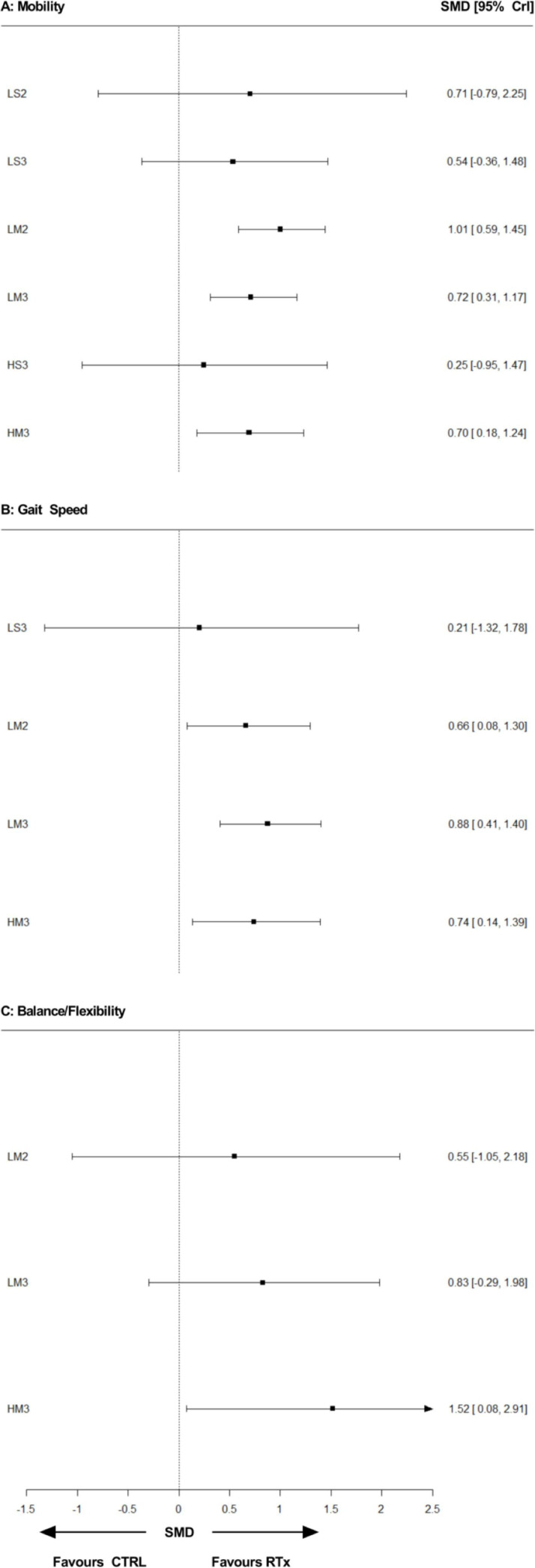
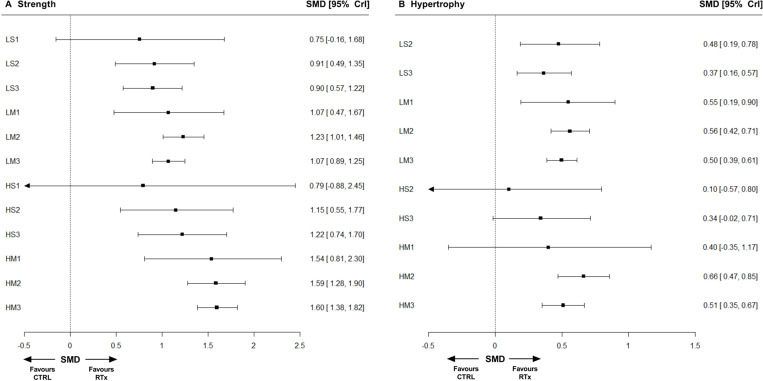
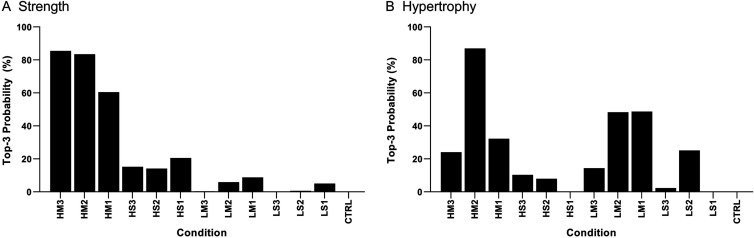
The strength network included 178 studies (n=5097; women=45%). The hypertrophy network included 119 studies (n=3364; women=47%). All RTxs were superior to CTRL for muscle strength and hypertrophy. Higher-load (>80% of single repetition maximum) prescriptions maximised strength gains, and all prescriptions comparably promoted muscle hypertrophy. While the calculated effects of many prescriptions were similar, higher-load, multiset, thrice-weekly training (standardised mean difference (95% credible interval); 1.60 (1.38 to 1.82) vs CTRL) was the highest-ranked RTx for strength, and higher-load, multiset, twice-weekly training (0.66 (0.47 to 0.85) vs CTRL) was the highest-ranked RTx for hypertrophy. Threshold analysis demonstrated these results were extremely robust.
All RTx promoted strength and hypertrophy compared with no exercise. The highest-ranked prescriptions for strength involved higher loads, whereas the highest-ranked prescriptions for hypertrophy included multiple sets.
CRD42021259663 and CRD42021258902.
确定阻力训练方案(RTx)变量(负荷、组数和频率)的不同组合如何影响肌肉力量和肥大。
截至 2022 年 2 月,检索了 MEDLINE、Embase、Emcare、SPORTDiscus、CINAHL 和 Web of Science。
纳入了健康成年人的随机试验,至少比较了 2 种预定义条件(非运动对照(CTRL)和 12 种 RTx,通过负荷、组数和/或每周频率区分),并报告了肌肉力量和/或肥大的研究。
使用系统评价和贝叶斯网络荟萃分析方法比较 RTx 和 CTRL。累积排序曲线下面积值用于对条件进行排名。使用阈值分析评估置信度。
力量网络包括 178 项研究(n=5097;女性=45%)。肥大网络包括 119 项研究(n=3364;女性=47%)。所有 RTx 对肌肉力量和肥大均优于 CTRL。高负荷(>80%的单次重复最大负荷)处方可最大限度地提高力量增益,所有处方均可同等促进肌肉肥大。虽然许多处方的计算效果相似,但高负荷、多组、每周训练 3 次(标准化均数差(95%可信区间);1.60(1.38 至 1.82)与 CTRL 相比)是强度方面排名最高的 RTx,高负荷、多组、每周训练 2 次(0.66(0.47 至 0.85)与 CTRL 相比)是肥大方面排名最高的 RTx。阈值分析表明这些结果极其稳健。
与不运动相比,所有 RTx 均促进了力量和肥大。最高排名的力量处方涉及更高的负荷,而最高排名的肥大处方则包括多组。
PROSPERO 注册号:CRD42021259663 和 CRD42021258902。