School of Public Health, Faculty of Medicine and Health, University of Sydney, Sydney, Australia; The Daffodil Centre, University of Sydney, a joint venture with Cancer Council NSW, Sydney, Australia.
School of Public Health, Faculty of Medicine and Health, University of Sydney, Sydney, Australia; The Daffodil Centre, University of Sydney, a joint venture with Cancer Council NSW, Sydney, Australia.
Breast. 2024 Jun;75:103714. doi: 10.1016/j.breast.2024.103714. Epub 2024 Mar 18.
Shorter time from symptoms recognition to diagnosis and timely treatment would be expected to improve the survival of patients with breast cancer (BC). This review identifies and summarizes evidence on time to diagnosis and treatment, and associated factors to inform an improved BC care pathways in Low- and Middle-Income Countries (LMICs).
A systematic search was conducted in electronic databases including Medline, Embase, PsycINFO and Global Health, covering publications between January 1, 2010, and November 6, 2023. Inclusion criteria encompassed studies published in English from LMICs that reported on time from symptoms recognition to diagnosis and/or from diagnosis to treatment, as well as factors influencing these timelines. Study quality was assessed independently by two reviewers using a standard checklist. Pre-contact, post-contact and treatment intervals and delays in these intervals are presented. Barriers and facilitators for shorter time to diagnosis and treatment found by individual studies after adjusting with covariates are summarized.
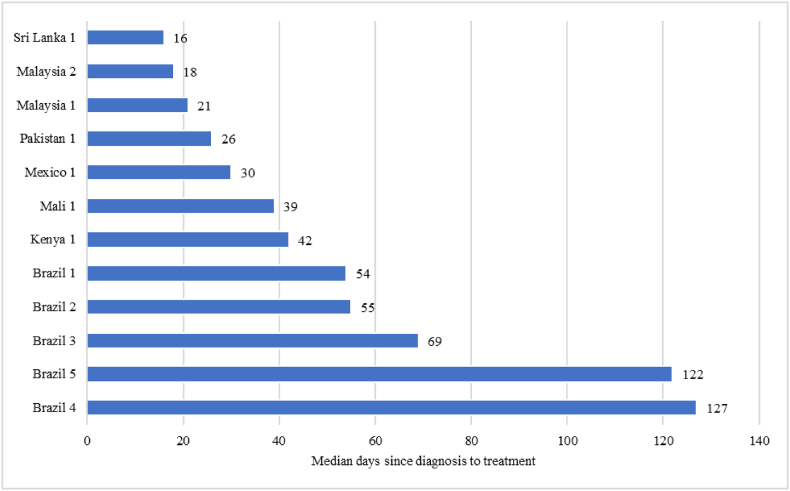
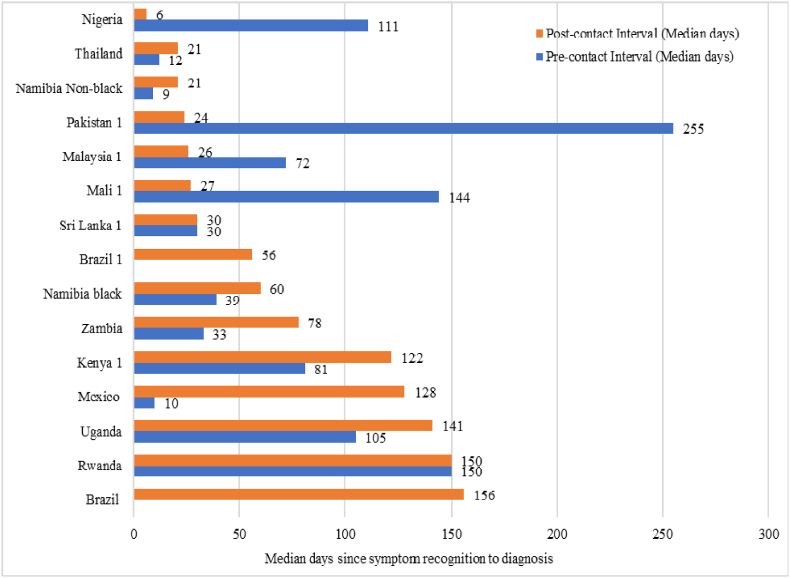
The review identified 21 studies across 14 countries and found that BC cases took a longer time to diagnosis than to treatment. However, time to treatment also exceeded the World Health Organization (WHO) recommended period for optimal survival. There was inconsistency in terminology and benchmarks for defining delays in time intervals. Low socioeconomic status and place of residence emerged as frequent barriers, while initial contact with a private health facility or specialist was commonly reported as a facilitator for shorter time to diagnosis and treatment.
Guidelines or consensus recommendations are essential for defining the optimal time intervals to BC diagnosis and treatment. Our review supported WHO's Global Breast Cancer Initiative recommendations. Increasing public awareness, strengthening of healthcare professional's capacities, partial decentralization of diagnostic services and implementation of effective referral mechanisms are recommended to achieve a shorter time to diagnosis and treatment of BC in LMICs.
从症状识别到诊断和及时治疗的时间缩短,预计将提高乳腺癌(BC)患者的生存率。本综述旨在确定和总结有关诊断和治疗时间以及相关因素的证据,以改进中低收入国家(LMIC)的 BC 护理路径。
系统检索了 Medline、Embase、PsycINFO 和 Global Health 等电子数据库,涵盖了 2010 年 1 月 1 日至 2023 年 11 月 6 日期间发表的英文出版物。纳入标准包括来自 LMIC 的报告症状识别到诊断和/或诊断到治疗时间以及影响这些时间线的因素的研究。两名评审员使用标准清单独立评估研究质量。呈现了预接触、接触后和治疗间隔以及这些间隔中的延迟。总结了个别研究在调整协变量后发现的缩短诊断和治疗时间的障碍和促进因素。
该综述共纳入了来自 14 个国家的 21 项研究,发现 BC 病例的诊断时间长于治疗时间。然而,治疗时间也超过了世界卫生组织(WHO)建议的最佳生存时间。在术语和定义时间间隔延迟的基准方面存在不一致。社会经济地位低和居住地是常见的障碍,而最初接触私立医疗机构或专家通常被报道为缩短诊断和治疗时间的促进因素。
制定 BC 诊断和治疗最佳时间间隔的指南或共识建议至关重要。我们的综述支持 WHO 的全球乳腺癌倡议建议。建议提高公众意识、加强医疗保健专业人员的能力、部分分散诊断服务以及实施有效的转诊机制,以在 LMIC 中实现更短的 BC 诊断和治疗时间。