Einig Sabrina, Ruess Esther, Schoetzau Andreas, Ayllon Bartet Kerstin, Heinzelmann-Schwarz Viola, Vigo Francesco, Kavvadias Tilemachos
University Hospital of Basel, Basel, Switzerland.
University of Basel, Basel, Switzerland.
Adv Urol. 2024 Mar 15;2024:5568010. doi: 10.1155/2024/5568010. eCollection 2024.
Women with lower urinary tract symptoms (LUTS) and high-tone pelvic floor often experience pain and have positive trigger points upon pelvic floor examination. However, the correlation of these findings has not yet been systematically examined and sufficiently understood. The aim of this cross-sectional study is to examine the correlation of pelvic myofascial pain with LUTS and pelvic floor tone.
All participants filled a standardized pelvic floor questionnaire to assess LUTS, which consists of a total of 43 questions regarding bladder, bowel, and sexual function as well as prolapse symptoms. Myofascial trigger points in different muscle groups including pubococcygeus, iliococcygeus, and obturator as well as pelvic floor muscle tone were assessed using a standardized digital examination technique.
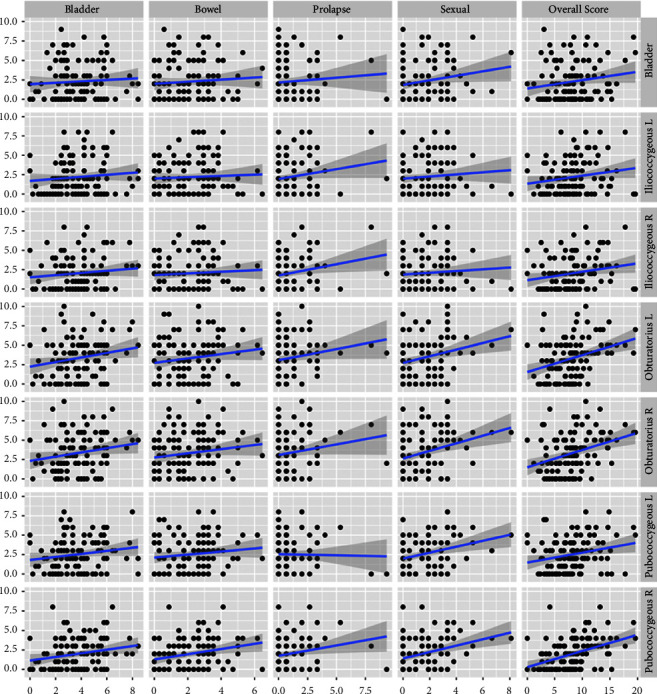
110 women were included in the study. There was a significant correlation between pain in various muscle groups and LUTS as well as high-tone pelvic floor muscle. A significant correlation could also be found between high pelvic floor muscle tone and the overall questionnaire score ( < 0.001) as well as the bladder function score ( < 0.001) and various pain scores of the different groups. Individuals with high-tone pelvic floor were more likely to have more LUTS and higher pain scores.
The existence of myofascial pelvic floor trigger points and high pelvic floor muscle tone seem to be reflective of pelvic floor symptoms, as assessed with a standardized pelvic floor questionnaire.
患有下尿路症状(LUTS)且盆底肌张力高的女性常常感到疼痛,并且在盆底检查时存在阳性触发点。然而,这些发现之间的相关性尚未得到系统研究和充分理解。这项横断面研究的目的是探讨盆腔肌筋膜疼痛与LUTS及盆底肌张力之间的相关性。
所有参与者均填写一份标准化的盆底问卷以评估LUTS,该问卷共有43个关于膀胱、肠道、性功能以及脱垂症状的问题。使用标准化的指检技术评估包括耻骨尾骨肌、髂尾骨肌和闭孔肌在内的不同肌肉群中的肌筋膜触发点以及盆底肌张力。
110名女性纳入本研究。不同肌肉群的疼痛与LUTS以及高张力盆底肌肉之间存在显著相关性。在高盆底肌张力与总体问卷评分(<0.001)、膀胱功能评分(<0.001)以及不同组别的各种疼痛评分之间也发现了显著相关性。盆底肌张力高的个体更有可能出现更多的LUTS且疼痛评分更高。
正如通过标准化盆底问卷所评估的那样,盆腔肌筋膜触发点的存在和高盆底肌张力似乎反映了盆底症状。