Nastase Alexandra, Rajan Alok, French Ben, Bhattacharya Debarshi
Oxford Policy Management, Oxford, UK.
Bill and Melinda Gates Foundation, Delhi, India.
Gates Open Res. 2021 Oct 18;4:180. doi: 10.12688/gatesopenres.13204.2. eCollection 2020.
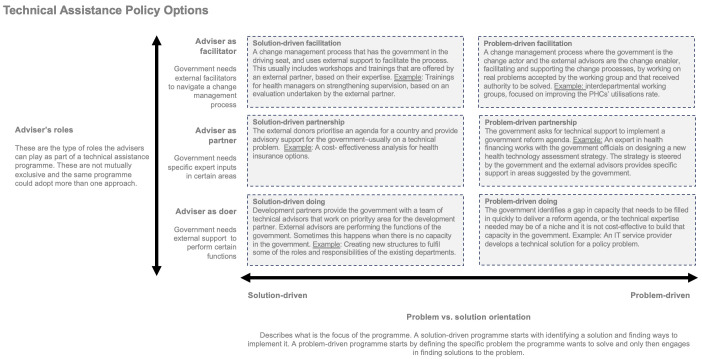
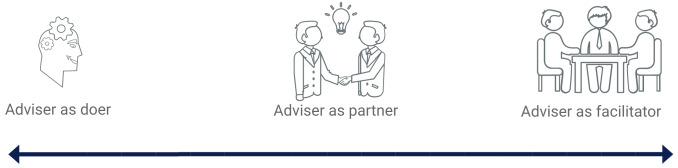
Technical assistance has been at the heart of development assistance provided to country governments by donor agencies over the past several decades. The current debates on reimagining technical assistance focus on the existing challenges of the different types of technical assistance and the (re)construction of an ideal model for delivering this type of support, with little discussion about the dilemmas involved in making day-to-day decisions and trade-offs in implementation. This article presents technical assistance as a policy option for governments and details the existing models of delivering technical assistance, their limitations, and the required enabling conditions. The models presented focus on the type of role for the technical advisers- as doers (performing government functions), partners (working with the government to perform a specific role) and facilitators (enabling and facilitating change programmes to address wicked problems). Finally, the paper provides a practical account of the implications of the programme design and suggests potential opportunities for change particularly in the context of COVID-19 pandemic. It complements an open letter on the practical account of the current challenges in the design and implementation of technical assistance programmes.
在过去几十年里,技术援助一直是捐助机构向各国政府提供的发展援助的核心内容。当前关于重新构想技术援助的辩论聚焦于不同类型技术援助所面临的现有挑战以及构建提供此类支持的理想模式,而对于日常决策中所涉及的困境以及实施过程中的权衡取舍讨论甚少。本文将技术援助作为政府的一种政策选择进行阐述,并详细介绍了现有的技术援助交付模式、其局限性以及所需的有利条件。所呈现的模式聚焦于技术顾问的角色类型——作为执行者(履行政府职能)、合作伙伴(与政府合作履行特定角色)以及促进者(推动和促进变革方案以解决棘手问题)。最后,本文对项目设计的影响进行了实际阐述,并提出了潜在的变革机会,特别是在新冠疫情背景下。它补充了一封关于技术援助项目设计与实施当前挑战实际情况的公开信。