Garrison-Desany Henri M, Meyers Jacquelyn L, Linnstaedt Sarah D, House Stacey L, Beaudoin Francesca L, An Xinming, Zeng Donglin, Neylan Thomas C, Clifford Gari D, Jovanovic Tanja, Germine Laura T, Bollen Kenneth A, Rauch Scott L, Haran John P, Storrow Alan B, Lewandowski Christopher, Musey Paul I, Hendry Phyllis L, Sheikh Sophia, Jones Christopher W, Punches Brittany E, Swor Robert A, Gentile Nina T, Hudak Lauren A, Pascual Jose L, Seamon Mark J, Harris Erica, Pearson Claire, Peak David A, Domeier Robert M, Rathlev Niels K, O'Neil Brian J, Sergot Paulina, Sanchez Leon D, Bruce Steven E, Joormann Jutta, Harte Steven E, McLean Samuel A, Koenen Karestan C, Denckla Christy A
Department of Social and Behavioral Sciences, Harvard T.H. Chan School of Public Health, Boston, MA, United States.
Department of Psychiatry and Behavioral Sciences, State University of New York Downstate Medical Center, New York City, NY, United States.
Front Psychiatry. 2024 Mar 8;15:1249382. doi: 10.3389/fpsyt.2024.1249382. eCollection 2024.
Post-traumatic stress disorder (PTSD) and substance use (tobacco, alcohol, and cannabis) are highly comorbid. Many factors affect this relationship, including sociodemographic and psychosocial characteristics, other prior traumas, and physical health. However, few prior studies have investigated this prospectively, examining new substance use and the extent to which a wide range of factors may modify the relationship to PTSD.
The Advancing Understanding of RecOvery afteR traumA (AURORA) study is a prospective cohort of adults presenting at emergency departments (N = 2,943). Participants self-reported PTSD symptoms and the frequency and quantity of tobacco, alcohol, and cannabis use at six total timepoints. We assessed the associations of PTSD and future substance use, lagged by one timepoint, using the Poisson generalized estimating equations. We also stratified by incident and prevalent substance use and generated causal forests to identify the most important effect modifiers of this relationship out of 128 potential variables.
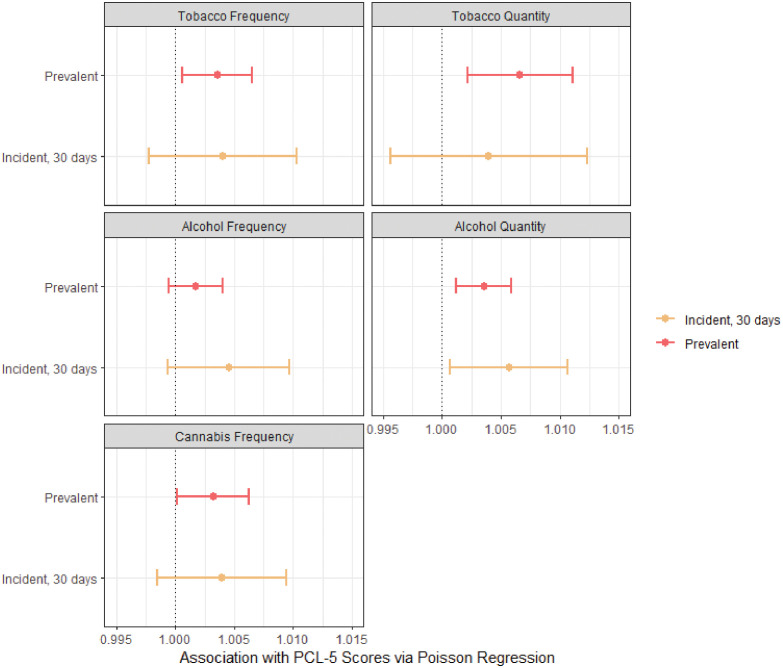
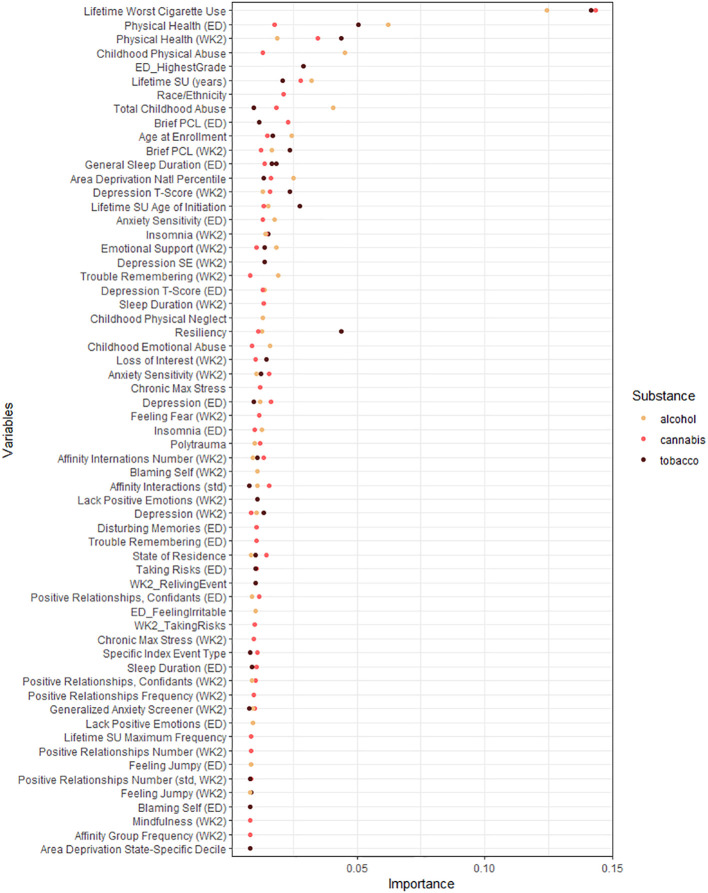
At baseline, 37.3% (N = 1,099) of participants reported likely PTSD. PTSD was associated with tobacco frequency (incidence rate ratio (IRR): 1.003, 95% CI: 1.00, 1.01, p = 0.02) and quantity (IRR: 1.01, 95% CI: 1.001, 1.01, p = 0.01), and alcohol frequency (IRR: 1.002, 95% CI: 1.00, 1.004, p = 0.03) and quantity (IRR: 1.003, 95% CI: 1.001, 1.01, p = 0.001), but not with cannabis use. There were slight differences in incident compared to prevalent tobacco frequency and quantity of use; prevalent tobacco frequency and quantity were associated with PTSD symptoms, while incident tobacco frequency and quantity were not. Using causal forests, lifetime worst use of cigarettes, overall self-rated physical health, and prior childhood trauma were major moderators of the relationship between PTSD symptoms and the three substances investigated.
PTSD symptoms were highly associated with tobacco and alcohol use, while the association with prospective cannabis use is not clear. Findings suggest that understanding the different risk stratification that occurs can aid in tailoring interventions to populations at greatest risk to best mitigate the comorbidity between PTSD symptoms and future substance use outcomes. We demonstrate that this is particularly salient for tobacco use and, to some extent, alcohol use, while cannabis is less likely to be impacted by PTSD symptoms across the strata.
创伤后应激障碍(PTSD)与物质使用(烟草、酒精和大麻)高度共病。许多因素影响这种关系,包括社会人口统计学和心理社会特征、其他既往创伤以及身体健康状况。然而,很少有先前的研究对此进行前瞻性调查,考察新的物质使用情况以及广泛的因素在多大程度上可能改变与PTSD的关系。
“创伤后恢复进展研究(AURORA)”是一项对在急诊科就诊的成年人进行的前瞻性队列研究(N = 2943)。参与者在总共六个时间点自我报告PTSD症状以及烟草、酒精和大麻使用的频率和数量。我们使用泊松广义估计方程评估PTSD与滞后一个时间点的未来物质使用之间的关联。我们还按新发和既往物质使用情况进行分层,并生成因果森林以从128个潜在变量中识别这种关系最重要的效应修饰因素。
在基线时,37.3%(N = 1099)的参与者报告可能患有PTSD。PTSD与烟草使用频率(发病率比(IRR):1.003,95%置信区间:1.00,1.01,p = 0.02)和数量(IRR:1.01,95%置信区间:1.001,1.01,p = 0.01)、酒精使用频率(IRR:1.002,95%置信区间:1.00,1.004,p = 0.03)和数量(IRR:1.003,95%置信区间:1.001,1.01,p = 0.001)相关,但与大麻使用无关。新发与既往烟草使用频率和使用量存在细微差异;既往烟草使用频率和使用量与PTSD症状相关,而新发烟草使用频率和使用量则不然。使用因果森林分析,一生中香烟的最严重使用情况、总体自我评定的身体健康状况以及童年期既往创伤是PTSD症状与所研究的三种物质之间关系的主要调节因素。
PTSD症状与烟草和酒精使用高度相关,而与前瞻性大麻使用的关联尚不清楚。研究结果表明,了解所发生的不同风险分层有助于为风险最高的人群量身定制干预措施,以最佳方式减轻PTSD症状与未来物质使用结果之间的共病情况。我们证明这对于烟草使用尤其显著,在某种程度上对酒精使用也如此,而大麻在各层中受PTSD症状影响的可能性较小。