Cao Jiang, Yu Xiao, Liu Jingcheng, Fu Jiaju, Wang Binyu, Wu Chaoqin, Zhang Sheng, Chen Hongtao, Wang Zi, Xu Yinyang, Sui Tao, Chang Jie, Cao Xiaojian
Department of Orthopedics, The First Affiliated Hospital of Nanjing Medical University, Nanjing, Jiangsu Province, China.
Department of Trauma Surgery, Subei People's Hospital of Jiangsu, Clinical Medical College of Yangzhou University, Yangzhou, Jiangsu Province, China.
Neural Regen Res. 2024 Nov 1;19(11):2499-2512. doi: 10.4103/NRR.NRR-D-23-01863. Epub 2024 Jan 31.
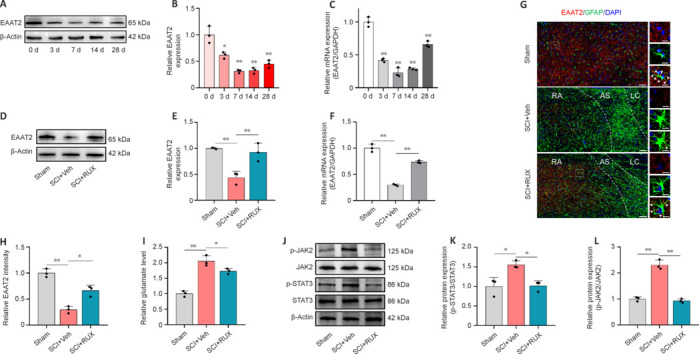
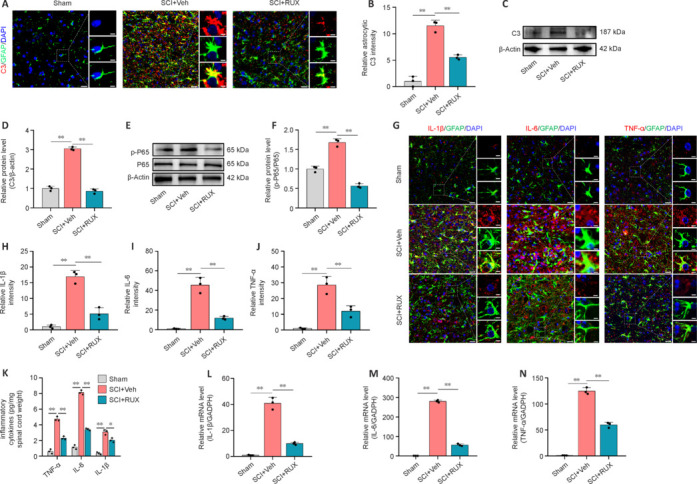
JOURNAL/nrgr/04.03/01300535-202419110-00030/figure1/v/2024-03-08T184507Z/r/image-tiff The inflammatory microenvironment and neurotoxicity can hinder neuronal regeneration and functional recovery after spinal cord injury. Ruxolitinib, a JAK-STAT inhibitor, exhibits effectiveness in autoimmune diseases, arthritis, and managing inflammatory cytokine storms. Although studies have shown the neuroprotective potential of ruxolitinib in neurological trauma, the exact mechanism by which it enhances functional recovery after spinal cord injury, particularly its effect on astrocytes, remains unclear. To address this gap, we established a mouse model of T10 spinal cord contusion and found that ruxolitinib effectively improved hindlimb motor function and reduced the area of spinal cord injury. Transcriptome sequencing analysis showed that ruxolitinib alleviated inflammation and immune response after spinal cord injury, restored EAAT2 expression, reduced glutamate levels, and alleviated excitatory toxicity. Furthermore, ruxolitinib inhibited the phosphorylation of JAK2 and STAT3 in the injured spinal cord and decreased the phosphorylation level of nuclear factor kappa-B and the expression of inflammatory factors interleukin-1β, interleukin-6, and tumor necrosis factor-α. Additionally, in glutamate-induced excitotoxicity astrocytes, ruxolitinib restored EAAT2 expression and increased glutamate uptake by inhibiting the activation of STAT3, thereby reducing glutamate-induced neurotoxicity, calcium influx, oxidative stress, and cell apoptosis, and increasing the complexity of dendritic branching. Collectively, these results indicate that ruxolitinib restores glutamate homeostasis by rescuing the expression of EAAT2 in astrocytes, reduces neurotoxicity, and effectively alleviates inflammatory and immune responses after spinal cord injury, thereby promoting functional recovery after spinal cord injury.
《期刊》/nrgr/04.03/01300535 - 202419110 - 00030/图1/v/2024 - 03 - 08T184507Z/图像 - tiff 炎症微环境和神经毒性会阻碍脊髓损伤后神经元的再生和功能恢复。鲁索替尼是一种JAK - STAT抑制剂,在自身免疫性疾病、关节炎以及控制炎症细胞因子风暴方面显示出有效性。尽管研究表明鲁索替尼在神经创伤中具有神经保护潜力,但其增强脊髓损伤后功能恢复的确切机制,尤其是对星形胶质细胞的作用,仍不清楚。为了填补这一空白,我们建立了T10脊髓挫伤小鼠模型,发现鲁索替尼有效改善了后肢运动功能并减少了脊髓损伤面积。转录组测序分析表明,鲁索替尼减轻了脊髓损伤后的炎症和免疫反应,恢复了EAAT2表达,降低了谷氨酸水平,并减轻了兴奋性毒性。此外,鲁索替尼抑制了损伤脊髓中JAK2和STAT3的磷酸化,降低了核因子κ - B的磷酸化水平以及炎症因子白细胞介素 - 1β、白细胞介素 - 6和肿瘤坏死因子 - α的表达。此外,在谷氨酸诱导的兴奋性毒性星形胶质细胞中,鲁索替尼通过抑制STAT3的激活恢复了EAAT2表达并增加了谷氨酸摄取,从而降低了谷氨酸诱导的神经毒性、钙内流、氧化应激和细胞凋亡,并增加了树突分支的复杂性。总体而言,这些结果表明鲁索替尼通过挽救星形胶质细胞中EAAT2的表达来恢复谷氨酸稳态,降低神经毒性,并有效减轻脊髓损伤后的炎症和免疫反应,从而促进脊髓损伤后的功能恢复。