Kumpf Vanessa J, Gray Brenda, Monczka Jessica, Zeraschi Sarah, Klek Stanislaw
Center for Human Nutrition, Vanderbilt University Medical Center, Nashville, TN, USA.
Clinical Pharmacy Partners, Tampa, FL, USA.
Am J Health Syst Pharm. 2024 Jun 13;81(Supplement_3):S112-S120. doi: 10.1093/ajhp/zxae081.
Some diseases require that patients receive parenteral nutrition (PN) over a prolonged time period. Long-term administration of PN can further complicate an already complex therapy, posing additional risk of potential complications. This article is based on presentations and discussions held at the International Safety and Quality of PN Summit, providing insights into aspects of home PN (HPN) and examples of good HPN practice.
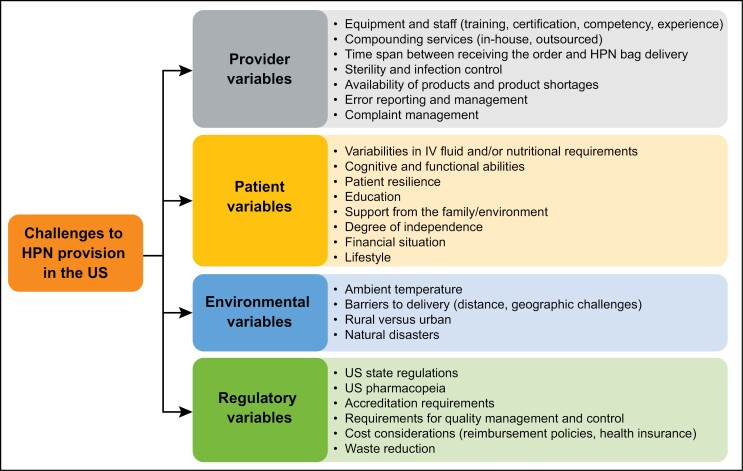
One critical step in the HPN process is when patients transition from a hospital to a home setting, and vice versa. Generally, electronic PN ordering is not feasible in an HPN setting, leading to potential difficulties in communication and coordination. HPN requires that patients (or their home caregivers) administer PN, and thus their education and competency are crucial. Likewise, the choice of PN formulation is of great importance. For example, using more modern intravenous lipid emulsions containing medium-chain triglycerides, olive oil, and/or fish oil can provide benefits in terms of liver function during long-term HPN. Internationally, there are wide variations in delivery of HPN, with compounded PN dominating in some countries while others make greater use of market-authorized multichamber bags (MCBs). Patient-related factors, institutional considerations, and the availability of different MCB formulations, are also contributing factors guiding formulation and delivery system preferences.
Education and communication remain key components of a successful HPN process. The information shared here may help to motivate efforts to improve HPN processes and to consider the often-differing perspectives of patients and their healthcare professionals.
一些疾病要求患者长期接受肠外营养(PN)。长期进行PN会使本已复杂的治疗进一步复杂化,带来潜在并发症的额外风险。本文基于在国际PN安全与质量峰会上的报告和讨论,深入探讨了家庭肠外营养(HPN)的各个方面,并列举了良好的HPN实践案例。
HPN过程中的一个关键步骤是患者在医院和家庭环境之间的转换,反之亦然。一般来说,在HPN环境中电子方式订购PN并不可行,这会导致沟通和协调方面的潜在困难。HPN要求患者(或其家庭护理人员)自行管理PN,因此他们的教育程度和能力至关重要。同样,PN配方的选择也非常重要。例如,使用含有中链甘油三酯、橄榄油和/或鱼油的更现代的静脉脂质乳剂,在长期HPN期间对肝功能有益。在国际上,HPN的供应存在很大差异,在一些国家复方PN占主导地位,而其他国家则更多地使用市场授权的多腔袋(MCB)。与患者相关的因素、机构考虑以及不同MCB配方的可用性,也是指导配方和输送系统偏好的因素。
教育和沟通仍然是成功的HPN过程的关键组成部分。这里分享的信息可能有助于推动改进HPN过程的努力,并考虑患者及其医护人员通常不同的观点。