Medical Affairs Department, Mochida Pharmaceutical Co., Ltd., Tokyo, Japan.
Second Department of Internal Medicine, Osaka Medical and Pharmaceutical University Hospital, Osaka, Japan.
Digestion. 2024;105(3):232-242. doi: 10.1159/000538319. Epub 2024 Mar 25.
5-aminosalicylic acid (5-ASA) is the first-line drug for the treatment of mild-to-moderate ulcerative colitis (UC). Three oral sustained-release formulations are often used. However, no unified view of their actual use in routine medical practice has been presented to date.
Using a health insurance claims database, we extracted patients with an initial diagnosis of mild-to-moderate UC during the period from December 1, 2017, to March 31, 2022. For the three types of oral 5-ASA formulation, we calculated and compared descriptive statistics of medication persistence rates (MPR), proportions of days covered (PDC), and adherence proportion (PDC ≥80%) in the extracted population.
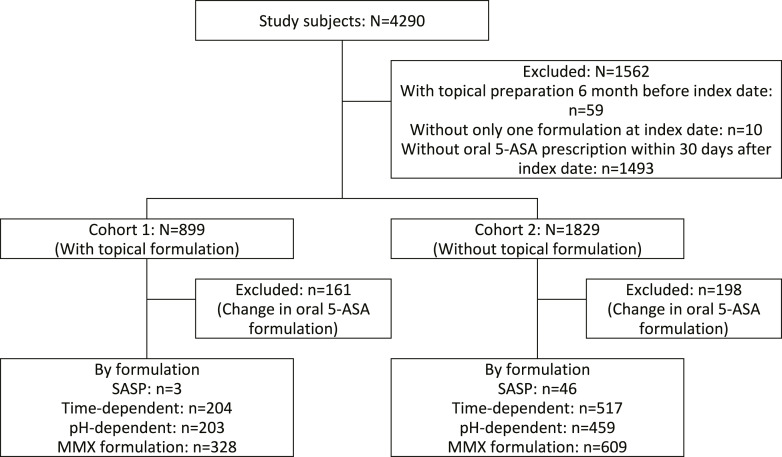
An oral 5-ASA formulation was used in combination with a topical preparation (cohort 1) in 899 patients, and oral 5-ASA was used alone (cohort 2) in 1,829 patients. In cohort 1, MPR at days 151-180 with concomitant use of topical formulation was significantly higher for the Multi Matrix System™ (MMX) formulation (65.2%) compared with that for pH-dependent formulation (51.7%, p < 0.025), while MPR tended to be higher for MMX than for the time-dependent formulation (56.4%, not significant). During days 151-180 after starting the oral formulation, MPR for MMX (66.7% and 65.8%) was higher than for pH-dependent (55.9% and 55.3%) and time-dependent (57.6% and 55.9%) formulations in cohorts 1 + 2 and 2, respectively. In cohort 1, there was a significant difference between MMX (68.3%) and pH-dependent (57.1%) formulations, but no significant difference was seen with time-dependent formulations (61.8%). In terms of the proportion of adherence until day 180, MMX was significantly better than the other formulations.
The analyses of the three oral 5-ASA formulations suggested that both MPR and medication adherence were better for the MMX formulation than for time-dependent or pH-dependent formulations.
5-氨基水杨酸(5-ASA)是治疗轻度至中度溃疡性结肠炎(UC)的一线药物。有三种口服缓释制剂常被使用。然而,迄今为止,还没有对其在常规医疗实践中的实际应用提出统一的看法。
我们使用医疗保险理赔数据库,提取了 2017 年 12 月 1 日至 2022 年 3 月 31 日期间初诊为轻度至中度 UC 的患者。对于三种口服 5-ASA 制剂,我们计算并比较了在提取人群中药物维持率(MPR)、覆盖率(PDC)和依从性比例(PDC≥80%)的描述性统计数据。
在 899 例患者中,一种口服 5-ASA 制剂与局部制剂联合使用(队列 1),1829 例患者单独使用口服 5-ASA(队列 2)。在队列 1 中,联合使用局部制剂时,多基质系统(MMX)制剂(65.2%)的 MPR 在第 151-180 天显著高于 pH 依赖性制剂(51.7%,p<0.025),而 MMX 的 MPR 倾向于高于时间依赖性制剂(56.4%,无显著差异)。在开始口服制剂后的第 151-180 天,在队列 1+2 和 2 中,MMX(66.7%和 65.8%)的 MPR 均高于 pH 依赖性(55.9%和 55.3%)和时间依赖性(57.6%和 55.9%)制剂。在队列 1 中,MMX(68.3%)和 pH 依赖性(57.1%)制剂之间存在显著差异,但时间依赖性制剂之间无显著差异(61.8%)。在第 180 天之前的依从性比例方面,MMX 明显优于其他制剂。
对三种口服 5-ASA 制剂的分析表明,与时间依赖性或 pH 依赖性制剂相比,MMX 制剂的 MPR 和药物依从性均更好。