Gjødsbøl Iben Mundbjerg, Ringgaard Anna Kirstine, Holm Peter Christoffer, Brunak Søren, Bundgaard Henning
Department of Public Health, Centre for Medical Science and Technology Studies, University of Copenhagen, Copenhagen, Denmark.
Department of Cardiology, The Heart Center, Copenhagen University Hospital, Copenhagen, Denmark.
Digit Health. 2024 Mar 24;10:20552076241241674. doi: 10.1177/20552076241241674. eCollection 2024 Jan-Dec.
Artificial intelligence (AI) and algorithms are heralded as significant solutions to the widening gap between the rising healthcare needs of ageing and multi-morbid populations and the scarcity of resources to provide such care.
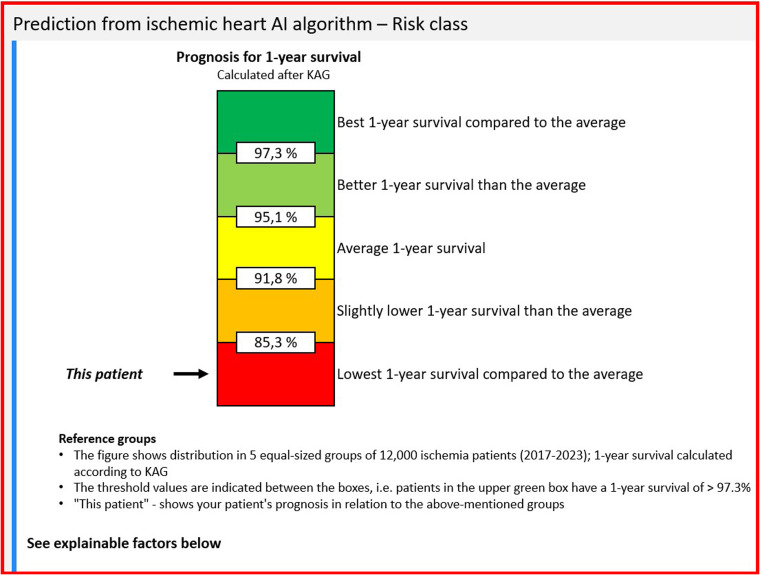
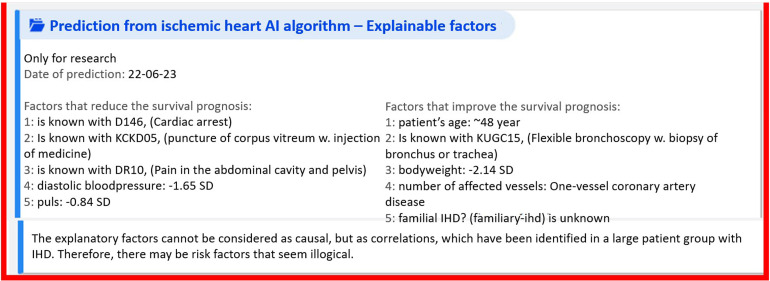
This article investigates how the PMHnet algorithm - an AI prognostication tool developed in Denmark to predict the one-year all-cause mortality risk for patients hospitalized with ischemic heart disease - was presented to cardiologists working in the hospital setting, and how they responded to this novel decision-support tool.
Empirically, we draw upon ethnographic fieldwork in the Danish-led international research project, PM Heart, which since 2019 has developed the PMHnet algorithm and implemented the software into the electronic health record system in hospitals in Eastern Denmark (the Capital Region and Region Zealand).
Paying careful attention to the hopes and concerns of cardiologists who will have to embrace and adapt to algorithmic tools in their everyday work of diagnosing and treating patients, we identify three analytical themes meriting attention when AI is implemented in healthcare: 1) the re-negotiation of agency and autonomy in human-algorithm relations, 2) accountability in algorithmic prognostication and 3) the complex relationship between association and causation actualized by predictive algorithms. From these analytical themes, we elicit methodological questions to guide future ethnographic explorations of how AI and advanced algorithms are put to use in the healthcare system, with what implications, and for whom.
We conclude that local, qualitative investigations of how algorithms are used, embraced and contested in everyday clinical practice are needed in order to understand their implications - good and bad, intended and unintended - for clinicians, patients and healthcare provision.
人工智能(AI)和算法被誉为解决老龄化和多病共存人群不断增长的医疗需求与提供此类护理资源稀缺之间日益扩大差距的重要解决方案。
本文调查了PMHnet算法——丹麦开发的一种人工智能预测工具,用于预测缺血性心脏病住院患者的一年全因死亡风险——是如何呈现给在医院工作的心脏病专家的,以及他们对这种新型决策支持工具的反应。
从实证角度出发,我们借鉴了丹麦主导的国际研究项目“PM Heart”中的人种志田野调查,该项目自2019年以来开发了PMHnet算法,并将该软件应用于丹麦东部(首都地区和西兰岛地区)医院的电子健康记录系统。
我们仔细关注心脏病专家在日常诊断和治疗患者工作中必须接受和适应算法工具的希望和担忧,确定了在医疗保健中实施人工智能时值得关注的三个分析主题:1)人机算法关系中能动性和自主性的重新协商,2)算法预测中的问责制,3)预测算法实现的关联与因果之间的复杂关系。从这些分析主题中,我们引出了方法学问题,以指导未来关于人工智能和先进算法如何在医疗系统中使用、有何影响以及对谁有影响的人种志探索。
我们得出结论,需要对算法在日常临床实践中的使用、接受和争议进行局部的定性调查,以便了解它们对临床医生、患者和医疗保健提供的影响——好的和坏 的、有意的和无意的。