Gan Pamela, Hajis Muhammad Irfan Bin, Yumna Mazaya, Haruman Jessline, Matoha Husnul Khotimah, Wahyudi Dian Tri, Silalahi Santha, Oktariani Dwi Rizky, Dela Fitria, Annisa Tazkia, Pitaloka Tessalonika Damaris Ayu, Adhiwijaya Priscilla Klaresza, Pauzi Rizqi Yanuar, Hertanto Robby, Kumaheri Meutia Ayuputeri, Sani Levana, Irwanto Astrid, Pradipta Ariel, Chomchopbun Kamonlawan, Gonzalez-Porta Mar
Nalagenetics Pte Ltd., Singapore, Singapore.
PT Genomik Solidaritas Indonesia, Jakarta, Indonesia.
Front Pharmacol. 2024 Mar 11;15:1349203. doi: 10.3389/fphar.2024.1349203. eCollection 2024.
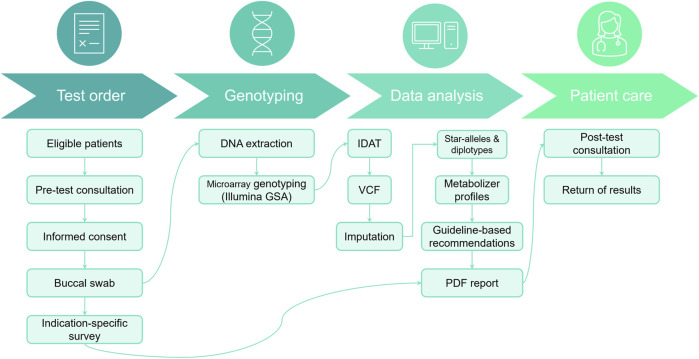
Microarrays are a well-established and widely adopted technology capable of interrogating hundreds of thousands of loci across the human genome. Combined with imputation to cover common variants not included in the chip design, they offer a cost-effective solution for large-scale genetic studies. Beyond research applications, this technology can be applied for testing pharmacogenomics, nutrigenetics, and complex disease risk prediction. However, establishing clinical reporting workflows requires a thorough evaluation of the assay's performance, which is achieved through validation studies. In this study, we performed pre-clinical validation of a genetic testing workflow based on the Illumina Global Screening Array for 25 pharmacogenomic-related genes. To evaluate the accuracy of our workflow, we conducted multiple pre-clinical validation studies. Here, we present the results of accuracy and precision assessments, involving a total of 73 cell lines. These assessments encompass reference materials from the Genome-In-A-Bottle (GIAB), the Genetic Testing Reference Material Coordination Program (GeT-RM) projects, as well as additional samples from the 1000 Genomes project (1KGP). We conducted an accuracy assessment of genotype calls for target loci in each indication against established truth sets. In our per-sample analysis, we observed a mean analytical sensitivity of 99.39% and specificity 99.98%. We further assessed the accuracy of star-allele calls by relying on established diplotypes in the GeT-RM catalogue or calls made based on 1KGP genotyping. On average, we detected a diplotype concordance rate of 96.47% across 14 pharmacogenomic-related genes with star allele-calls. Lastly, we evaluated the reproducibility of our findings across replicates and observed 99.48% diplotype and 100% phenotype inter-run concordance. Our comprehensive validation study demonstrates the robustness and reliability of the developed workflow, supporting its readiness for further development for applied testing.
微阵列是一种成熟且广泛应用的技术,能够检测人类基因组中的数十万个位点。结合填补技术以涵盖芯片设计中未包含的常见变异,它们为大规模基因研究提供了一种经济高效的解决方案。除了研究应用之外,该技术还可用于药物基因组学、营养遗传学和复杂疾病风险预测的检测。然而,建立临床报告工作流程需要对检测方法的性能进行全面评估,这通过验证研究来实现。在本研究中,我们基于Illumina全球筛选阵列对25个药物基因组相关基因进行了基因检测工作流程的临床前验证。为了评估我们工作流程的准确性,我们进行了多项临床前验证研究。在此,我们展示了准确性和精密度评估的结果,涉及总共73个细胞系。这些评估包括来自“瓶中基因组”(GIAB)、基因检测参考物质协调计划(GeT-RM)项目的参考物质,以及来自千人基因组计划(1KGP)的其他样本。我们针对每个适应症中目标位点的基因型调用,对照既定的真值集进行了准确性评估。在我们的每个样本分析中,我们观察到平均分析灵敏度为99.39%,特异性为99.98%。我们通过依赖GeT-RM目录中既定的双倍型或基于1KGP基因分型做出的调用,进一步评估了星型等位基因调用的准确性。平均而言,我们在14个具有星型等位基因调用的药物基因组相关基因中检测到双倍型一致性率为96.47%。最后,我们评估了我们的研究结果在重复样本中的可重复性,并观察到运行间双倍型一致性为99.48%,表型一致性为100%。我们的全面验证研究证明了所开发工作流程的稳健性和可靠性,支持其为应用检测进行进一步开发的准备就绪。