Department of Epidemiology & Health Economics, Julius Center for Health Sciences and Primary Care, Utrecht, The Netherlands.
Division of Psychosocial Research and Epidemiology, Netherlands Cancer Institute, Amsterdam, The Netherlands.
J Immunother Cancer. 2024 Mar 26;12(3):e008372. doi: 10.1136/jitc-2023-008372.
In a multicenter, open-label randomized phase 3 clinical trial conducted in the Netherlands and Denmark, treatment with ex vivo-expanded tumor-infiltrating lymphocytes (TIL-NKI/CCIT) from autologous melanoma tumor compared with ipilimumab improved progression-free survival in patients with unresectable stage IIIC-IV melanoma after failure of first-line or second-line treatment. Based on this trial, we conducted a cost-utility analysis.
A Markov decision model was constructed to estimate expected costs (expressed in 2021€) and outcomes (quality-adjusted life years (QALYs)) of TIL-NKI/CCIT versus ipilimumab in the Netherlands. The Danish setting was assessed in a scenario analysis. A modified societal perspective was applied over a lifetime horizon. TIL-NKI/CCIT production costs were estimated via activity-based costing. Through sensitivity analyses, uncertainties and their impact on the incremental cost-effectiveness ratio (ICER) were assessed.
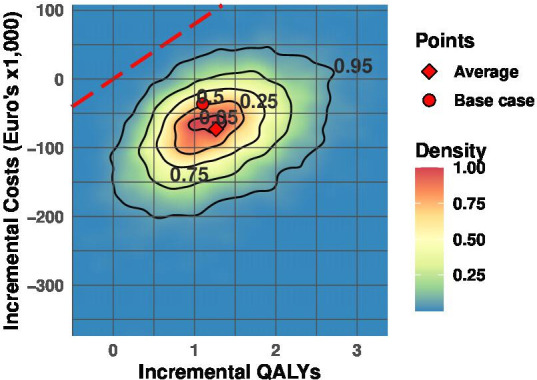
Mean total undiscounted lifetime benefits were 4.47 life years (LYs) and 3.52 QALYs for TIL-NKI/CCIT and 3.33 LYs and 2.46 QALYs for ipilimumab. Total lifetime undiscounted costs in the Netherlands were €347,168 for TIL-NKI/CCIT (including €67,547 for production costs) compared with €433,634 for ipilimumab. Undiscounted lifetime cost in the Danish scenario were €337,309 and €436,135, respectively. This resulted in a dominant situation for TIL-NKI/CCIT compared with ipilimumab in both countries, meaning incremental QALYs were gained at lower costs. Survival probabilities, and utility in progressive disease affected the ICER most.
Based on the data of a randomized phase 3 trial, treatment with TIL-NKI/CCIT in patients with unresectable stage IIIC-IV melanoma is cost-effective and cost-saving, both in the current Dutch and Danish setting. These findings led to inclusion of TIL-NKI/CCIT as insured care and treatment guidelines. Publicly funded development of the TIL-NKI/CCIT cell therapy shows realistic promise to further explore development of effective personalized treatment while warranting economic sustainability of healthcare systems.
在荷兰和丹麦进行的一项多中心、开放性、随机 3 期临床试验中,与伊匹单抗相比,使用自体黑色素瘤肿瘤来源的体外扩增肿瘤浸润淋巴细胞(TIL-NKI/CCIT)治疗一线或二线治疗失败后的不可切除 III C 期-IV 期黑色素瘤患者,改善了无进展生存期。基于这项试验,我们进行了一项成本效用分析。
构建了一个马尔可夫决策模型,以评估在荷兰,TIL-NKI/CCIT 相对于伊匹单抗的预期成本(以 2021 年€表示)和结果(质量调整生命年(QALYs))。在情景分析中评估了丹麦的情况。采用改良的社会视角进行了终生分析。通过作业成本法估算 TIL-NKI/CCIT 的生产成本。通过敏感性分析评估了不确定性及其对增量成本效益比(ICER)的影响。
TIL-NKI/CCIT 和伊匹单抗的平均总无折扣终生效益分别为 4.47 生命年(LYs)和 3.52 QALYs,3.33 LYs 和 2.46 QALYs。在荷兰,TIL-NKI/CCIT 的终生无折扣总成本为 347168 欧元(包括 67547 欧元的生产成本),而伊匹单抗的总成本为 433634 欧元。在丹麦情景中,无折扣的终生成本分别为 337309 欧元和 436135 欧元。这使得 TIL-NKI/CCIT 在两国均优于伊匹单抗,这意味着增量 QALYs 的获得成本更低。生存概率和进展期疾病的效用对 ICER 的影响最大。
基于 3 期随机试验的数据,在荷兰和丹麦现行的治疗方案中,使用 TIL-NKI/CCIT 治疗不可切除的 III C 期-IV 期黑色素瘤具有成本效益,并且具有成本节约效果。这些发现促使 TIL-NKI/CCIT 被纳入保险护理和治疗指南。公共资金支持 TIL-NKI/CCIT 细胞治疗的开发有望进一步探索有效的个性化治疗方法的发展,同时确保医疗保健系统的经济可持续性。