Department of Plant and Microbial Biology, University of Zurich, Zollikerstrasse 107, 8008, Zurich, Switzerland.
Department of Microbiology and Genetics, Spanish-Portuguese Institute for Agricultural Research (CIALE), University of Salamanca, 37007, Salamanca, Spain.
Theor Appl Genet. 2024 Mar 27;137(4):88. doi: 10.1007/s00122-024-04582-4.
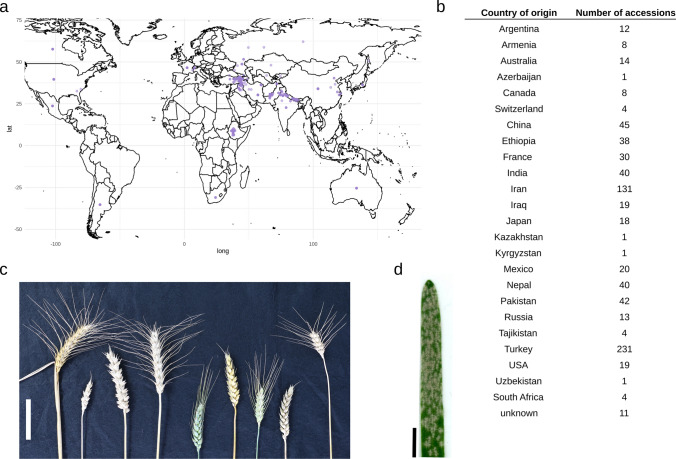
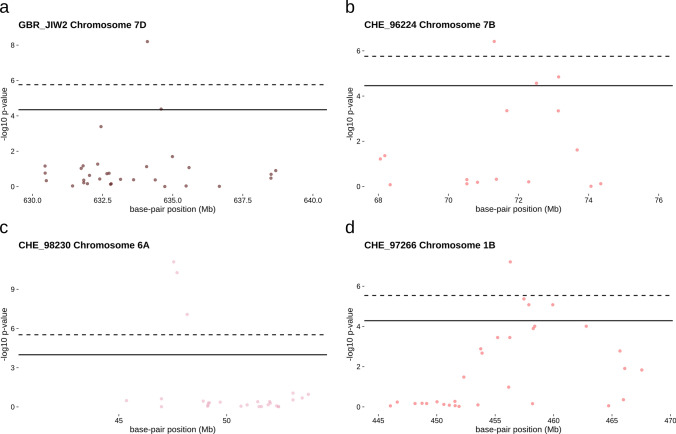
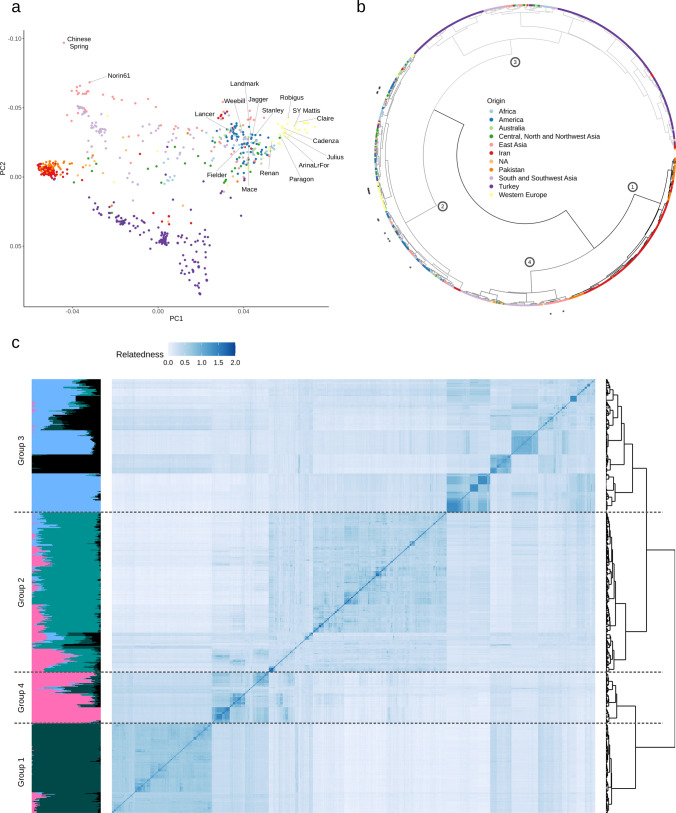
A bread wheat panel reveals rich genetic diversity in Turkish, Pakistani and Iranian landraces and novel resistance loci to diverse powdery mildew isolates via subsetting approaches in association studies. Wheat breeding for disease resistance relies on the availability and use of diverse genetic resources. More than 800,000 wheat accessions are globally conserved in gene banks, but they are mostly uncharacterized for the presence of resistance genes and their potential for agriculture. Based on the selective reduction of previously assembled collections for allele mining for disease resistance, we assembled a trait-customized panel of 755 geographically diverse bread wheat accessions with a focus on landraces, called the LandracePLUS panel. Population structure analysis of this panel based on the TaBW35K SNP array revealed an increased genetic diversity compared to 632 landraces genotyped in an earlier study and 17 high-quality sequenced wheat accessions. The additional genetic diversity found here mostly originated from Turkish, Iranian and Pakistani landraces. We characterized the LandracePLUS panel for resistance to ten diverse isolates of the fungal pathogen powdery mildew. Performing genome-wide association studies and dividing the panel further by a targeted subsetting approach for accessions of distinct geographical origin, we detected several known and already cloned genes, including the Pm2a gene. In addition, we identified 22 putatively novel powdery mildew resistance loci that represent useful sources for resistance breeding and for research on the mildew-wheat pathosystem. Our study shows the value of assembling trait-customized collections and utilizing a diverse range of pathogen races to detect novel loci. It further highlights the importance of integrating landraces of different geographical origins into future diversity studies.
一个面包小麦面板揭示了丰富的遗传多样性在土耳其、巴基斯坦和伊朗的地方品种和新型的抗性基因座,以不同的粉状霉 isolate 通过子集的方法在关联研究。小麦抗病性育种依赖于遗传资源的可用性和利用。全球有超过 80 万份小麦资源被保存在基因库中,但它们大多没有被鉴定为抗性基因的存在及其在农业中的潜力。基于对以前组装的用于疾病抗性等位基因挖掘的集合的选择性减少,我们组装了一个定制的 755 个地理上多样化的面包小麦品种的面板,重点是地方品种,称为 LandracePLUS 面板。基于 TaBW35K SNP 阵列的该面板的种群结构分析显示,与之前研究中 632 个地方品种和 17 个高质量测序的小麦品种相比,遗传多样性增加。这里发现的额外遗传多样性主要来自土耳其、伊朗和巴基斯坦的地方品种。我们对该面板进行了十种不同的粉状霉真菌病原体分离物的抗性特征分析。通过全基因组关联研究,并通过针对不同地理起源的品种的有针对性的子集方法进一步细分面板,我们检测到了一些已知的和已经克隆的基因,包括 Pm2a 基因。此外,我们还鉴定了 22 个可能的新型粉状霉抗性基因座,它们为抗性育种和粉状霉-小麦病理系统的研究提供了有用的来源。我们的研究表明了组装定制的集合和利用多种病原体群体来检测新型基因座的价值。它进一步强调了将不同地理起源的地方品种纳入未来多样性研究的重要性。