
使用无标记和基于标记的运动捕捉技术对步态期间下肢的运动学和关节力矩计算进行比较。
Comparison of kinematics and joint moments calculations for lower limbs during gait using markerless and marker-based motion capture.
作者信息
Huang Tianchen, Ruan Mianfang, Huang Shangjun, Fan Linlin, Wu Xie
机构信息
Sports Biomechanics Laboratory, College of Physical Education and Health, Wenzhou University, Wenzhou, China.
Laboratory of Biomechanics and Rehabilitation Engineering, School of Medicine, Tongji University, Shanghai, China.
出版信息
Front Bioeng Biotechnol. 2024 Mar 12;12:1280363. doi: 10.3389/fbioe.2024.1280363. eCollection 2024.
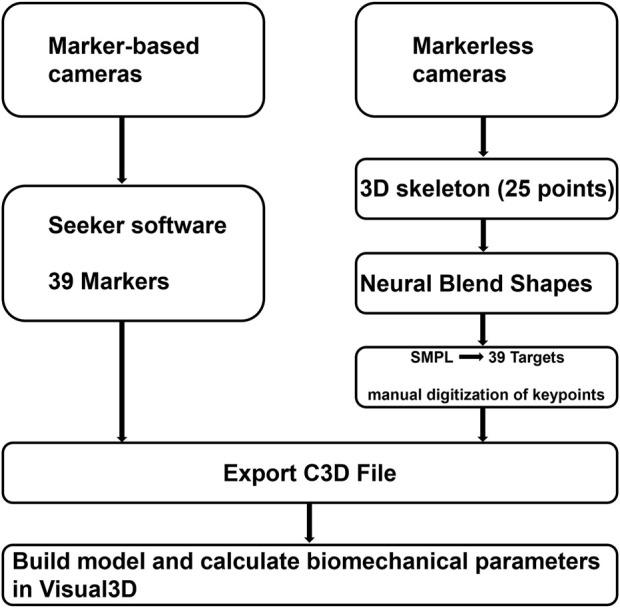
This study aimed at quantifying the difference in kinematic and joint moments calculation for lower limbs during gait utilizing a markerless motion system (TsingVA Technology, Beijing, China) in comparison to values estimated using a marker-based motion capture system (Nokov Motion Capture System, Beijing, China). Sixteen healthy participants were recruited for the study. The kinematic data of the lower limb during walking were acquired simultaneously based on the markerless motion capture system (120 Hz) and the marker-based motion capture system (120 Hz). The ground reaction force was recorded synchronously using a force platform (1,200 Hz). The kinematic and force data were input into Visual3D for inverse dynamics calculations. The difference in the lower limb joint center position between the two systems was the least at the ankle joint in the posterior/anterior direction, with the mean absolute deviation (MAD) of 0.74 cm. The least difference in measuring lower limb angles between the two systems was found in flexion/extension movement, and the greatest difference was found in internal/external rotation movement. The coefficient of multiple correlations (CMC) of the lower limb three joint moments for both systems exceeded or equaled 0.75, except for the ad/abduction of the knee and ankle. All the Root Mean Squared Deviation (RMSD) of the lower limb joint moment are below 18 N·m. The markerless motion capture system and marker-based motion capture system showed a high similarity in kinematics and inverse dynamic calculation for lower limbs during gait in the sagittal plane. However, it should be noted that there is a notable deviation in ad/abduction moments at the knee and ankle.
本研究旨在利用无标记运动系统(中国北京清微智能科技)量化步态期间下肢运动学和关节力矩计算的差异,并与使用基于标记的运动捕捉系统(中国北京诺亦腾运动捕捉系统)估计的值进行比较。16名健康参与者被招募来参与这项研究。行走过程中下肢的运动学数据基于无标记运动捕捉系统(120Hz)和基于标记的运动捕捉系统(120Hz)同时采集。使用测力平台(1200Hz)同步记录地面反作用力。运动学和力数据被输入到Visual3D中进行逆动力学计算。两个系统之间下肢关节中心位置在踝关节前后方向的差异最小,平均绝对偏差(MAD)为0.74厘米。两个系统在测量下肢角度时,屈伸运动的差异最小,内外旋运动的差异最大。除了膝关节和踝关节的内收/外展,两个系统下肢三个关节力矩的多重相关系数(CMC)均超过或等于0.75。下肢关节力矩的均方根偏差(RMSD)均低于18N·m。无标记运动捕捉系统和基于标记的运动捕捉系统在矢状面步态期间下肢的运动学和逆动力学计算方面显示出高度相似性。然而,应该注意的是,膝关节和踝关节的内收/外展力矩存在显著偏差。




 Zotero 插件