Nakano Nobuyasu, Sakura Tetsuro, Ueda Kazuhiro, Omura Leon, Kimura Arata, Iino Yoichi, Fukashiro Senshi, Yoshioka Shinsuke
Department of Life Sciences, Graduate School of Arts and Sciences, The University of Tokyo, Tokyo, Japan.
Research Fellow of the Japan Society for the Promotion of Science, Tokyo, Japan.
Front Sports Act Living. 2020 May 27;2:50. doi: 10.3389/fspor.2020.00050. eCollection 2020.
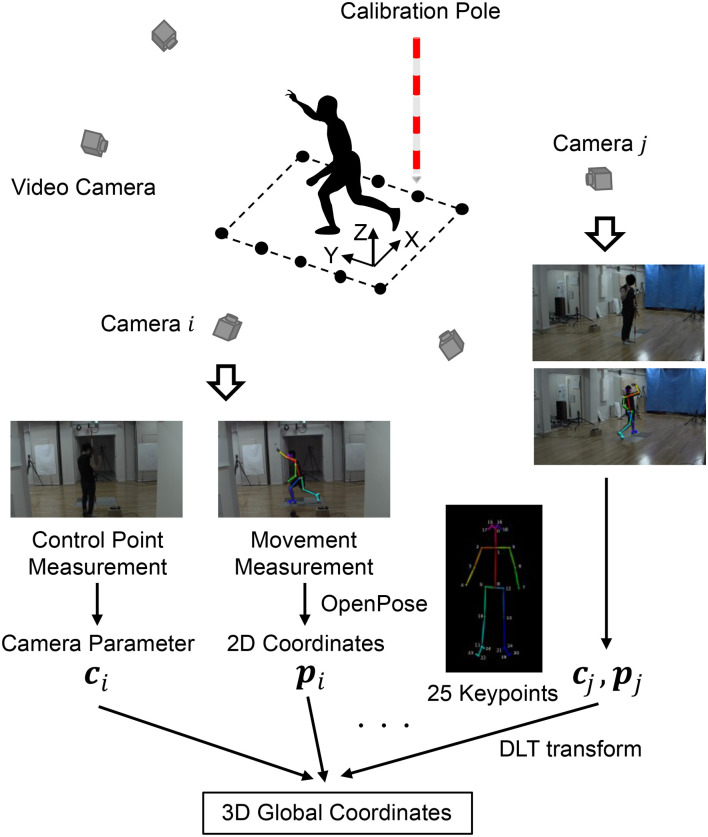
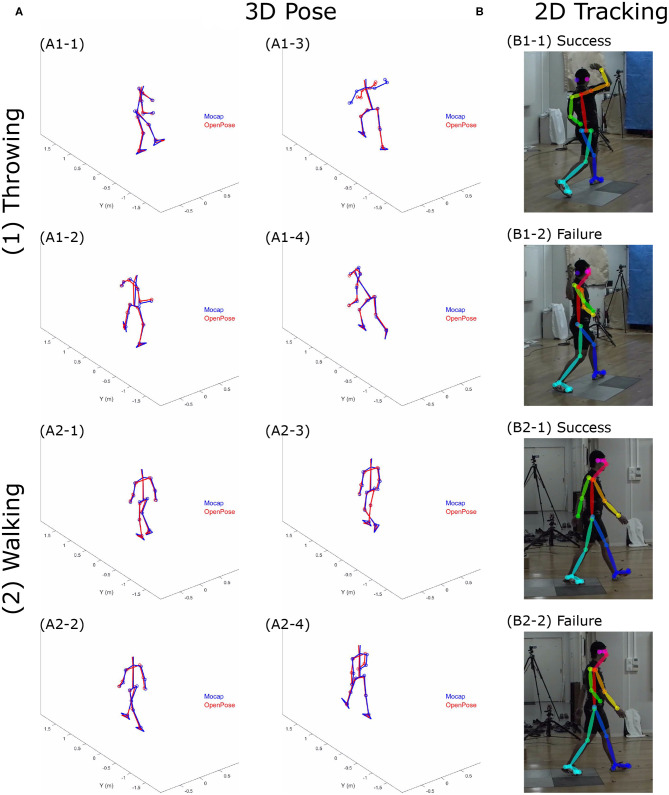
There is a need within human movement sciences for a markerless motion capture system, which is easy to use and sufficiently accurate to evaluate motor performance. This study aims to develop a 3D markerless motion capture technique, using OpenPose with multiple synchronized video cameras, and examine its accuracy in comparison with optical marker-based motion capture. Participants performed three motor tasks (walking, countermovement jumping, and ball throwing), and these movements measured using both marker-based optical motion capture and OpenPose-based markerless motion capture. The differences in corresponding joint positions, estimated from the two different methods throughout the analysis, were presented as a mean absolute error (MAE). The results demonstrated that, qualitatively, 3D pose estimation using markerless motion capture could correctly reproduce the movements of participants. Quantitatively, of all the mean absolute errors calculated, approximately 47% were <20 mm, and 80% were <30 mm. However, 10% were >40 mm. The primary reason for mean absolute errors exceeding 40 mm was that OpenPose failed to track the participant's pose in 2D images owing to failures, such as recognition of an object as a human body segment or replacing one segment with another depending on the image of each frame. In conclusion, this study demonstrates that, if an algorithm that corrects all apparently wrong tracking can be incorporated into the system, OpenPose-based markerless motion capture can be used for human movement science with an accuracy of 30 mm or less.
人类运动科学领域需要一种无标记运动捕捉系统,该系统易于使用且精度足以评估运动表现。本研究旨在开发一种使用带有多个同步摄像机的OpenPose的三维无标记运动捕捉技术,并与基于光学标记的运动捕捉技术相比,检验其准确性。参与者执行了三项运动任务(行走、反向运动跳跃和投球),并使用基于标记的光学运动捕捉和基于OpenPose的无标记运动捕捉来测量这些运动。在整个分析过程中,由两种不同方法估计的相应关节位置差异以平均绝对误差(MAE)表示。结果表明,定性地说,使用无标记运动捕捉进行的三维姿态估计可以正确再现参与者的运动。定量地说,在所有计算出的平均绝对误差中,约47%<20毫米,80%<30毫米。然而,10%>40毫米。平均绝对误差超过40毫米的主要原因是,由于诸如将物体识别为人的身体部位或将一个部位替换为另一部位(取决于每一帧的图像)等故障,OpenPose未能在二维图像中跟踪参与者的姿态。总之,本研究表明,如果可以将纠正所有明显错误跟踪的算法纳入系统,基于OpenPose的无标记运动捕捉可用于人类运动科学,精度可达30毫米或更低。