Hartner Elena, Gawlitta Nadine, Gröger Thomas, Orasche Jürgen, Czech Hendryk, Geldenhuys Genna-Leigh, Jakobi Gert, Tiitta Petri, Yli-Pirilä Pasi, Kortelainen Miika, Sippula Olli, Forbes Patricia, Zimmermann Ralf
Joint Mass Spectrometry Center (JMSC) at Comprehensive Molecular Analytics (CMA), Helmholtz Zentrum München, Ingolstädter Landstr. 1, D-85764 Neuherberg, Germany.
Joint Mass Spectrometry Center (JMSC) at Analytical Chemistry, Institute of Chemistry, University of Rostock, Albert-Einstein-Straße 27, D-18059 Rostock, Germany.
ACS Earth Space Chem. 2024 Feb 28;8(3):533-546. doi: 10.1021/acsearthspacechem.3c00301. eCollection 2024 Mar 21.
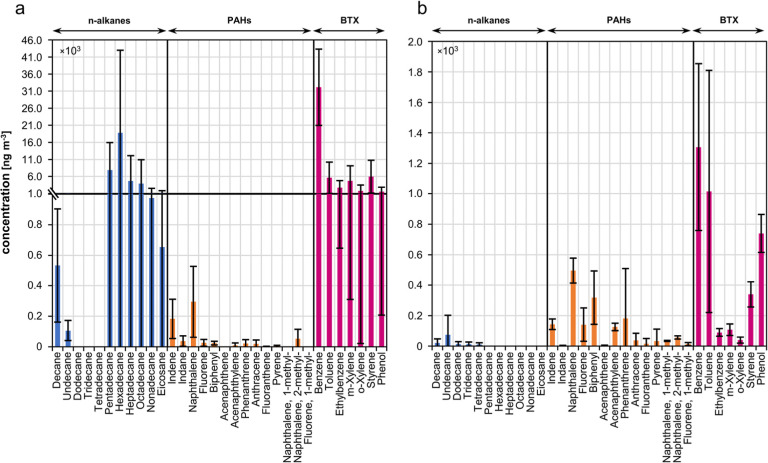
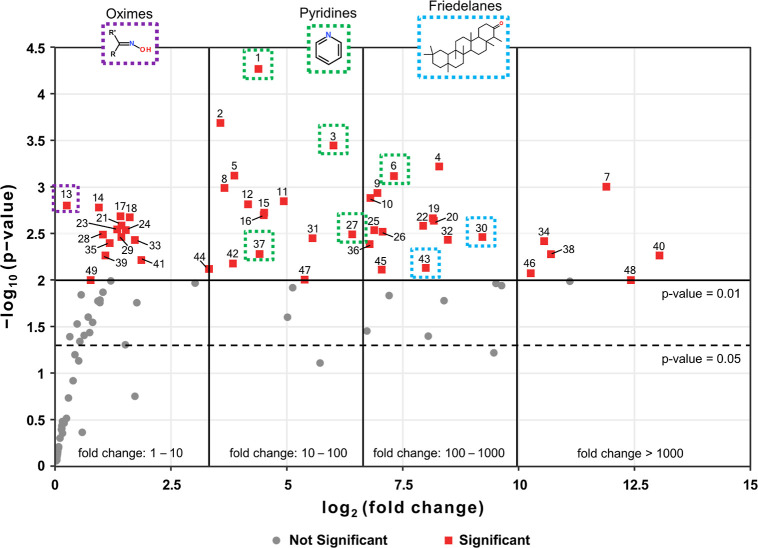
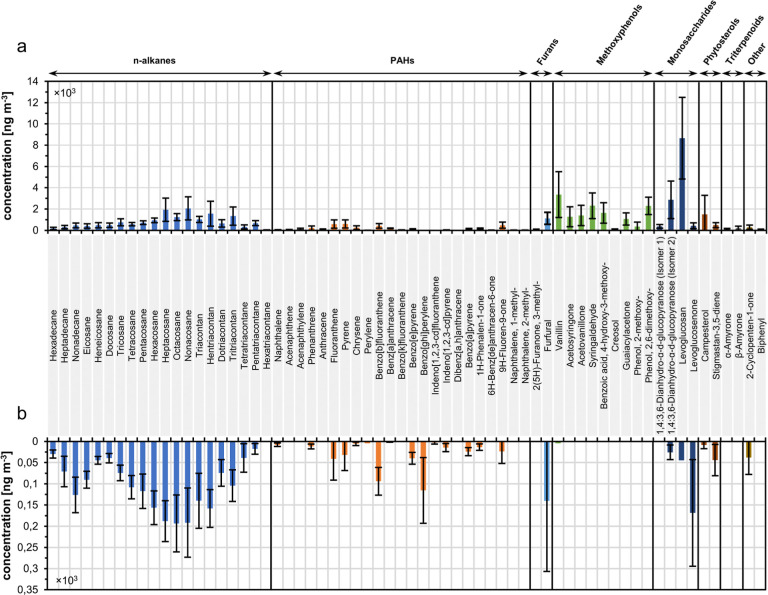
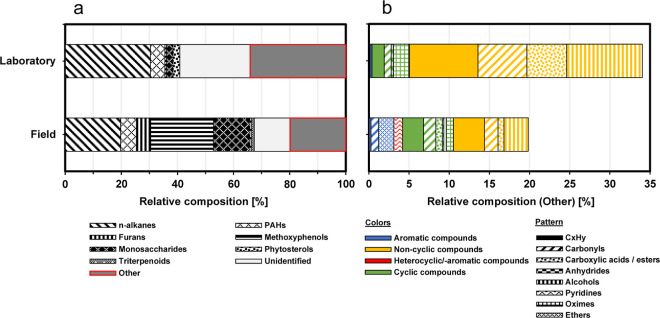
Agricultural fires are a major source of biomass-burning organic aerosols (BBOAs) with impacts on health, the environment, and climate. In this study, globally relevant BBOA emissions from the combustion of sugar cane in both field and laboratory experiments were analyzed using comprehensive two-dimensional gas chromatography time-of-flight mass spectrometry. The derived chemical fingerprints of fresh emissions were evaluated using targeted and nontargeted evaluation approaches. The open-field sugar cane burning experiments revealed the high chemical complexity of combustion emissions, including compounds derived from the pyrolysis of (hemi)cellulose, lignin, and further biomass, such as pyridine and oxime derivatives, methoxyphenols, and methoxybenzenes, as well as triterpenoids. In comparison, laboratory experiments could only partially model the complexity of real combustion events. Our results showed high variability between the conducted field and laboratory experiments, which we, among others, discuss in terms of differences in combustion conditions, fuel composition, and atmospheric processing. We conclude that both field and laboratory studies have their merits and should be applied complementarily. While field studies under real-world conditions are essential to assess the general impact on air quality, climate, and environment, laboratory studies are better suited to investigate specific emissions of different biomass types under controlled conditions.
农业火灾是生物质燃烧有机气溶胶(BBOAs)的主要来源,对健康、环境和气候都有影响。在本研究中,利用全二维气相色谱-飞行时间质谱分析法,分析了田间和实验室实验中甘蔗燃烧产生的全球相关BBOA排放。使用靶向和非靶向评估方法对新排放物的化学指纹图谱进行了评估。野外甘蔗焚烧实验揭示了燃烧排放物的高度化学复杂性,包括来自(半)纤维素、木质素和其他生物质热解的化合物,如吡啶和肟衍生物、甲氧基酚和甲氧基苯以及三萜类化合物。相比之下,实验室实验只能部分模拟真实燃烧事件的复杂性。我们的结果表明,所进行的田间和实验室实验之间存在很大差异,我们从燃烧条件、燃料成分和大气处理等方面进行了讨论。我们得出结论,田间和实验室研究都有其优点,应相辅相成地应用。虽然实际条件下的田间研究对于评估对空气质量、气候和环境的总体影响至关重要,但实验室研究更适合在受控条件下研究不同生物质类型的特定排放。