Department of Internal Medicine, Justus Liebig University, Universities of Giessen and Marburg Lung Center (UGMLC), Member of the German Center for Lung Research (DZL), Giessen, Germany.
The Cardio-Pulmonary Institute (CPI), Giessen, Germany.
Front Immunol. 2024 Mar 12;15:1360370. doi: 10.3389/fimmu.2024.1360370. eCollection 2024.
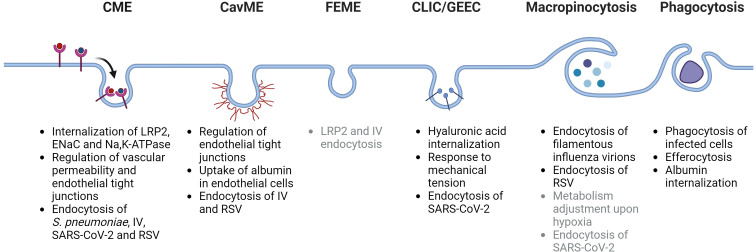
Acute respiratory distress syndrome (ARDS) is associated with high morbidity and mortality but lacks specific therapeutic options. Diverse endocytic processes play a key role in all phases of acute lung injury (ALI), including the initial insult, development of respiratory failure due to alveolar flooding, as a consequence of altered alveolar-capillary barrier function, as well as in the resolution or deleterious remodeling after injury. In particular, clathrin-, caveolae-, endophilin- and glycosylphosphatidyl inositol-anchored protein-mediated endocytosis, as well as, macropinocytosis and phagocytosis have been implicated in the setting of acute lung damage. This manuscript reviews our current understanding of these endocytic pathways and subsequent intracellular trafficking in various phases of ALI, and also aims to identify potential therapeutic targets for patients with ARDS.
急性呼吸窘迫综合征(ARDS)发病率和死亡率均较高,但缺乏特异性治疗方法。多种内吞作用在急性肺损伤(ALI)的各个阶段均发挥关键作用,包括初始损伤、肺泡灌洗导致的呼吸衰竭、肺泡毛细血管屏障功能改变、损伤后修复或有害重塑等。特别是网格蛋白、小窝蛋白、内收蛋白和糖基磷脂酰肌醇锚定蛋白介导的内吞作用,以及巨胞饮作用和吞噬作用,均与急性肺损伤有关。本文综述了目前对 ALI 各阶段这些内吞途径和随后的细胞内运输的认识,并旨在确定 ARDS 患者的潜在治疗靶点。