Jiang Ming-Xun, Yang Sang-Ren, Tsao I-Yu, Wardhana Bayu Satriya, Hsueh Shih-Feng, Jang Jason Shian-Ching, Hsin Cheng-Lun, Lee Sheng-Wei
Institute of Materials Science and Engineering, National Central University, Taoyuan 32001, Taiwan.
Department of Electrical Engineering, National Central University, Taoyuan 32001, Taiwan.
Nanomaterials (Basel). 2024 Mar 9;14(6):494. doi: 10.3390/nano14060494.
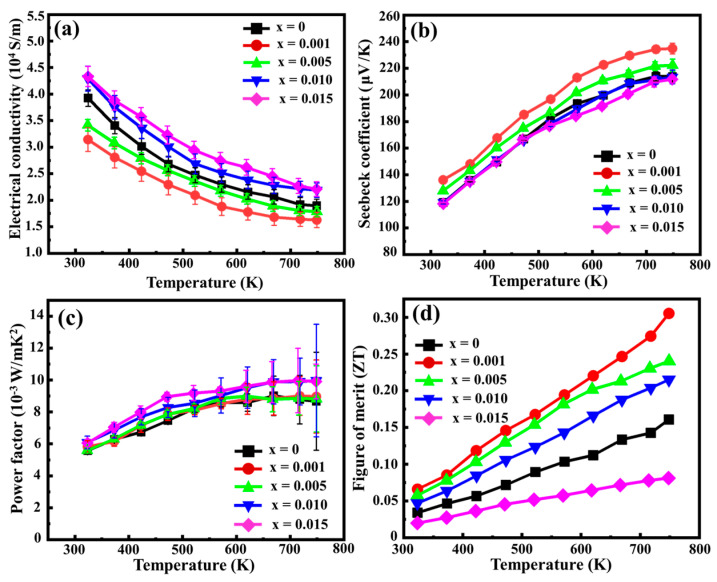
This study introduces Sn-substituted higher manganese silicides (MnSi, HMS) synthesized via an arc-melting process followed by spark plasma sintering (SPS). The influences of Sn concentrations on the thermoelectric performance of Mn(SiSn) (x = 0, 0.001, 0.005, 0.01, 0.015) are systematically investigated. Our findings reveal that metallic Sn precipitates within the Mn(SiSn) matrix at x ≥ 0.005, with a determined solubility limit of approximately x = 0.001. In addition, substituting Si with Sn effectively reduces the lattice thermal conductivity of HMS by introducing point defect scattering. In contrast to the undoped HMS, the lattice thermal conductivity decreases to a minimum value of 2.0 W/mK at 750 K for the Mn(SiSn) sample, marking a substantial 47.4% reduction. Consequently, a figure of merit (ZT) value of ~0.31 is attained at 750 K. This considerable enhancement in ZT is primarily attributed to the suppressed lattice thermal conductivity resulting from Sn substitution.
本研究介绍了通过电弧熔炼工艺结合放电等离子烧结(SPS)合成的锡取代的高锰硅化物(MnSi,HMS)。系统研究了锡浓度对Mn(SiSn)(x = 0、0.001、0.005、0.01、0.015)热电性能的影响。我们的研究结果表明,当x≥0.005时,金属锡在Mn(SiSn)基体中析出,确定的溶解度极限约为x = 0.001。此外,用锡取代硅通过引入点缺陷散射有效地降低了HMS的晶格热导率。与未掺杂的HMS相比,Mn(SiSn)样品在750 K时晶格热导率降至最小值2.0 W/mK,降低了47.4%。因此,在750 K时获得了约0.31的优值(ZT)。ZT的显著提高主要归因于锡取代导致的晶格热导率降低。