Allgemein-, Viszeral- und Tumorchirurgie, Wilhelminenspital Montleartstr. 37, 1160, Vienna, Austria.
Med. Fakultät, Sigmund Freud Privatuniversität, Freudplatz 3, 1020, Vienna, Austria.
Hernia. 2024 Aug;28(4):1283-1291. doi: 10.1007/s10029-024-03025-9. Epub 2024 Mar 27.
Clinical trials have shown reduced incisional hernia rates 1 year after elective median laparotomy closure using a short-stitch technique. With hernia development continuing beyond the first postoperative year, we aimed to compare incisional hernias 3 years after midline closure using short or long stitches in patients from the ESTOIH trial.
The ESTOIH trial was a prospective, multicenter, parallel-group, double-blind, randomized-controlled study of primary elective midline closure. Patients were randomized to fascia closure using a short- or long-stitch technique with a poly-4-hydroxybutyrate-based suture. A predefined 3-year follow-up analysis was performed with the radiological imaging-verified incisional hernia rate as the primary endpoint.
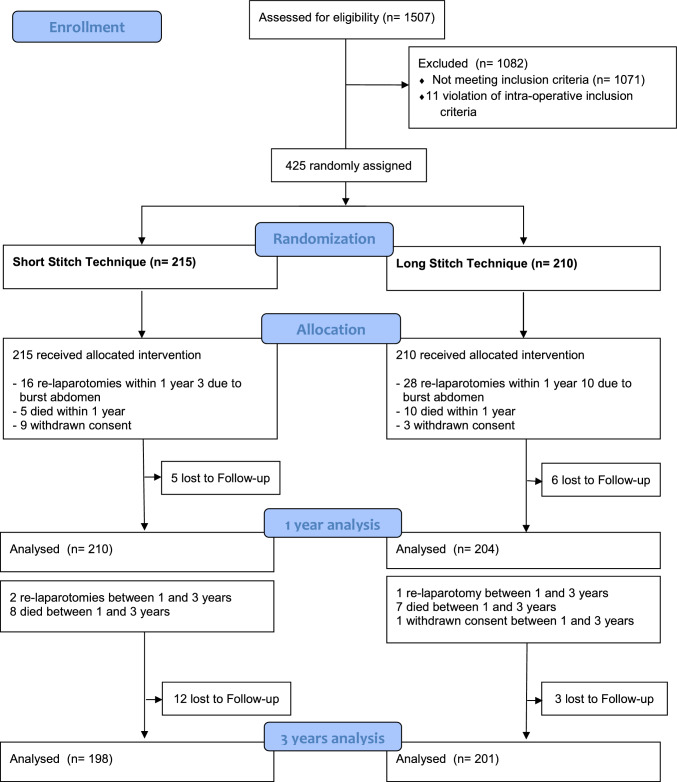
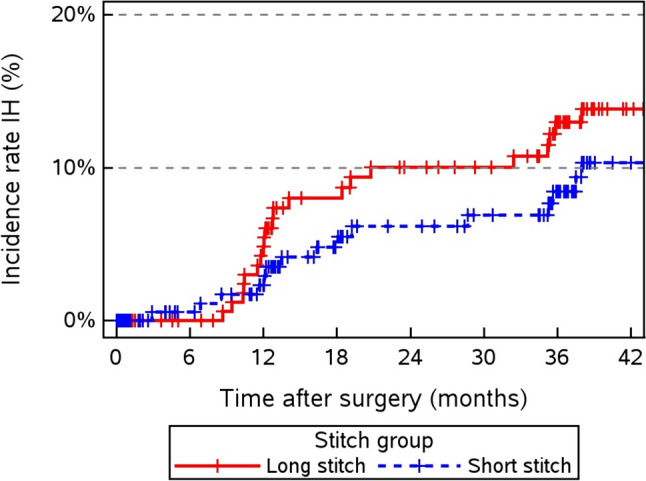
The 3-year intention-to-treat follow-up cohort consisted of 414 patients (210 short-stitch and 204 long-stitch technique) for analysis. Compared with 1 year postoperatively, incisional hernias increased from 4.83% (20/414 patients) to 9.02% (36/399 patients, p = 0.0183). The difference between the treatment groups at 3 years (short vs. long stitches, 15/198 patients (7.58%) vs. 21/201 (10.45%)) was not significant (OR, 1.4233; 95% CI [0.7112-2.8485]; p = 0.31).
Hernia rates increased significantly between one and 3 years postoperatively. The short-stitch technique using a poly-4-hydroxybutyrate-based suture is safe in the long term, while no significant advantage was found at 3 years postoperatively compared with the standard long-stitch technique.
NCT01965249, registered on 18 October 2013.
临床试验表明,在择期正中剖腹术后采用短缝线技术缝合切口,1 年后切口疝发生率降低。由于疝的发展在术后第一年之后仍在继续,我们旨在比较 ESTOIH 试验中使用短缝线或长缝线的中线缝合后 3 年的切口疝。
ESTOIH 试验是一项前瞻性、多中心、平行组、双盲、随机对照研究,主要为择期正中切口缝合。患者被随机分为短缝线或长缝线技术缝合筋膜,缝线为聚 4-羟基丁酸酯缝线。进行了预先设定的 3 年随访分析,以影像学证实的切口疝发生率为主要终点。
3 年意向治疗随访队列包括 414 例患者(210 例短缝线组和 204 例长缝线组)进行分析。与术后 1 年相比,切口疝发生率从 4.83%(414 例患者中的 20 例)增加到 9.02%(399 例患者中的 36 例,p=0.0183)。3 年时两组之间的差异(短缝线与长缝线,15/198 例(7.58%)与 21/201 例(10.45%))无统计学意义(OR,1.4233;95%CI [0.7112-2.8485];p=0.31)。
术后 1 年至 3 年内,疝的发生率显著增加。使用聚 4-羟基丁酸酯缝线的短缝线技术长期是安全的,与标准长缝线技术相比,术后 3 年时未发现明显优势。
NCT01965249,于 2013 年 10 月 18 日注册。