Department of Forest Botany, Dendrology and Geobiocoenology, Faculty of Forestry and Wood Technology, Mendel University in Brno, Brno, Czech Republic.
Forest Management Institute, Brandýs nad Labem, Kroměříž, Czech Republic.
PLoS One. 2024 Mar 27;19(3):e0301109. doi: 10.1371/journal.pone.0301109. eCollection 2024.
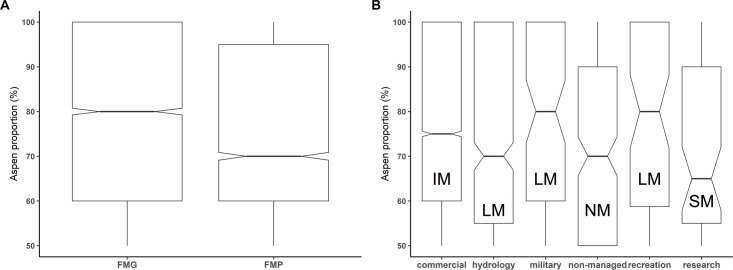
Knowledge of Eurasian aspen's (Populus tremula L.) ecological and growth characteristics is of high importance to plant and wildlife community ecology, and noncommercial forest ecosystem services. This research assessed these characteristics, identified aspen's habitat optimum, and examined causality of its current scarce distribution in central Europe. We analyzed a robust database of field measurements (4,656,130 stands) for forest management planning over 78,000 km2 of the Czech territory. Our analysis we used GIS techniques, with basic and multivariate statistics such as general linear models, ordination, and classification. Results describe a species of broad ecological amplitude that has heretofore attracted little research attention. Spatial analysis showed significant differences between aspen and other forest non-forest cover types. Additionally, we found significant association between the proportion of aspen in a stand, the size of forest property, and the forest category. The results demonstrate historic reasons for aspen's widespread presence, though contemporary occurrence is limited. This study advances the concept of a quantitatively based aspen ecological optimum (niche), which we believe may be beneficial for numerous aspen associates in the context of anticipated warming. Irrespective of local ecology (i.e., the realized aspen niche), the study confirms that profit-driven policy in forestry is chiefly responsible for historic aspen denudation in central Europe. Even so, we demonstrate that ample habitat is present. Further solutions for improving aspen resilience are provided to support these keystone systems so vital to myriad dependent flora and fauna.
了解欧洲山杨(Populus tremula L.)的生态和生长特征对于植物和野生动物群落生态学以及非商业性森林生态系统服务至关重要。本研究评估了这些特征,确定了山杨的最佳栖息地,并探讨了其在中欧目前分布稀少的原因。我们分析了一个捷克领土 78000 平方公里范围内用于森林管理规划的大量实地测量数据库(4656130 个林分)。我们的分析使用了 GIS 技术以及基本和多元统计方法,如一般线性模型、排序和分类。结果描述了一个具有广泛生态幅度的物种,迄今为止,该物种吸引的研究关注很少。空间分析显示了山杨与其他森林非森林覆盖类型之间的显著差异。此外,我们发现林分中山杨的比例、森林地产的规模和森林类别之间存在显著关联。结果表明了山杨广泛存在的历史原因,但目前的存在是有限的。本研究提出了一个基于数量的山杨生态最佳(生态位)概念,我们认为这对于预期变暖背景下众多山杨相关物种可能是有益的。无论当地生态(即已实现的山杨生态位)如何,该研究都证实了林业中以利润为导向的政策是中欧历史上山杨大量减少的主要原因。即便如此,我们还是证明了存在充足的栖息地。进一步提出了提高山杨弹性的解决方案,以支持这些对依赖于它们的众多动植物至关重要的关键系统。