Graduated Program in Rehabilitation Sciences, Universidade Nove de Julho, São Paulo, Brazil.
Department of Physical Education, Federal University of Rio Grande do Norte, Natal, Brazil.
PLoS One. 2024 Mar 27;19(3):e0298289. doi: 10.1371/journal.pone.0298289. eCollection 2024.
In peripheral artery disease (PAD) patients, the joint profile of low strength and cardiorespiratory fitness on movement behaviors, specifically physical activity levels and sedentary time, remains unclear.
To investigate the joint profiles between cardiorespiratory and neuromuscular fitness and daily physical activity among PAD patients.
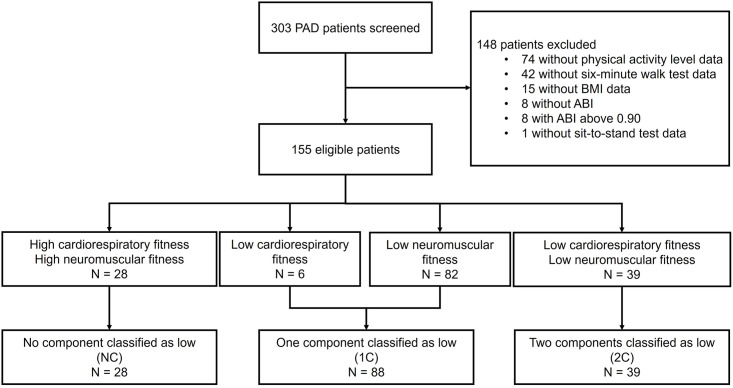
Cross-sectional study in a sample of 155 PAD patients. We measured their physical activity level per week using accelerometers, assessed their muscle strength through a sit-to-stand test and cardiorespiratory fitness through a six-minute walk test. Patients were categorized into three groups: those with high strength and cardiorespiratory fitness (NC, n = 28), those with at least one component classified as low (1C, n = 88), and those with both components classified as low fitness (2C, n = 39).
The patients in the 1C and 2C groups spent less time engaged in low-light and moderate activities compared to the NC group (low-light: NC: 2291 ± 680 minutes/week vs. 1C: 1826 ± 649 minutes/week vs. 2C: 1885 ± 651 minutes/week, p = .005; moderate: NC: 2617 ± 796 minutes/week vs. 1C: 2071 ± 767 minutes/week vs. 2C: 2092 ± 776 minutes/week, p = .005) and the patients in the 2C group spent less time engaged in vigorous activities compared to the NC and 1C groups (NC: 155 ± 148 minutes/week vs. 1C: 110 ± 110 minutes/week vs. 2C: 64 ± 70 minutes/week, p = .003).
PAD patients with low strength and/or cardiorespiratory fitness are more likely to spend less time engaging in low-light and moderate physical activities and patients with low fitness in both components are more likely to spend less time engaging in vigorous physical activity.
在周围动脉疾病(PAD)患者中,低强度和心肺适能对运动行为(尤其是体力活动水平和久坐时间)的综合特征尚不清楚。
探讨 PAD 患者心肺适能和神经肌肉功能与日常体力活动之间的综合特征。
横断面研究纳入了 155 名 PAD 患者。我们使用加速度计评估他们每周的体力活动水平,通过坐站测试评估他们的肌肉力量,通过六分钟步行测试评估他们的心肺适能。患者被分为三组:高强度和心肺适能高(NC,n=28),至少有一个指标低(1C,n=88),两个指标均低(2C,n=39)。
1C 和 2C 组患者的低强度和中等强度活动时间均少于 NC 组(低强度:NC:2291±680 分钟/周;1C:1826±649 分钟/周;2C:1885±651 分钟/周,p=0.005;中等强度:NC:2617±796 分钟/周;1C:2071±767 分钟/周;2C:2092±776 分钟/周,p=0.005);2C 组患者的高强度活动时间也少于 NC 组和 1C 组(NC:155±148 分钟/周;1C:110±110 分钟/周;2C:64±70 分钟/周,p=0.003)。
低强度和/或心肺适能低的 PAD 患者更可能减少低强度和中等强度体力活动的时间,而两个指标均低的患者更可能减少高强度体力活动的时间。